Facebook
 Google
 GitHub
 Linkedin
Preventing Power Outages With Bidirectional EV Charging
Two developments have shown that vehicle-to-grid technology can supply power during blackouts.
The push toward net-zero emissions is an ambitious goal, but without a concerted effort to update and expand the grid, power failures are likely, and prices could surge. However, a powerful patch may be available until long-term infrastructure updates can be made. Even though the proliferation of electric vehicles has been considered a drain on grid performance, EVs might be the answer for supplying interim power.
How can electric vehicles power the grid? Video used courtesy of PG&E
Vehicle-to-grid (V2G) technology describes how an EV’s battery system can transfer power back to the grid or an individual home, effectively reversing the typical charging pathways. Two separate developments demonstrate the V2G effectiveness. In Australia, EVs supported the grid during a blackout for the first time worldwide. On a smaller level, Ford is rolling out a home-based program to turn the F-150 Lightning into a power source for homes.
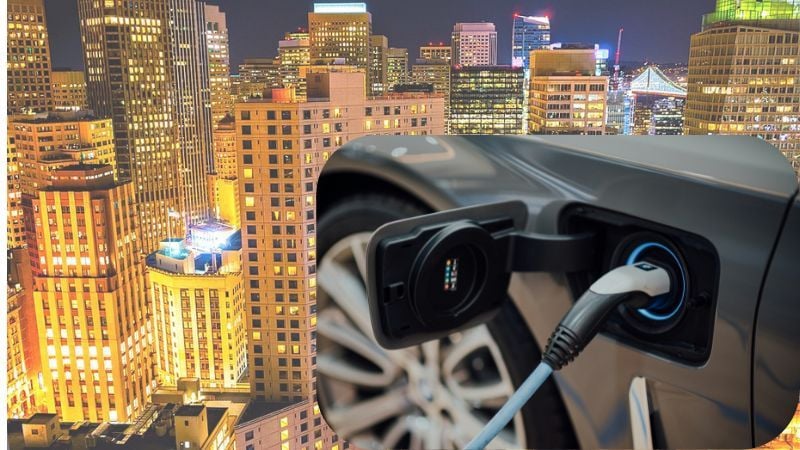
Can EVs power an entire city? Images used courtesy of Wikimedia Commons and Unsplash
Understanding the Grid’s Weaknesses
The American Society of Civil Engineers has rated the U.S. grid as lacking in condition, maintenance, and operations. The organization says the grid is underfunded and needs extensive updates. The latest and greatest renewable technology has often absorbed investments and attention while the existing grid waits for maintenance and equipment replacement.
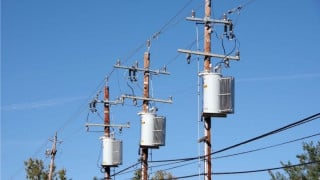
The grid comprises thousands of miles of transmission and distribution lines, many over 50 years old and far exceeding their intended lifespan. These aging lines are prone to failures, especially under the stress of extreme weather, which are more frequent due to climate change.
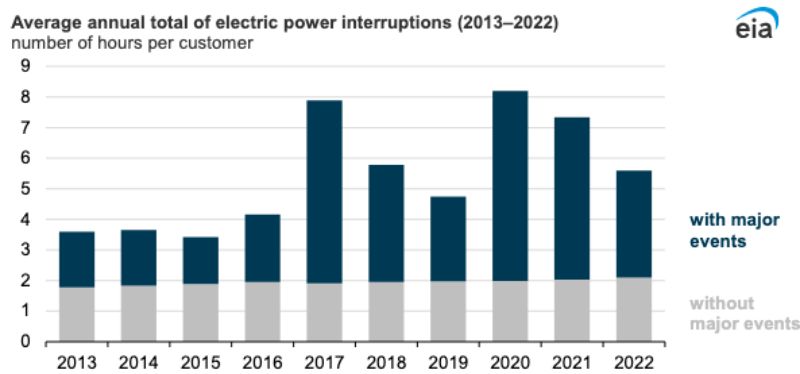
U.S. power outages over the past decade. Image used courtesy of Energy Information Administration
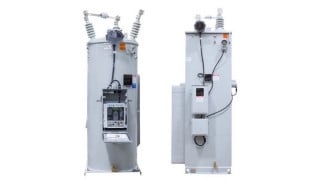
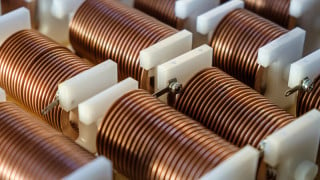
Key grid components, such as transformers and circuit breakers, are outdated. Transformers, crucial for voltage regulation across the grid, often operate beyond their 40-year expected life, leading to inefficiencies and increased blackout risks. Supply shortages and market conditions make it increasingly difficult to replace transformers promptly. The time pressure to replace old transformers and market challenges make for a distressing combination for grid personnel.
Circuit breakers, which protect the grid from overloads, are similarly antiquated. Many are decades old and lack modern technological advancements.
Equipment replacement is urgent. Upgrades are necessary for transmission and distribution infrastructure, including replacing old conductors, insulators, and substations. Without significant investment in modernizing the grid, the U.S. faces increased risks of outages and an inability to meet future energy demands.
However, in a surprising reversal, EVs might be able to help us meet these demands while long-term grid updates are executed.
V2G Support for the Grid
Blackout threats and cascading power failures become more severe when the grid depends on renewable energy sources. Crumbling grid infrastructure and the fast shift to renewables create an increasingly precarious power situation. However, the surging EV market and V2G technology can intervene to stabilize the grid.
In Australia, a February storm led to grid failure. Still, an EV fleet plugged in and programmed to detect failures immediately started supplying power back to the grid to avoid service disruption. This is the first recorded milestone of using EVs to prevent the blackout on the consumer side even while the grid failure still occurred.
In this case, only 16 EVs were needed to supply power for 10 minutes while the grid stabilized. Then, the vehicles seamlessly resumed normal charging. Researchers determined it would take only 105,000 EVs to supply utility grid support for the entire New South Wales region.
With sophisticated software programming, EVs can essentially serve as a dispersed network of backup batteries for the grid. Bidirectional chargers allow EVs to draw power from and supply power back to the grid. This process involves an onboard inverter within the EV that converts the direct current (DC) stored in the vehicle's battery into alternating current (AC), which is compatible with the power grid. Smart communication systems can coordinate the timing and amount of power transferred, ensuring stability and efficiency in the energy exchange.
Transferring power from vehicles back to the grid is only one possibility.
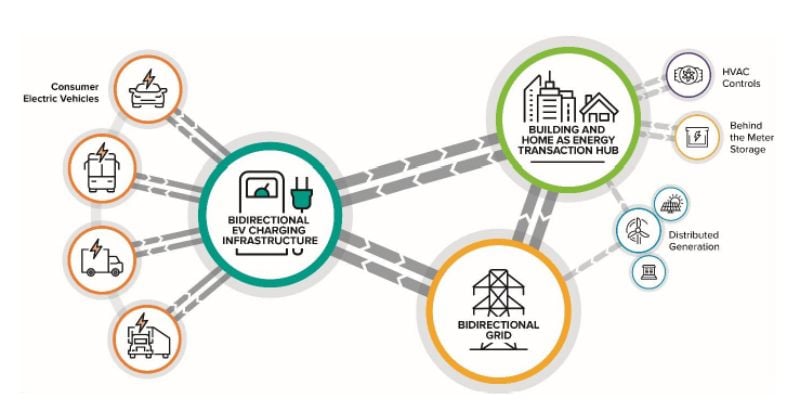
Vehicle to grid charging. Image used courtesy of Department of Energy
Localized EV Power
On a local level, EVs can power homes and other buildings. Ford has rolled out a program partnership with renewable energy subscription provider Sunrun, facilitated by Baltimore Gas and Electric Company. Pairing the Ford F-150 Lightning with the Ford Charge Station Pro and Home Integration System creates a power source for the home that can essentially replace the grid during peak demand hours. Grid stress is lessened, and the consumer benefits significantly. Program providers estimate enrolled consumers will earn $200 monthly during the program.
Innovation transforming EVs into power sources for the grid and individual buildings provides a much-needed buffer period for critical grid upgrades and maintenance. Combining an improved grid with efficient V2G tech will significantly diminish grid failure threats.