Facebook
 Google
 GitHub
 Linkedin
Can Hybrid Plant Design Ease Grid Congestion?
Solar- and wind-plus-storage power systems add value to energy transmission, but can they ease connection backlogs?
As renewable energy grows and fossil fuel plants retire, regional grids can leverage renewable-plus-battery storage resources to ease load congestion. According to the Lawrence Berkeley National Laboratory (LBNL), power plants can increase their energy values by deploying one-hour battery storage systems to manage wind and solar loads.
LBNL analyzed load centers and variable renewable energy (VRE)-rich grids—two categories of congested regions, where transmission capacity rules limit VRE and storage integration based on an over- or under-supply of local generation relative to the grid.
The study found that converting standalone wind and solar generators to hybrid plants with one-hour batteries increased load centers’ energy values by 48.8% (from $33.8/MWh to $50.3/MWh). VRE-rich regions can deploy the same configuration to unlock an 80.5% value boost for solar and 81.1% for wind.
Extending the storage duration from one to four hours increased hybrid plants’ median values by 23% for load centers and 31.7% for VRE-rich areas. In the latter category, four-hour batteries sized to 100% of plants’ nameplate capacity can increase values by 29.4% for solar and 26.8% for wind.
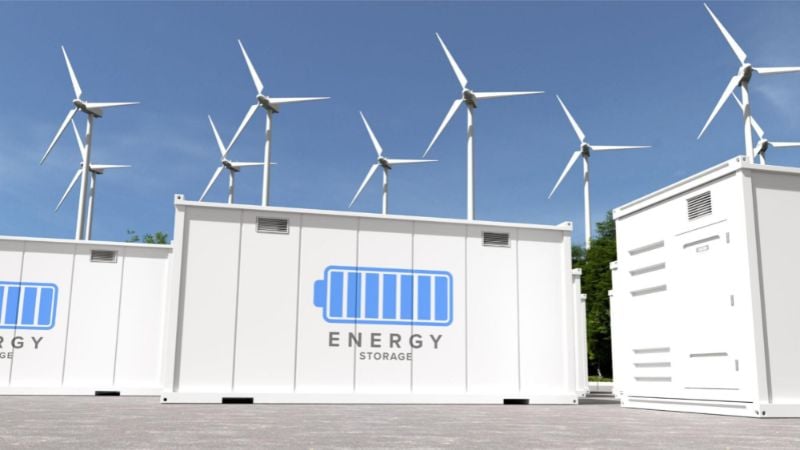
Wind and storage units. Image used courtesy of Adobe Stock
Hybrid Plants Dominate Interconnection Queues
Power plants combining storage with solar photovoltaic (PV) or wind resources dominate the project proposals awaiting interconnection nationwide, particularly in California and other western areas. Hybrids accounted for nearly half of the generation capacity in interconnection queues last year, up from 37% in 2022.
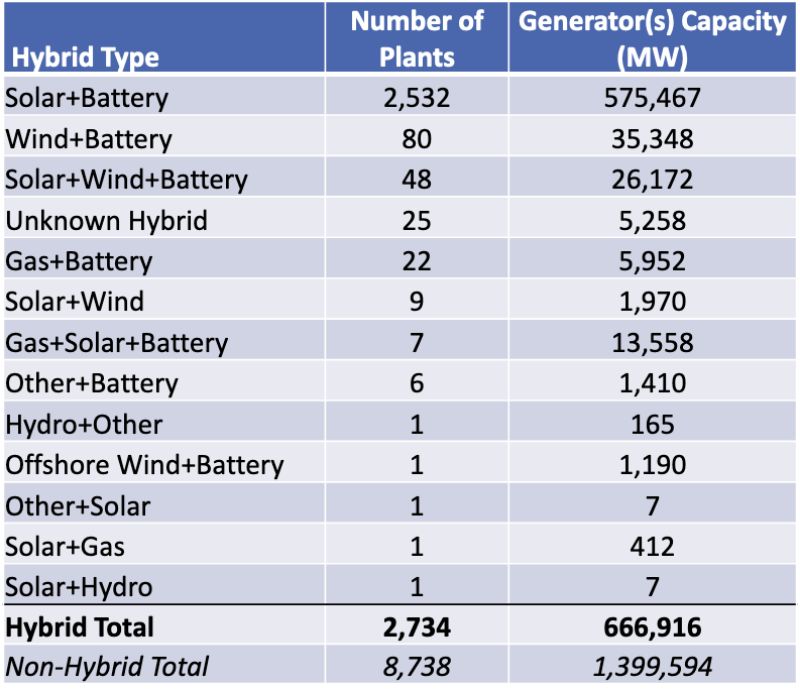
Hybrid projects in interconnection queues as of 2023. Image used courtesy of LBNL (Page 34)
Hybrid plants deliver several benefits. PV-plus-storage provides renewable firming and curtailment mitigation, while wind-plus-storage offers grid services like load following, frequency regulation, and reactive power support.
PV-plus-storage is the most common hybrid configuration operating today, with 288 sites, 7.8 GW of capacity, and 24 GWh of energy online at the end of 2023, according to LNBL data. This combination also represents 86% of the requested capacity in queues (575 GW across 2,532 plants). The next-top category is wind-plus-battery storage (35,348 MW and 80 plants), followed by solar-plus-wind-plus-battery (26,172 across 48 plants).
However, less than a quarter of these projects will come to fruition, as developers often withdraw proposals before approval. The interconnection backlog has grown almost sixfold since 2010. Projects built in 2023 faced a five-year wait time. LBL estimates that nearly 80% of hybrid capacity has requested to come online by late 2027, though only 11% have executed interconnection agreements.
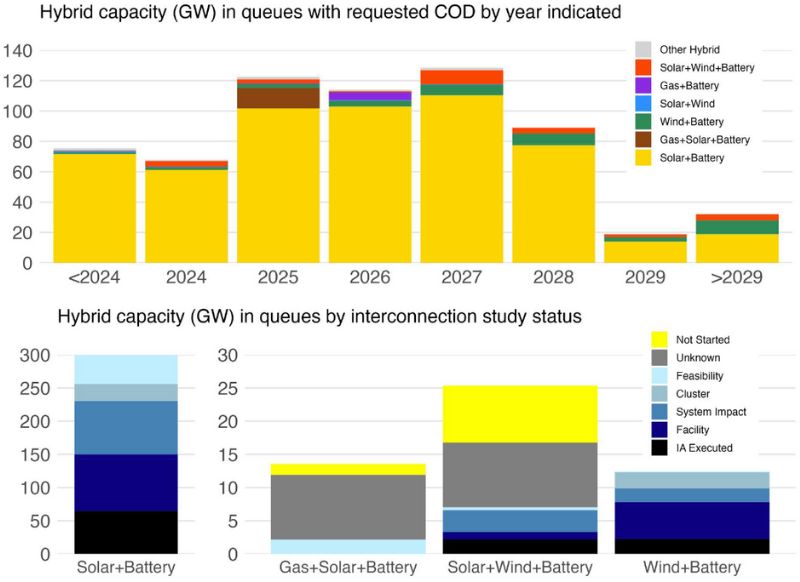
Hybrid capacity in interconnection queues by year and status. (“COD” indicates the expected commercial operation date.) Image used courtesy of LBNL (Page 39)
Regional independent system operators (ISOs) set Point of Interconnection (POI) capacity limits for projects joining the grid. For example, the California Independent System Operator (CAISO) restricts POI based on generator capacity. According to LBNL, the median capacity for solar-plus-storage plants is 205% of the POI limit, while wind-plus-storage is 158%. This means hybrid facilities only dispatch batteries when generators operate below the full output.
Amid high VRE penetration, some of the nation’s seven primary ISOs are updating their capacity market rules to account for hybrid plants. CAISO is switching to a framework that values each plant based on hourly performance on the highest peak-load day in a month. PJM also introduced a change that values generation resources by resource adequacy contribution.
These Hybrid Configurations Offer the Most Value
LNBL provided a hybrid value for each configuration based on wholesale power market prices across seven ISOs. With VREs increasing rapidly, local VRE oversupply is expected to lead to more congestion. Accordingly, the study identified two types of congested regions involving an under-supply or over-supply of low-cost local generation.
VRE-rich resources are particularly concentrated among CAISO (solar), the Electric Reliability Council of Texas, and PJM (solar and wind). The typical hybrid setup is a 100-MW wind or solar generator and 100-MW batteries, each connected via a 100-MW POI corresponding to the generator’s AC capacity. Most PV-plus-storage hybrids are AC-coupled with a centralized battery yard, unlike a DC-coupled setup where batteries are distributed near inverters throughout the plant. These hybrids typically have an inverter loading ratio of 1.3, meaning the maximum solar output is 30% larger than the inverter’s. LNBL scaled batteries’ energy-to-power ratio (or duration) in one- to 10-hour increments.
The study found adding one-hour batteries to standalone PV and wind generators increased the energy value by nearly 50% among load centers and over 80% among VRE-rich systems.
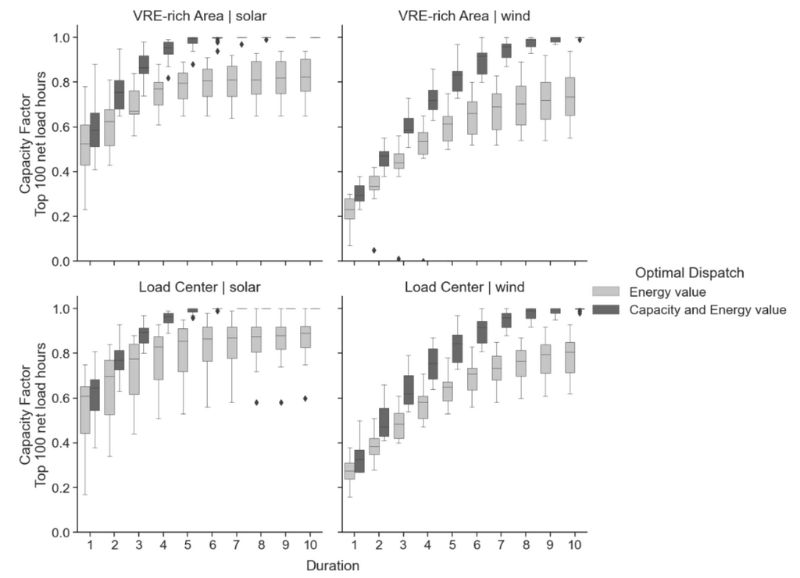
Hybrid capacity and energy values by storage duration, plant type, and location in the top 100 net load hours. Image used courtesy of LBNL (Page 19, Figure 7)
In VRE-rich regions, extending the storage duration from one to four hours increased energy values by nearly 30% for solar and 26.8% for wind. This assumes battery degradation costs are low and each unit is sized to 100% of the nameplate capacity.
However, increasing the duration beyond four hours didn’t improve the plant’s value in energy markets, even in renewable-rich areas. Solar hybrids reach a 90% capacity credit with four hours of storage, while wind hybrids need eight hours to meet peak demand in the top 100 load hours.