Facebook
 Google
 GitHub
 Linkedin
PCIM 2025: New SiC Power Products for EVs and Industrial Systems
SemiQ, Infineon, Nexperia, and Navitas debuted SiC devices to tackle rising demands in thermal control, system efficiency, and automotive-grade reliability last week at PCIM Europe 2025.
As the global shift toward electrification intensifies, engineers grapple with the same fundamental problem: how to pack more power into tighter spaces without sacrificing thermal performance or long-term reliability. Whether it's in electric vehicles, renewable energy systems, or advanced industrial machinery, traditional silicon-based power devices are hitting their limits. Rising switching speeds, stricter efficiency mandates, and the growing complexity of modern applications have exposed the need for more capable power semiconductors.
To meet these escalating demands, four semiconductor leaders, SemiQ, Infineon, Nexperia, and Navitas, have released new silicon carbide (SiC) product lines to solve the thermal, form factor, and durability challenges plaguing next-generation systems. Though the designs differ in architecture and packaging, the collective focus is clear: deliver scalable, high-efficiency, and robust power devices built for the realities of high-voltage, high-density environments.
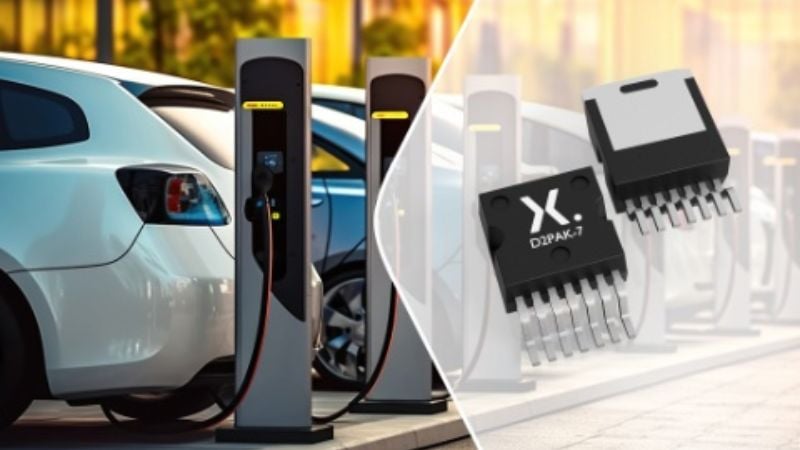
Nexperia’s 1200 V SiC MOSFETs were among the SiC products showcased at PCIM 2025. Image used courtesy of Nexperia
SemiQ: Shrinking the Power Footprint With Faster, Cooler Switches
SemiQ’s latest release expands its Gen3 SiC MOSFET series with a 1200 V lineup housed in a compact TSPAK package. Designed with top-side cooling and a ceramic-isolated thermal path, the devices are optimized for industrial and automotive applications such as EV charging stations, solar inverters, and motor drives.
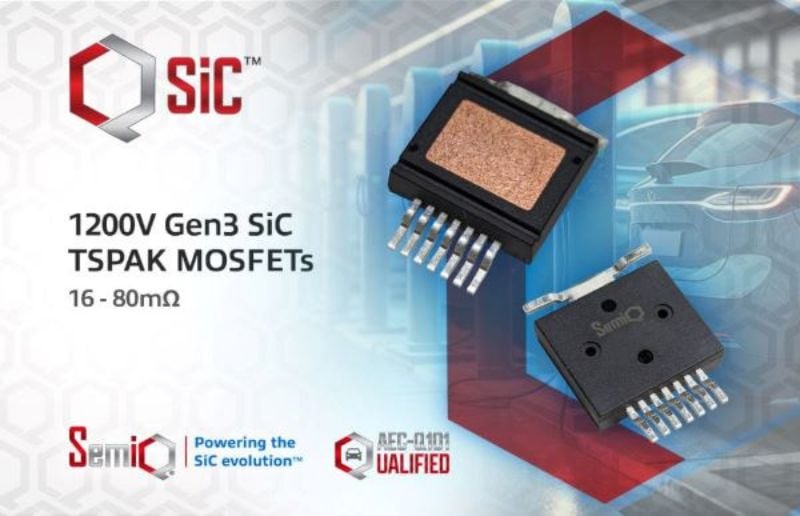
The 1200 V TSPAK-packaged series. Image used courtesy of SemiQ
What sets these MOSFETs apart is their switching speed, ranging from 49 to 114 nanoseconds, alongside low RDS(on) values as low as 16 mΩ. This combination reduces switching losses and supports greater power density in space-constrained environments. Additionally, the devices have passed reliability tests, including wafer-level burn-in and avalanche energy thresholds up to 800 mJ, assuring harsh operating conditions.
By offering high drain current ratings (up to 101 A), simplified paralleling, and thermal management, SemiQ directly addresses the need for compact yet powerful solutions in today’s power-constrained applications.
Infineon: Fortifying Power Distribution with JFET Reliability
Infineon brings a different flavor to the SiC conversation with its CoolSiC JFET line. These devices focus on efficiency and operational predictability, a crucial trait in critical infrastructure and automotive safety systems. The JFETs are purpose-built for solid-state circuit breakers, battery disconnects, AI server hot-swaps, and other intelligent distribution components. With ultra-low RDS(on) starting at just 1.5 mΩ and a bulk-channel design that handles short circuits and avalanche events with ease, the devices are engineered for durability. Infineon also uses its proprietary.XT diffusion soldering technology enhances thermal stability during pulse loads and thermal cycling.
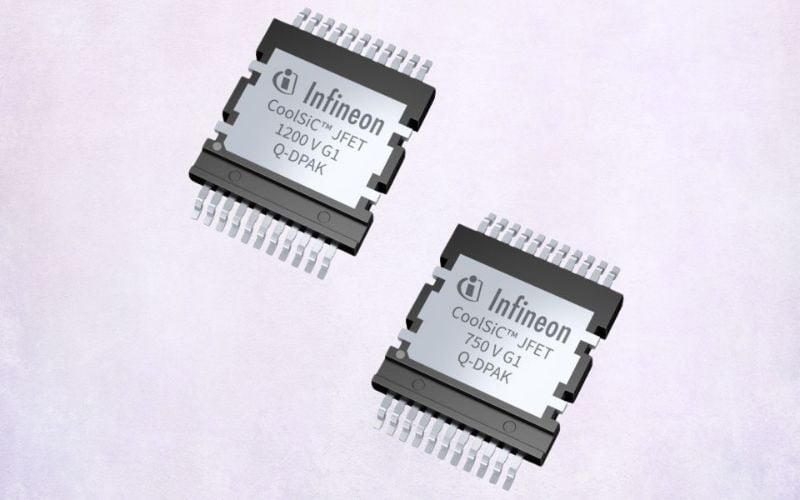
Infineon’s new CoolSiC JFET product family. Image used courtesy of Infineon
By addressing unpredictable stress conditions and offering scalable current handling in a standard Q-DPAK package, Infineon’s new line aims to improve the safety, precision, and uptime of solid-state power systems.
Nexperia: Temperature Stability for Automotive Integration
In the automotive world, component reliability under extreme temperatures can make or break a system. That’s where Nexperia’s latest AEC-Q101-qualified SiC MOSFETs make their mark. Available in surface-mount D2PAK-7 packages, the 30, 40, and 60 mΩ-rated devices now bring industrial-grade efficiency into EV onboard chargers, HVAC systems, and high-voltage DC converters.
Unlike many SiC devices whose conduction resistance more than doubles at high temperatures, Nexperia’s new MOSFETs limit RDS(on) drift to just 38% from 25°C to 175°C. That thermal consistency translates into more predictable performance and relaxed cooling requirements, particularly critical in PCB-mounted applications where thermal dissipation is inherently limited. With easy assembly, compact form factor, and performance that holds up under pressure, these devices offer OEMs the power to build smaller, lighter, and more efficient electric drive systems without design compromises.
Navitas: SiC Reliability
Navitas rounds out the innovation wave with its HV-T2PaK SiC MOSFETs, which aim to exceed even the stringent AEC-Q101 standard. Branded as “AEC-Plus,” these trench-assisted planar devices are used for mission-critical environments like EV fast chargers, energy storage systems, and high-density industrial drives.

Traditional planar vs. trench-assisted planar. Image used courtesy of Navitas
The package design provides 6.45 mm creepage for 1200 V IEC compliance, thanks to an innovative groove mold and NiNiP-plated thermal pad that maintains post-reflow flatness for optimal heat transfer. Internally, the devices are qualified to withstand 200°C junction temperatures, double-length power cycling, and extended high-voltage stress tests.
With up to 20% lower RDS(on) under high-temperature operating conditions and excellent switching figures-of-merit, Navitas positions its SiC technology as a solution for engineers who simply can’t afford failure in long-lifecycle systems.
From smart circuit protection to high-efficiency EV drivetrains, these four companies are tackling the same power issues: heat, space, and reliability. Their new SiC offerings promise not only technical advantages but also a shift in how power systems are designed, enabling the next generation of high-performing energy solutions.