Facebook
 Google
 GitHub
 Linkedin
PCIM 2025: SiC and GaN Innovations for Power Electronics
Infineon, EPC, and Navitas unveiled SiC and GaN technologies for electric vehicles, data centers, robotics, and industrial motor drives at PCIM Europe 2025.
Last week, the world’s leading power semiconductor firms gathered at PCIM Europe 2025 in Nuremberg, showcasing cutting-edge silicon carbide (SiC) and gallium nitride (GaN) innovations for automotive electrification, data center power, robotics, and industrial automation. As demand for compact, efficient, and reliable power systems surges, breakthroughs from Infineon, EPC, and Navitas demonstrate the rapid pace of progress in wide bandgap semiconductors.
Each company presented unique technologies that push the boundaries of efficiency, reliability, and scalability. Infineon’s SiC superjunction technology, EPC’s latest GaN FETs and ICs, and Navitas’ integrated GaNFast and SiCPAK solutions offer engineers powerful tools to meet modern challenges in EV drivetrains, robotics, renewable energy, and AI infrastructure.
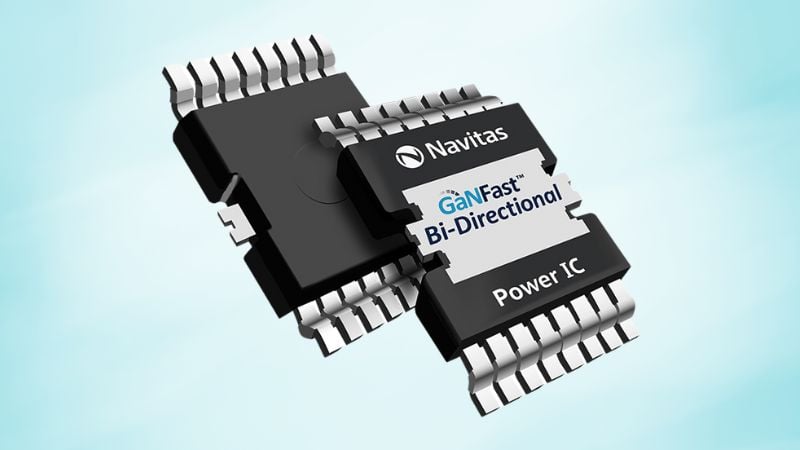
Navitas’ 650 V bi-directional GaN with top-cooled TOLT was one of many products introduced at PCIM 2025. Image used courtesy of Navitas
Infineon’s SiC Trench Superjunction Expands Efficiency
Infineon Technologies AG introduced its trench-based SiC superjunction (TSJ) technology. Expanding upon its proven CoolSiC portfolio and silicon-based CoolMOS heritage, Infineon’s latest innovation combines trench architecture with superjunction design, which can deliver up to 40% better R DS(on)*A performance.
Engineers focused on automotive traction inverters and industrial drives, which will benefit from enhanced power density, current capacity, and short-circuit robustness. The first commercial TSJ-based product, a 1200 V ID-PAK module, targets inverters up to 800 kW with 25% higher current capability, reducing the need for parallel devices. This design is expected to lower total cost while also enhancing energy efficiency and thermal management.
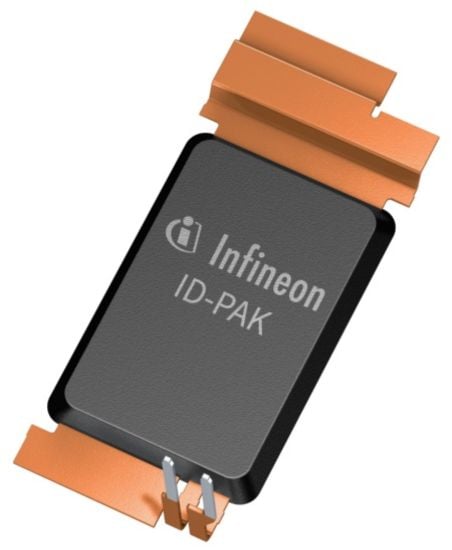
Infineon’s 1200 V ID-PAK automotive traction inverters are included in Infineon’s trench technology and superjunction design. Image used courtesy of Infineon
Infineon’s roadmap includes broad package support and key early adopters like Hyundai Motor Company, which is already using the technology for next-gen EV platforms. The company also highlighted its leadership role at PCIM with technical sessions and showcases centered on decarbonization and digitalization.
EPC’s GaN Drives Robotics, Data Centers, and Motor Systems Forward
Efficient Power Conversion (EPC) showcased its latest enhancement-mode GaN FETs and ICs with live demos highlighting the technology’s versatility across robotics, AI servers, drones, and automation. GaN’s fast switching, low losses, and compact size are enabling new performance and miniaturization levels.
For robotics, EPC’s GaN drives can power humanoid and quadruped platforms, delivering better torque, control, and battery life. In drones, high-frequency switching can extend flight time while improving maneuverability. Meanwhile, GaN-enabled power tools, vacuum cleaners, and delivery robots benefit from the same high-density gains.
In computing, EPC focused on 48 V GaN solutions for AI servers and edge data centers. Demonstrations included totem-pole PFC converters and multilevel inverters, optimizing power conversion with smaller footprints and improved thermal management. Technical talks by CEO Dr. Alex Lidow and his team highlighted high-efficiency designs for emerging computing architectures, Bodo’s Power systems, and other topics that emphasize GaN’s role in high-density, thermally-challenged environments.
Navitas’ Integrated GaN and SiC Solutions for EVs, AI, and Renewable Energy
Navitas Semiconductor unveiled a suite of GaNFast, GaNSafe, and SiCPAK products designed for EVs, AI data centers, and industrial systems. As the first to release 650 V bi-directional GaNFast ICs in production, Navitas is enabling single-stage topologies that reduce size and increase efficiency for chargers, solar inverters, and energy storage.

Bidirectional GaNFast Power ICs. Image used courtesy of Navitas
Navitas also introduced automotive-qualified GaNSafe ICs and Gen-3 Fast SiC MOSFETs with trench-assisted planar design, offering cool-switching, robust performance in OBCs, DC-DC converters, and AI platforms. SiCPAK modules with epoxy potting reduce thermal resistance shift by 5x, extending lifespan in high-temperature, mission-critical environments.
A key highlight was the unveiling of the world’s first 8.5 kW AI data center power supply, achieving 98% efficiency using three-phase interleaved PFC and LLC topologies.
Another breakthrough included the world’s highest power density server supply, with 137 W/in³. The company’s patented IntelliWeave digital control further reduced power losses by 30%.
From Infineon’s SiC TSJ modules pushing traction inverter boundaries, to EPC’s GaN-driven robotics and computing, to Navitas’ record-setting integrated platforms, PCIM offered engineers a quick glimpse into the future of power electronics. As efficiency demands climb across mobility, energy, and computer sectors, innovations presented at PCIM are setting new benchmarks for the next decade of sustainable, high-performance design.