Facebook
 Google
 GitHub
 Linkedin
PCIM 2025: Wide Bandgap Innovations for EVs, Testing, Design
This year’s PCIM featured wide bandgap products from Rohde & Schwarz, Wise Integration, and Texas Instruments.
PCIM Europe 2025 reaffirmed its role as the global stage for next-generation power electronics. This year’s event brought key announcements from companies driving innovation in wide bandgap semiconductors, digital control, and power testing.
Among the standout contributions were Wise-integration’s debut of a SiC-based onboard charger, Rohde & Schwarz’s suite of wide bandgap test solutions, and Texas Instruments’ high-efficiency power ICs targeting electric vehicles and consumer applications.
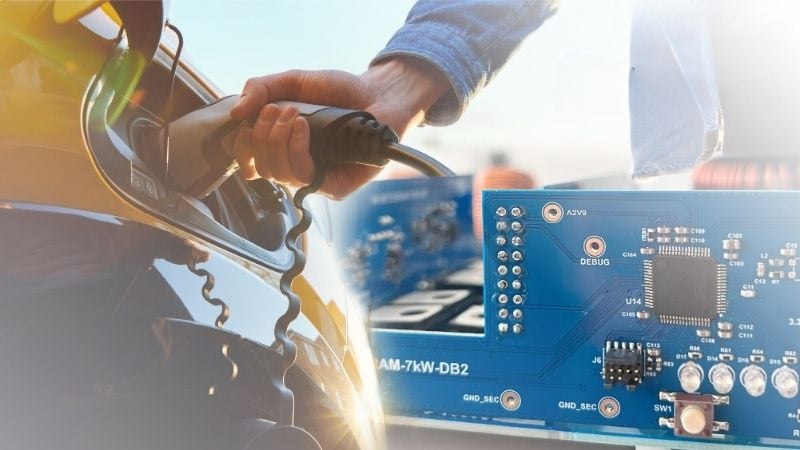
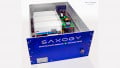
7 kW onboard charger demonstrator. Image used courtesy of Wise Integration
Wise Integration Debuts SiC Onboard Charger
Wise Integration, best known for its GaN-based digital control solutions, made its first major move into silicon carbide (SiC) territory with a 7 kW onboard charger demonstrator, developed in partnership with Tier 1 automotive supplier Savoy International Group. Built around the company’s WiseWare digital controller, the SiC platform validates a technology-agnostic control layer capable of interfacing with both GaN and SiC power stages.
The demonstrator supports high-voltage automotive applications, including Savoy’s KILOW brand of light electric vehicles. WiseWare replaces analog controllers with a digital architecture capable of zero-voltage switching at up to 2 MHz. Prototype testing shows efficiencies exceeding 98%, and a system footprint reduction of over 30% compared to traditional silicon-based chargers.
WiseWare also enables OEMs to standardize control designs across power stages, whether using GaN for DC/DC converters or SiC for onboard charging. The platform’s open, modular design reduces vendor lock-in and supports future features like predictive maintenance and V2G integration.
Rohde & Schwarz Tackles WBG Testing with Advanced Instrumentation
Rohde & Schwarz showcased a comprehensive test and measurement portfolio targeting the unique challenges in developing wide-bandgap semiconductors. The exhibit focused on the characterization of SiC and GaN power devices, with live demonstrations of switching behavior analysis, double pulse testing, and automated load jump validation.
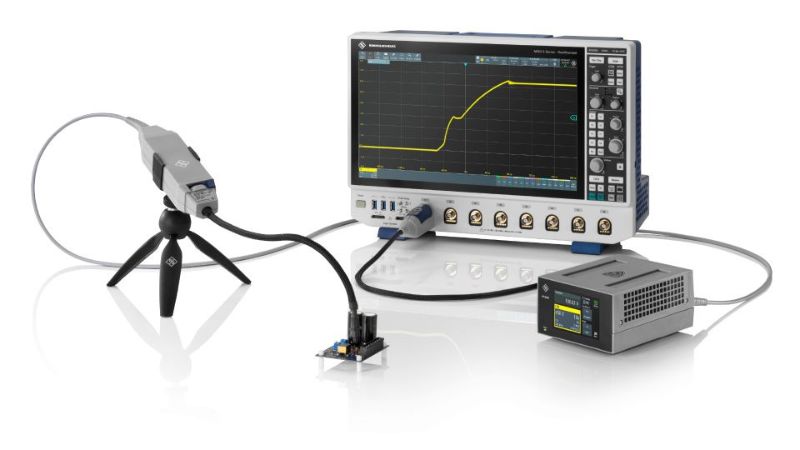
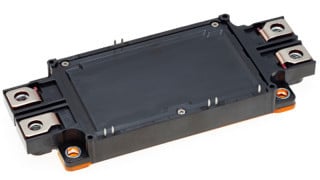
The Rohde & Schwarz RT-ZISO isolated probing system. Image used courtesy of Rohde & Schwartz
A highlight was the R&S RT-ZISO isolated probing system, engineered for fast-switching WBG applications. Paired with the MXO 5 eight-channel oscilloscope, the system demonstrated accurate switching analysis of 1200 V SiC devices, a common architecture in EV traction inverters. The company also presented component characterization solutions using the R&S LCX LCR meters and Zurich Instruments’ MFIA impedance analyzer, enabling full-spectrum analysis from shunt resistors to DC link capacitors.
Rohde & Schwarz’s testing approach emphasizes repeatability, thermal profiling, and time-based performance analytics, which are key for accelerating WBG adoption in automotive, renewable energy, and high-density computing applications.
TI Pushes Power Density with Automotive and Consumer Designs
Texas Instruments (TI) used PCIM to unveil several power-management innovations focused on increasing efficiency and density across electric vehicle and consumer platforms. Leading the showcase was the UCC25661-Q1, the industry’s first automotive-qualified LLC controller optimized for light EV battery chargers. It enables a three-stage AC/DC converter with double the power density of legacy designs, and features integrated Input Power Proportional Control to maintain high efficiency across load conditions.
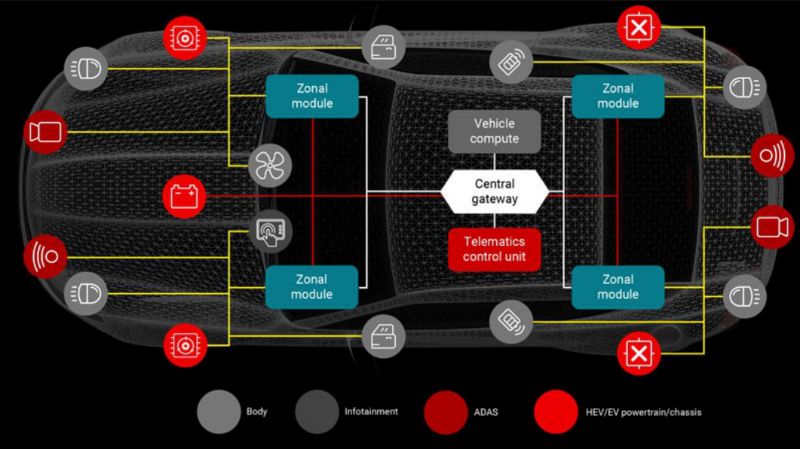
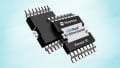
The TI UCG28826 supports EV zone architecture. Image used courtesy of Texas Instruments
TI also debuted the UCG28826, a 65 W self-biasing GaN flyback converter for compact USB PD fast chargers. The converter operates up to 500 kHz and delivers 98% efficiency, all without auxiliary windings, reducing BOM costs and improving manufacturability.
For higher-voltage EV systems, TI demonstrated a 3.5 kW bi-directional GaN-based DC/DC converter supporting 400 V and 800 V battery architectures. With peak power bursts up to 7 kW, the platform eliminates pre-charging circuits and reduces board area by 30% over silicon-based equivalents.