
 Facebook
 Google
 GitHub
 Linkedin
Desert Dome: SRP Adds 19-MW CO2 Battery to Arizona Power Plant
The Google-backed project will install an Energy Dome CO2 battery for long-duration energy storage as the grid grapples with the growth of renewables and data centers.
Energy Dome and Salt River Project (SRP) will add a 19 MW, 10-hour carbon dioxide (CO2) battery system to the Arizona grid. The project aims to provide grid stability as SRP adds more renewable energy while easing dependency on lithium-ion batteries.
The Energy Dome battery stores excess renewable energy by compressing carbon dioxide into a liquid for storage, then reheating and expanding it back into gas to drive a turbine and generate electricity.
The CO2 battery will be installed at SRP’s Coronado Generating Station in St. Johns, Arizona, and will operate under a 20-year tolling agreement. Energy Dome will own and operate the system, while SRP will dispatch the stored energy to support grid operation. Google will help fund the project through a cost-sharing agreement with SRP.
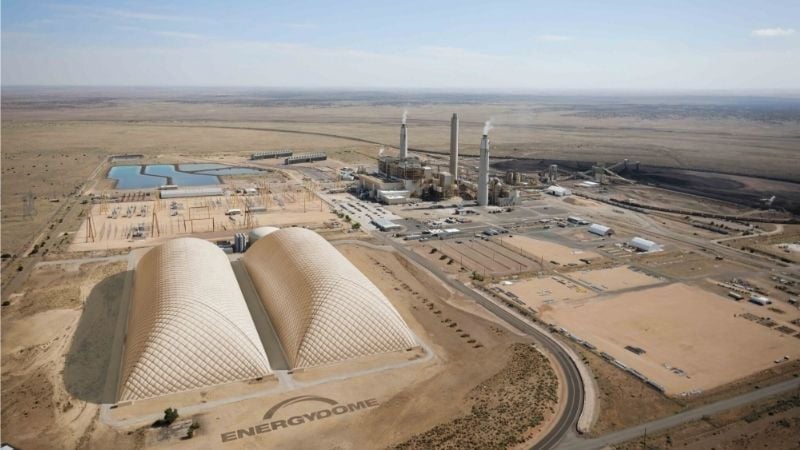
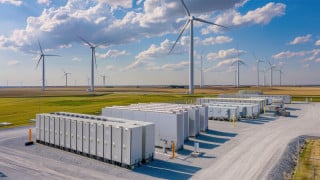
Rendering of Energy Dome at the Coronado Generation site in Arizona. Image used courtesy of Energy Dome
Long-Duration Storage
Building a cleaner, more resilient grid remains challenging because it requires effectively matching demand with energy sources whose output is variable. The most common solution has been lithium-ion battery storage, which captures excess energy generated during periods of high production and releases it back to the grid when generation declines.
While lithium-ion batteries have proven effective for short-duration applications, scaling the technology to support longer periods of low renewable generation remains challenging, as most systems are designed to provide only a few hours of storage.
However, long-duration energy storage (LDES) technologies can store and dispatch energy for much longer. Energy Dome states that its CO2 battery can operate for 8-12 hours. Adding these systems can increase grid reliability as demand grows and more renewable energy sources are integrated.
The CO2 battery system can store enough energy to power approximately 4,275 homes for up to 10 hours, demonstrating the potential of long-duration energy storage to support grid reliability during periods of low renewable generation.
Energy Dome’s CO2 Battery Storage
Energy Dome's approach to long-duration energy storage uses CO2 in a closed-loop system to store excess renewable energy and dispatch it when needed. During periods of abundant solar or wind generation, electricity is used to compress CO2 gas into a liquid state for storage. When energy demand rises, the liquid CO2 is reheated and expanded back into a high-pressure gas, which drives a turbine to generate electricity.
Graphic of the CO2 battery’s functionality. Video used courtesy of Energy Dome
Because the carbon dioxide remains within the system and is continuously reused, the technology can provide carbon-free energy storage without relying on lithium-ion batteries. Energy Dome's CO2 battery is designed to deliver electricity for between 8 and 24 hours, making it well-suited for balancing renewable generation over longer periods and helping utilities maintain grid reliability as clean energy adoption grows.
The Arizona LDES Plan and Future Developments
Arizona is an appropriate test of how a resilient grid can help boost an already strained system. Arizona’s grid struggles with the effects of population growth, electrification, and rising energy demand from data centers. At the same time, utilities are working to integrate larger amounts of solar generation while maintaining reliability during periods when sunlight is unavailable.
Google’s 288,000-square-foot data center near Mesa began operating in mid-2025. Google is adding a second facility of similar size on the same site and is reviewing designs for a third building.
Energy Dome’s CO2 battery has already proven successful with grid integration in Italy, where the technology has been operating for more than three years and has since scaled to a full-size 20 MW/200 MWh commercial plant. The first U.S. deployment is currently under development in Madison, Wisconsin, with a facility of the same size expected to be completed in 2027.
Arizona’s energy storage project is expected to be operational in 2029. The installation aligns with SRP’s broader plans to at least double the generating resources on its power system by 2035 as it works to meet growing energy demand across the Phoenix metropolitan area.




$/MWh please?