Facebook
 Google
 GitHub
 Linkedin
Addressing Power Density in AI Data Center PSUs
This article outlines the industry's challenges as it powers the next evolution in generative AI.
This article is published by EEPower as part of an exclusive digital content partnership with Bodo’s Power Systems.
Standardization brings many benefits to the data center environment. It enables power supplies (and other components) to be swapped out easily, regardless of vendor, with almost no downtime. However, it also challenges component manufacturers who must deliver innovative leaps forward while constrained by specifications set several years before.
Image used courtesy of Adobe Stock
This can be seen if we take a look at the M-CRPS specification for internal redundant power supplies, which forms part of the Open Compute Project’s DC-MHS (Data Center – Modular Hardware System) family of standardized interfaces and form factors, which are used as building blocks for a range of functions from control panel connections to computer host-processor modules and high-speed data interfaces.
The M-CRPS power modules come in a small number of form factors, with notable ones including the CRPS185 (185 x 73.5 x 40 mm) and CRPS265 (265 x 73.5 x 40 mm). Output voltages can be set to 12 V or 54 V, and using this latter 54 V standard enhances distribution efficiency in high-power hyperscale/AI workloads.
Recent years have seen rapid growth in both generative AI capabilities and demand. As such, this is placing exceptional demands on the server power networks.
The advances underpinning the latest generation of AI processors, such as NVIDIA’s Grace Hopper and Blackwell GPUs as well as AMD’s Instinct “Antares” MI300X GPU, enable significant energy efficiency improvements compared with their predecessors, with kilowatts per petaFLOPS markedly down, albeit it should be said that despite this, the raw power drawn per processor is simultaneously markedly up.
According to Figure 1, these two generational improvements from NVIDIA have delivered a more than 14-fold increase in processing power, and this has been achieved with little more than a doubling of power, a great leap forward.
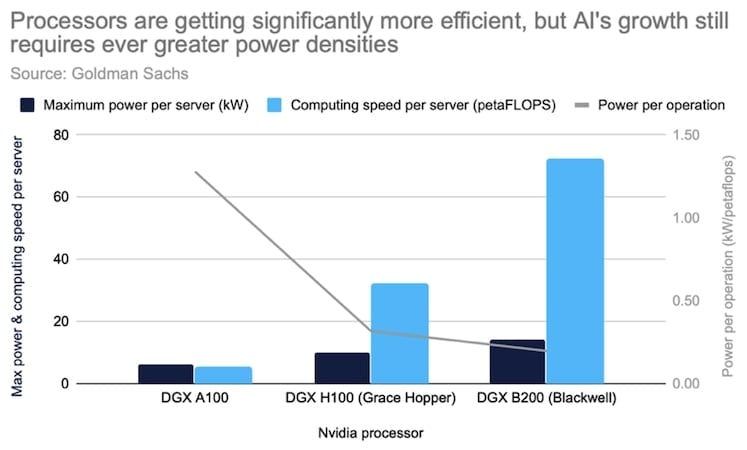
Figure 1. The power efficiencies of NVIDIA’s leading AI processor offerings. Note: specifications for NVIDIA’s Rubin processors are not yet available but are expected to follow the table’s trend. Image used courtesy of Bodo’s Power Systems [PDF]
But it’s equally clear that to deliver this improved execution performance from a standard CRPS form factor, PSU power density improvements are needed…and needed quickly.
NVIDIA’s data center SuperPOD reference designs incorporate six 1U CRPS PSU slots. For the DGXH100 SuperPOD design, the PSUs are configured with a 4+2 redundancy. But, if we look at the DGX B200 (Blackwell) SuperPOD reference documentation, we see redundancy is reduced, with five of the six needing to be energized at any given time: “The system can operate if a single internal power supply unit is de-energized, but will not operate if more than one power supply unit is de-energized, regardless of upstream power redundancies.”
With minimal redundancy in place for the current generation, it’s a safe bet that the squeeze on power is only set to intensify.
Improving Power Density From 98 to 137 W/In3
With silicon reaching its physical limits, wide bandgap semiconductors—particularly silicon carbide (SiC) and gallium nitride (GaN)—can be applied in PSUs to deliver a higher-density power supply design. Earlier this year, Navitas Semiconductor developed a reference design for a 54 V CRPS PSU that enabled a 40% increase in delivered power (4.5 kW vs. the existing 3.2 kW) from within a standard CRPS185 form factor. This increases the power density for the reference design from 98 W/in3 (3.2 kW PSU) to 137 W/in3.
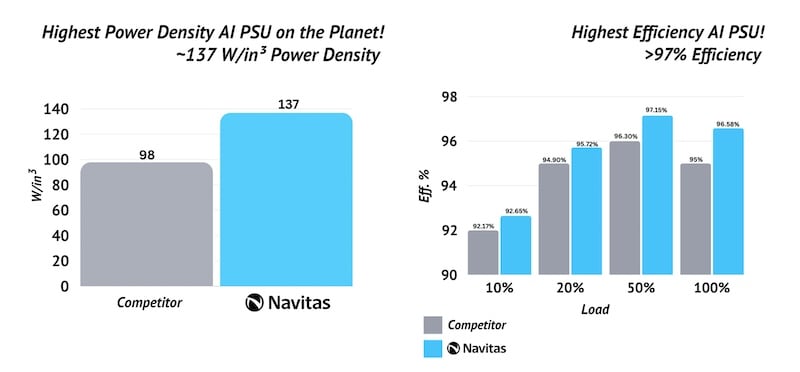
Figure 2. Power densities and efficiencies of the 4.5 kW reference design compared with a commercially available 3.2 kW CRPS185 PSU. Image used courtesy of Bodo’s Power Systems [PDF]
Of course, power supplies for data centers must meet efficiency specifications, with 80PLUS Titanium being adopted either voluntarily or (in the case of data centers in the EU) through mandated legislation. To demonstrate compliance, PSUs need to meet efficiency targets across the load range—10%, 20%, 50%, and 100%, with the standard stipulating 96% efficiencies at 50% load. The reference design exceeds requirements across the load range and reaches over 97% at 50% load. 80PLUS Titanium also stipulates PSUs have a power factor of at least 0.95 at lower load levels, making active power factor correction (PFC) necessary.
Bridgeless Interleaved Totem Pole PFC
As shown in Figure 3, Navitas Semiconductor has adopted a bridgeless interleaved totem pole PFC for the reference design, which includes a boost stage with steering switches. In comparison with a conventional bridge rectifier, this has the benefit of greatly reducing component losses.
SiC MOSFETs have been used because of their minimal switching and reverse-recovery losses, enabling the PFC to operate with a loss budget well beyond what would be capable through silicon alone.
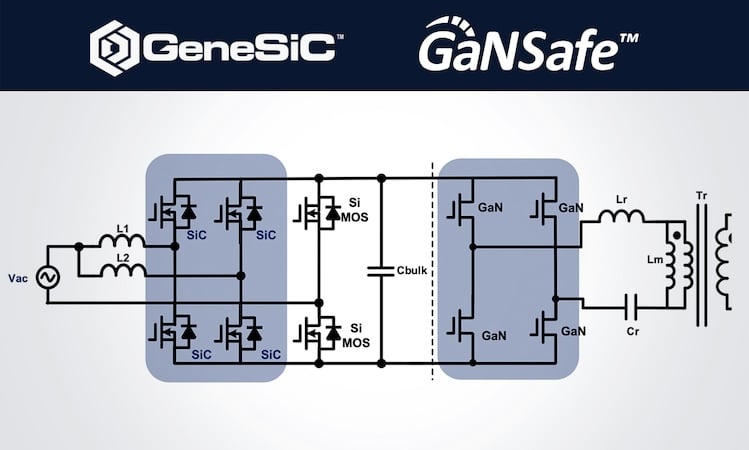
Figure 3. 4.5kW reference design with SiC bridgeless totem-pole PFC and GaN full-bridge LLC. Image used courtesy of Bodo’s Power Systems [PDF]
LLC Resonant Converter
This PFC stage, in turn, powers an LLC resonant converter with a full bridge square wave generator to excite the resonant tank circuit, with the stable 54 V output delivered on the transformer’s secondary side through a CR filter and GaN rectifiers.
We can further improve efficiencies by using zero-voltage switching (ZVS) of the full-bridge transistors at the resonance frequency of the tank circuit. However, the resonant components and the associated circuitry and output filter must handle a greater current within the same overall form factor with output current for a 54 V PSU, delivering the full-load power of 4.5 kW, 83 A.
The full bridge for the 4.5 kW reference design is built using 650 V GaNSafe ICs, with the reference design’s power density requiring a selected switching frequency of 300 kHz. This is roughly double that of the most powerful silicon-based CRPS units (c.150 kHz), and while silicon’s switching frequency cannot significantly go beyond 150 kHz, properties such as the output capacitance and gate charge of the GaN power transistor enable it to operate efficiently well beyond 300 kHz.
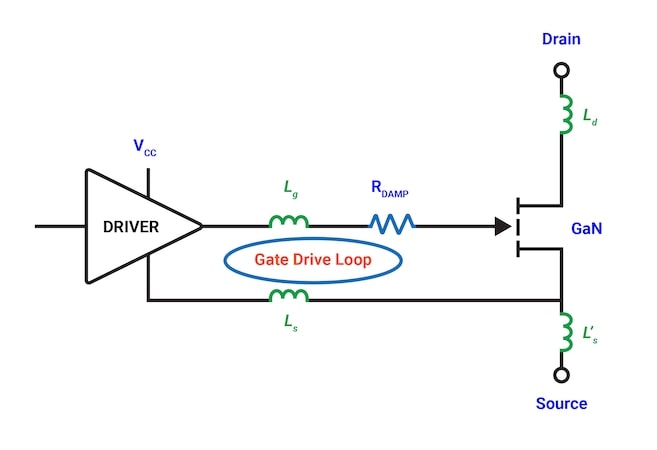
Figure 4. The integrated driver permits controlled gate-loop inductance. Image used courtesy of Bodo’s Power Systems [PDF]
GaN’s Gate Fragility
At this point, GaN’s fragile gate structure should be noted. The gate-drive circuit's design is critical to mitigate this and protect against negative voltage spikes and ringing.
GaNSafe ICs integrate an optimized driver to protect the gates, enabling a carefully controlled inductance and resistance between the output and the gate. This can also be achieved through discrete components, but doing so would introduce extra design challenges and require an increased PCB area (and, therefore, reduced power density).
Takeaways
With the rise in demand for AI has come a huge increase in data center power consumption. Constrained by fixed form factors, PSU manufacturers must significantly improve the power density of their supplies if the industry is to be able to meet these evolving needs.
Through this reference design, we have shown this is possible through a combination of SiC totem-pole PFC and GaN high-frequency LLC that drive efficiency to the 80PLUS Titanium stipulated level and reach a power density well beyond the capabilities of ordinary silicon devices.
As the next generation of GPUs for AI data centers enters operation, the need for ever more powerful PSUs will continue. Navitas Semiconductor has, therefore, set out a roadmap to reach 8.5 kW per PSU before the end of 2024 and 10 kW after that.
This article originally appeared in Bodo’s Power Systems [PDF] magazine and is co-authored by Charles Bailey, Senior Director of Business Development, and Tao Wei, Director of Applications, Navitas Semiconductor.