Facebook
 Google
 GitHub
 Linkedin
Keeping Cool: Boosting Data Center Efficiency With AI
Data centers consume enormous power, but artificial intelligence cooling systems could provide better energy efficiency.
Data centers consume enormous power, but artificial intelligence cooling systems could provide better energy efficiency.
Energy efficiency and sustainability are vital for data centers, which use large numbers of high-power processors and are increasing their energy consumption footprint. According to a recent report from Goldman Sachs, data centers will consume up to 8% of total U.S. energy production by 2030 as cloud service providers scale to meet demand for AI compute services.
Mark Zuckerberg speaks about energy and data centers. Video used courtesy of Dwarkesh Patel
Phaidra, a Seattle-based startup, is developing next-generation artificial intelligence solutions to help operators better manage data center power consumption and cooling systems. The company has secured $12 million of new funding from Index Ventures.
The recent round brings Phaidra's total funding to $60.5 million. The money will be used to expand research and development and go-to-market efforts for Phaidra’s AI-powered virtual plant operator, which helps cooling systems for data centers and other critical infrastructure operate more efficiently, reliably, and sustainably.
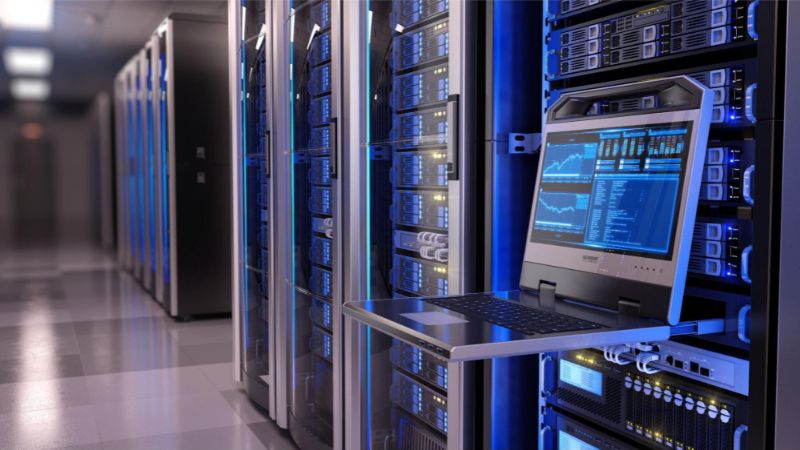
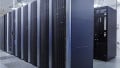
Data center servers. Image used courtesy of Adobe Stock
More Power for Data Centers
According to Index Ventures, “compute is king,” as evidenced by the growing demand for high-power GPUs (general processor units) and the expanding market caps of companies like NVIDIA that make them.
However, the growing demand for the high-power processing needed to run increasingly sophisticated AI algorithms is creating huge problems in delivering the necessary power to keep them running.
AI systems scale exponentially with compute capacity. In theory, this means a tenfold increase in computational capabilities can result in a 100-fold performance increase in the underlying AI systems. The result is a horse race to accumulate hardware compute capacity quickly and the energy to power it to capitalize on these systems' inherent advantages when operating at scale.
AI-Driven Virtual Plant Operator
Data centers require power for data processing and for cooling hardware systems to prevent overheating. According to Phaidra, cooling systems account for as much as 20-40% of the total energy consumed by a data center.
For data center cooling systems, Phaidra’s AI agent serves as a virtual plant operator, using algorithms fed with data from thousands of sensors to dynamically control key parameters like temperature, pressure, and flow rate. In this manner, excess heat can be removed from the system while minimizing the power consumed by pumps, chillers, cooling towers, and other cooling system equipment.
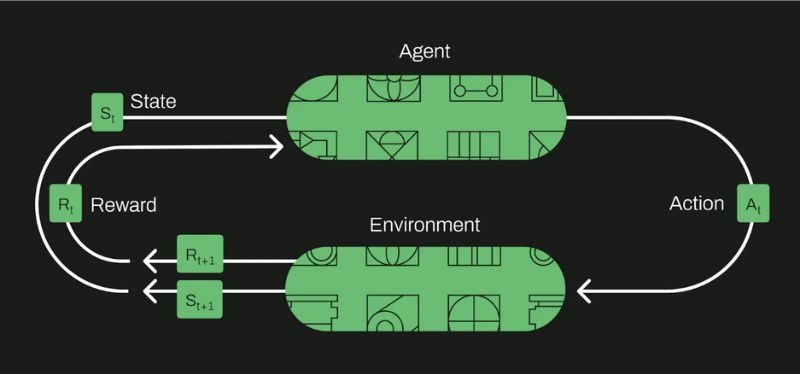
Reinforcement learning for an AI agent. Image used courtesy of Phaidra
Phaidra’s AI control platform uses general intelligence based on reinforcement learning. This means the technology is self-learning and improves over time as it examines more data and fine-tunes its algorithms. In simple terms, like humans, AI gets better with experience and practice. Also, as a closed-loop service, it is not dependent on outside data sources, so it can operate autonomously.
Phaidra’s founding team initially developed the AI solution while working at Google, using AI technologies to reduce Google’s data center's cooling power consumption by as much as 40%. The work at Google led to an eventual spinout of Phaidra as a separate company in 2019.
Phaidra’s initial customer set reported 15% energy savings during their first year using the company’s AI agents, and the energy savings are expected to increase over time as the agents get “smarter” and more efficient.
Broader Industrial Applications
In addition to data centers, Phaidra’s AI agents can also be applied to mission-critical cooling systems for pharmaceutical and other industrial applications. Beyond cooling systems, the platform’s general and autonomous AI capabilities can apply to broader industrial applications, including water conservation, equipment maintenance, and general power utilization.