Facebook
 Google
 GitHub
 Linkedin
‘Mining’ Cryptocurrency Operations To Meet Power Demand
Cryptocurrency mining changes could end the strain on power grids.
Bitcoin mining alone accounted for 0.6% to 2.3% of U.S. electricity consumption in 2023 (25-91 TWh), amounting to the annual power demand of 3-6 million homes. When factoring in other cryptocurrencies, the energy share is even higher, covering the consumption of entire states like West Virginia or Utah.
Can crypto save more energy than it uses? Video used courtesy of Riot Platforms
The Energy Information Administration (EIA) counts 137 cryptocurrency mining facilities nationwide. Some have 10,000 to 20,000 networked mining units, while others host 100,000 or more. These machines are notoriously energy-intensive, raising concerns among grid planners and regulators about their impact on peak demand, system operations, and resource projections.
The rise of crypto mining isn’t all bad news for the power grid. These electricity-hungry operations can provide flexibility for balancing supply and demand amid the transition to intermittent wind and solar generators. Unlike renewables, which take several minutes to hours to ramp up, depending on timing and weather, Bitcoin miners can adjust their energy consumption within minutes, offering a valuable demand-response tool during peak hours.
By ramping their energy use on demand, Bitcoin mining operations open new opportunities for enhancing grid flexibility.

Bitcoin mining operations can quickly adjust their energy consumption on demand, creating new possibilities for grid flexibility. Image used courtesy of Pexels/by David McBee
Crypto Mining Power Demands: An Introduction
According to the International Energy Agency, global crypto energy consumption is projected to grow more than 40% by 2026, reaching 160 TWh. Bitcoin is the market’s top user, representing 120 TWh of the 130 TWh attributed to cryptocurrency demand last year.
Bitcoin miners rely on an energy-intensive proof of work (PoW) process to solve cryptographic puzzles and add transaction blocks to a public ledger. PoW operations perform trillions of calculations every second, with miners earning transaction fees and new digital coins in return.
Some other cryptocurrencies have adopted alternative consensus mechanisms to control their power consumption. Ethereum, for example, switched to a proof of stake (PoS) model in 2022, where participants offer a portion of their own cryptocurrency as collateral and receive compensation for validating transactions.
PoS is far more computationally efficient, using only about .005% of the power required by Bitcoin’s PoW process. Ethereum’s annual energy consumption dropped to 5.85 GWh after transitioning to PoS, compared to Bitcoin’s 163 TWh. These savings—topping 99.8%—amount to the electricity needs of entire countries like Ireland or Austria, according to a 2023 study.
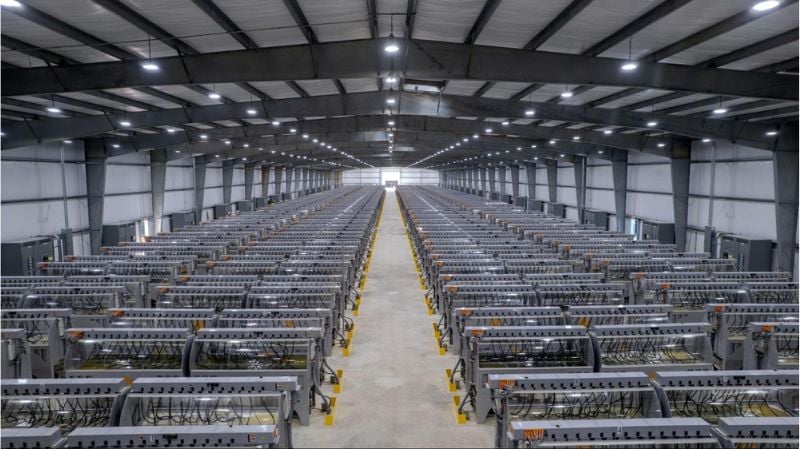
This 1-GW Bitcoin mining facility in Texas was energized in April 2024. Image used courtesy of Riot Platforms
PoS marks an innovative departure from conventional consensus methods, but PoW still remains dominant across most digital currencies today. Bitcoin miners typically secure power through spot markets, paying the market price based on supply and demand. When prices exceed mining revenue, operators reduce (curtail) their electricity use to avoid losses. Another route is long-term power purchase agreements, where prices are based on current market dynamics—similar to residential fixed-rate electricity arrangements.
Since miners can temporarily interrupt or scale their operations to capitalize on optimal pricing, curtailment can relieve local load congestion and stabilize the power grid.
Crypto Mining Can Stabilize the Power Grid: Case Studies
The growth of cryptocurrency mining has led some independent system operators (ISO) to update their forecasting models to account for large, concentrated loads.
Some are even teaming up with miners to contribute demand-response functions. The Electric Reliability Council of Texas (ERCOT) has signed voluntary curtailment agreements with “large flexible loads” such as data centers, crypto miners, and other large-scale customers with a peak demand capacity of 75 MW or more. The arrangement calls upon these facilities to lower their consumption during high system demand or limited generator availability. In return, they can participate in ancillary service markets.
ERCOT faces a high volume of crypto-related interconnection requests (around 41 GW). By late 2025, it’s expected to approve 9.5 GW of such capacity, about 73% more than today’s 5.4 GW. The EIA expects demand from Texas’ data centers, crypto sites, and other large flexible loads to reach 54 TWh next year, up nearly 60% from 2024 and representing about 10% of ERCOT’s forecasted electricity consumption.
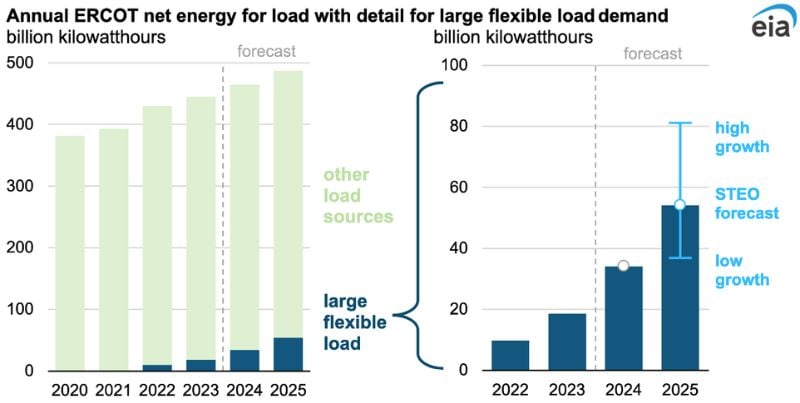
ERCOT’s large flexible load demand forecast (as of September 2024). Large flexible loads include data centers, crypto miners, and other large-scale customers. Image used courtesy of EIA
ERCOT isn’t the only ISO viewing crypto mining as an opportunity. The New York Independent System Operator recently updated its models to discover that cryptocurrency mining and hydrogen production facilities could unlock 1.2 GW of load reduction during summer and winter peaks.
PJM Interconnection, an ISO overseeing eastern mid-Atlantic states, has drafted guidelines allowing crypto mining facilities to participate in energy markets as demand-response resources. Curtailment service providers could receive a discount for responding during load reduction hours. For example, if the facility reduces 1 MW of load for 10 hours and incurs a $100 shutdown cost, PJM will pay $10 per MWh.
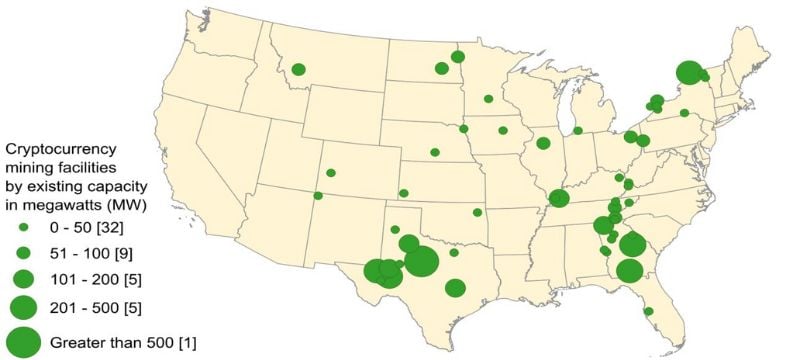
Map of 52 selected crypto mining sites in the U.S. (as of January 2024). Image used courtesy of EIA
State-level policies are also responding to these trends. Oklahoma recently enacted tax exemptions for digital asset mining equipment purchases, including servers, computers, power distribution units, transformers, switchgear, substations, and electricity used for mining purposes. To receive the tax credit, facilities must enter into load reduction agreements with local electric providers to temporarily cut their energy use during adverse conditions.