Facebook
 Google
 GitHub
 Linkedin
Hydrohertz Aims To Enable Precision EV Battery Thermal Control
The Dectravalve thermal management system divides the battery pack into independent cooling zones.
Electric vehicle fast charging has always run into the same barrier: heat. Even with 350 kW chargers and increasingly capable cell chemistries, the battery’s internal temperature limits how long fast-charging can be sustained. When any part of the pack begins to drift toward unsafe temperatures, charging power must be tapered sharply, extending the total charge time regardless of the charger's power.
Hydrohertz has aimed to address that constraint with its Dectravalve thermal management system. Dectravalve is a compact, digitally controlled multi-zone valve designed to manage temperature and energy recovery across the battery. By mitigating temperature imbalances inside the pack, the system could enable every cell to remain closer to its optimal operating region, even under ultra-fast charging.
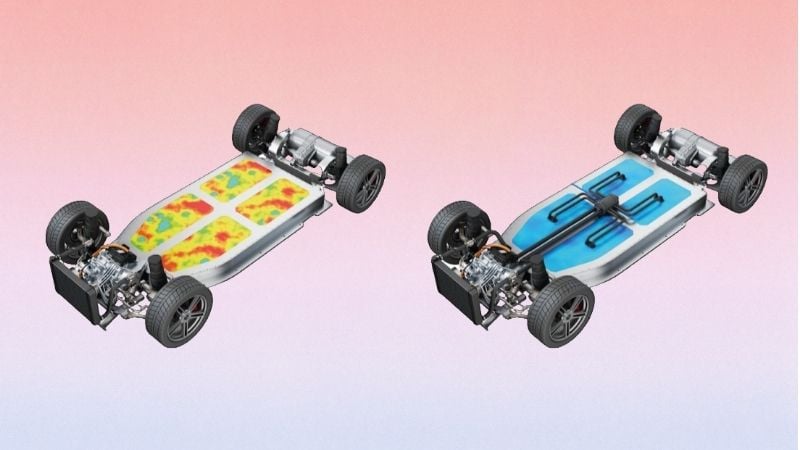
Traditional EV battery cooling vs. Hydrohertz’s Dectravalve system. Image used courtesy of Hydrohertz
Multi-Zone Thermal Management Without Leakage
Traditional EV thermal systems circulate coolant through a shared loop, which can lead to uneven heat distribution as coolant absorbs energy along its path. Hot spots develop, cooler areas fall behind, and the pack may begin to drift out of balance, a problem that becomes even more pronounced during high-power charging.
Dectravalve tackles this by dividing the battery into several independent cooling zones, each with its own precisely managed flow path. Because coolant does not bleed between zones, there is no cross-contamination of temperatures and no slow drift toward equilibrium that may compromise efficiency.
Each zone can be heated or cooled individually based on real-time sensor feedback, which helps maintain a narrow temperature window across the pack. When every module remains thermally aligned, the pack may avoid the weak points that could cause early throttling.
Ultra-Fast Charging Performance Tests
A 100 kWh LFP pack equipped with Dectravalve underwent independent testing with Warwick Manufacturing Group, demonstrating a high thermal consistency level in EV batteries. During aggressive fast charging, the hottest cell remained below 44.5°C, and the entire pack stayed within 2.6°C of uniformity.
For comparison, many EVs experience temperature rises into the mid-50s under high load, with spreads exceeding 12°C from one battery pack region to another.
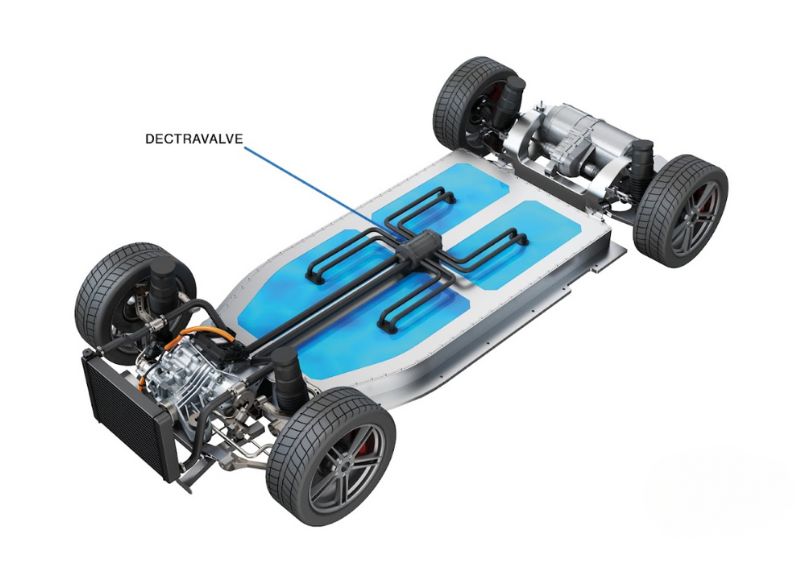
Hydrohertz’s Dectravalve is integrated into a multi-zone cooling layout, with isolated coolant paths maintaining tight thermal control across the battery pack. Image used courtesy of Hydrohertz
Once cells reach 50°C, charging must be reduced to avoid lithium plating, a condition in which metallic lithium deposits on the anode and accelerates degradation. Because Dectravalve is designed to prevent any part of the pack from reaching that threshold, the system can remain in the high-power charging zone far longer.
Hydrohertz reports charge-time reductions up to 68%, which could reduce the typical 30-minute 10-80% charge session into roughly 10 minutes. This time would be comparable to the range of conventional refueling.
Range, Efficiency, and Lifespan Gains
A battery that remains in its most efficient temperature band also delivers more usable energy. Hydrohertz estimates the potential for real-world range improvements of up to 10% through reduced internal resistance and more efficient cell behavior. For many mid-size EVs, that equates to roughly 30 to 40 additional miles of driving without altering the pack’s chemistry or capacity.
Long-term battery health also stands to benefit. Harsh temperatures and uneven heat across a pack can cause batteries to wear out early. By keeping peak temperatures in check and stopping hot spots from forming, Dectravalve could ease the strain on each cell and help maintain the battery’s overall health. The result may contribute to a longer service life, better long-term value for the vehicle, and a pack that remains more useful when repurposed for stationary storage.
Working With Battery Chemistries
Notably, the system is chemistry-agnostic. Whether the battery uses LFP, NMC, silicon-enhanced chemistries, or emerging solid-state designs, the thermal requirements remain fundamentally the same: keep the cells uniform, stable, and within the optimal band.
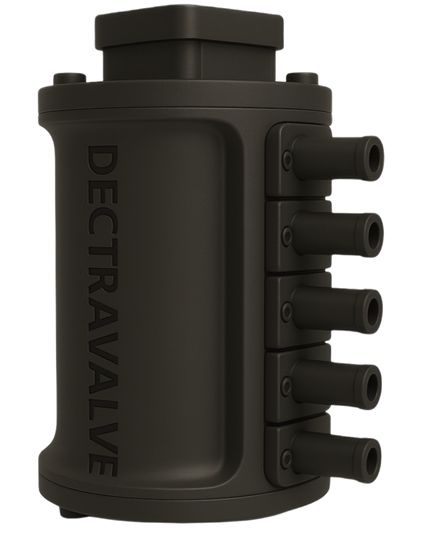
The Dectravalve. Image used courtesy of Hydrohertz
The same hardware can optimize any present or future battery type because Dectravalve is built around zoned coolant control rather than electrochemical manipulation.
Aiming for High-Performance EVs
Developing a new battery chemistry can require a decade of research and billions in investment. Automakers, however, need improvements now. Dectravalve could provide a shortcut, with potential to extract improved performance from existing battery packs.
Instead of relying on a maze of separate valves, manifolds, and auxiliary hardware, the system consolidates everything into a single compact unit. Stripping out that extra plumbing reduces the bulk and energy usually associated with multi-zone cooling setups.
Toward the Next Phase of EV Usability
The automotive industry has been looking for a realistic way to cut charging times, boost driving range, and help batteries last longer without relying on untested chemistries or a complete battery pack redesign.
By stabilizing the thermal environment across the pack, Dectravalve could raise the performance ceiling of existing batteries and provide a framework that future cell technologies can build on.