Facebook
 Google
 GitHub
 Linkedin
Is Cathode Chemistry Key to EV Battery Range?
Integrals Power’s battery chemistry delivers significant gains in energy density
Integrals Power has started shipping its lithium iron phosphate (LFP) and lithium manganese FP (LMFP) samples to automotive and battery manufacturers in Europe and the U.S. The cathode materials will be used in lithium-ion battery cells for energy storage devices and electric vehicles.
How does LFP improve battery performance? Video used courtesy of Integrals Power
The U.K.-based startup produces samples at its pilot plant in Milton Keynes, which can produce 20 tonnes of LFP material annually. Integrals Power plans to expand to an industrial-scale line by 2027.
With an 80% manganese composition supplying a high energy density, Integrals Power’s LMFP cathode material unlocks a 20% longer EV range. The high manganese content enables the material to maintain a high voltage profile without compromising specific capacity. The company’s LFP product also offers similarly compelling features, including a high specific capacity, an ultra-high discharge rate of 30-40C, and capacity retention in extreme temperatures.
Integrals Power CEO Behnam Hormozi told EEPower that 80% manganese-rich materials are “difficult to achieve with a conventional approach due to the limitations at the chemistry and particle development level.”
However, “Given our unique approach in battery cathode materials, we have been successful in developing such a high-performance material that offers up to 20% boost of energy density (range) due to the boost of the voltage profile, which comes at no extra cost," Hormozi added.
_and_LFP_(right)_cathode_materials.jpg)
Samples of Integrals Power’s LMFP (left) and LFP (right) cathode materials. Image used courtesy of Integrals Power
LFP Battery Chemistry Benefits
Integrals Power’s novel battery chemistry leverages high-purity raw materials rather than bulk precursors commonly used in lithium nickel manganese cobalt (NMC) batteries.
Although NMC remains the dominant battery chemistry in European and U.S. EV markets, LFP batteries are gaining popularity for their long cycle life, enhanced safety and thermal stability, and competitive performance. LFP also uses fewer critical minerals besides lithium and is significantly cheaper than NMC, thanks to price declines.
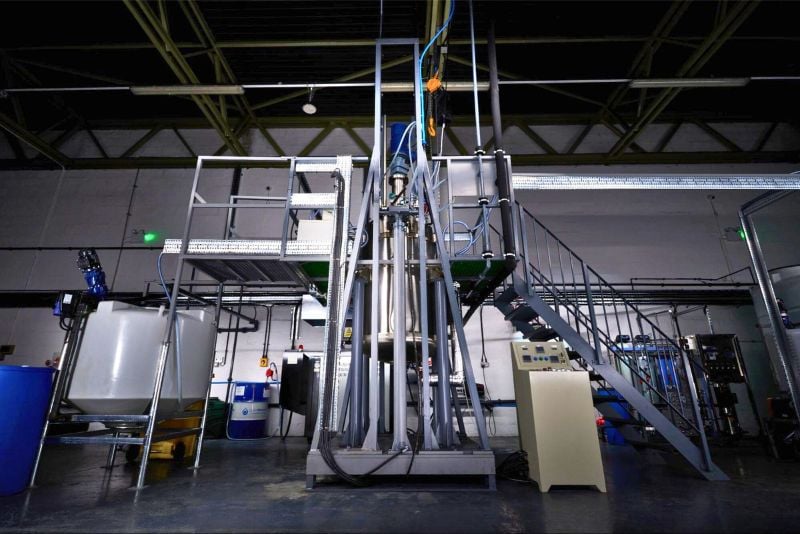
Integrals Power’s pilot production line in the U.K. Image used courtesy of Integrals Power
Tesla was one of the first automakers to adopt LFP in its standard-range models. Others are following suit, including General Motors and Ford. According to the International Energy Agency, LFP supplied over 40% of global EV demand by capacity last year—more than double 2020’s share. About two-thirds of China’s EV sales used LFP, but adoption has been slower in the U.S. and Europe (below 10%).
Manufacturers are also interested in increasing LFP batteries’ manganese content to achieve cost-effective gains in energy density. LMFP batteries’ energy density is 15-20% higher than LFP, though the cost is about the same.
Integrals Power’s LFP and LMFP Solutions
Integrals Power uses 80% manganese content, significantly less than the industry standard of 50% to 70% in existing blends. This composition means customers can avoid price volatility and supply chain issues typical in the critical mineral market.
The company’s LMFP cathode active materials have a specific capacity of about 150 mAh/g, slightly lower than LFP’s average 170 mAh/g. However, the higher voltage (4.1 V) unlocks a higher energy density than LFP (3.4 V) and NCM (3.7 V), meaning the battery can produce more power for longer—thus boosting EV driving range.
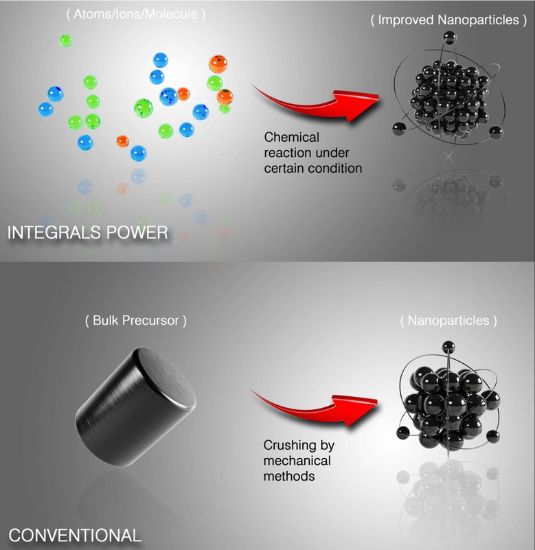
Integrals Power’s proprietary chemical reaction compared to conventional methods. Image used courtesy of Integrals Power
After securing third-party validation from the U.K.’s Graphene Engineering Innovation Center, Integrals Power recently started distributing samples to three customers developing EV batteries and static energy storage systems. Another 10 customers are in the company’s pipeline across Europe and the U.S.