Facebook
 Google
 GitHub
 Linkedin
Research Roundup: Battery Breakthroughs To Extend EV Range
Battery technology improvements focus on increasing energy density, performance, and efficiency.
The electric vehicle industry has rapidly evolved, driven by the global push for sustainable transportation solutions. However, one persistent challenge has been the limited range of EVs compared to their gasoline-powered counterparts. This range anxiety has been a significant barrier to widespread EV adoption, prompting intense research and development efforts in battery technology.
Current lithium-ion batteries have reached a saturation point in energy density and performance. Researchers have been exploring various avenues to overcome these limitations, including new materials for anodes and cathodes, alternative electrolytes, and novel battery architectures.
Recent breakthroughs in battery technology promise to address these long-standing issues and resolve range anxiety.
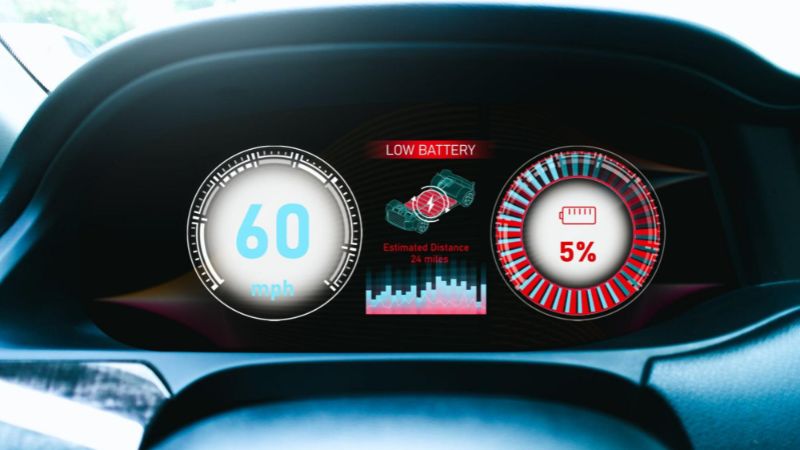
Low battery warning on EV dashboard. Image used courtesy of Adobe Stock
Silicon Anodes Unleashed
Lithium-ion batteries operate through the reversible lithium-ion movement between the cathode and anode during charge-discharge cycles. The anode, typically composed of graphite, intercalates lithium ions during charging. Silicon anodes offer higher theoretical capacity but suffer from significant volume expansion during lithiation, leading to degradation of structure and capacity.
Pohang University of Science and Technology researchers have engineered a special binding material to prevent high-capacity silicon anodes from expanding, increasing the capacity by 10 times. The research team effectively stabilized silicon anodes, which was key to unlocking their potential for significantly higher energy storage. According to the team, this technological advancement could extend EV driving ranges to over 3,000 miles on a single charge.
Solid State, Stellar Range
The driving range for most high-end commercial EVs is around 400 miles. To overcome this limit, Mercedes-Benz and American battery startup Factorial have made significant progress in developing solid-state battery technology. Their battery pack, dubbed Solstice, has achieved an energy density up to 450 watt-hours per kilogram (Wh/kg), substantially higher than average lithium-ion batteries.

Factorial Solstice battery packs. Image used courtesy of Factorial
The key architectural difference lies in the electrolyte composition. While lithium-ion batteries use a liquid electrolyte, solid-state batteries employ a solid electrolyte, resulting in many benefits, including higher energy density. According to the team, the Solstice battery is more energy-dense, compact, lighter, and safer than existing lithium-ion batteries. The team believes this breakthrough could extend EV ranges to over 600 miles.
Structural Batteries Provide Massless Energy
EVs need more efficient energy storage solutions that don’t add burdensome weight to the vehicle. This demand has given rise to structural batteries that store energy and support the system. Researchers at Chalmers University of Technology have developed a structural battery that combines energy storage capabilities with load-bearing properties, effectively creating a "massless energy storage" solution.
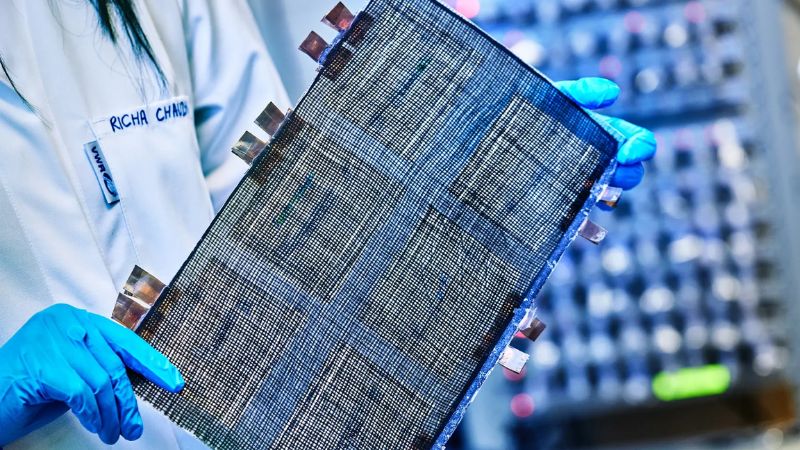
Carbon fiber composite for structural batteries. Image used courtesy of Chalmers University
According to the study, the battery uses carbon fiber as positive and negative electrodes. Lithium iron phosphate is applied to the carbon fiber in the positive electrode. This dual-purpose design eliminates heavy current collectors like aluminum and copper. The semi-solid electrolyte enhances safety by minimizing fire risk. The latest iteration of this technology boasts an energy density of 30 Wh/kg and an improved stiffness of 70 gigapascals.
While the battery’s energy density is slightly lower than conventional solutions, the weight reduction can potentially increase EV range by up to 70%.
Looking Ahead
As consumers adopt EVs in mass, the demand for extended EV ranges will continue to catalyze battery advances. With progress already made in silicon anodes, solid-state batteries, and structural batteries, it’s clear that the industry is already working on these challenges.