Facebook
 Google
 GitHub
 Linkedin
Why Don’t LFP Batteries Last Longer?
Can TU Graz research lead to longer-lasting LFP batteries in EVs and storage facilities?
Lithium iron phosphate (LFP) batteries have potential in electric vehicles and large-scale grid storage applications because they are safer and longer lasting than lithium-ion batteries. In the future, LFPs could serve as the battery architecture for all-solid-state lithium metal batteries because of their performance and lack of expensive transition metals.
Scientists are continually improving LFP batteries’ energy density to bolster their commercial attractiveness over other architectures. However, while most batteries never reach their theoretical capacity, many LFP batteries undercut their theoretical electricity storage capacity by up to 25%. The lower capacity has puzzled researchers for a while, so a team in Switzerland probed the cathodes’ lithium diffusion mechanics to find out why.
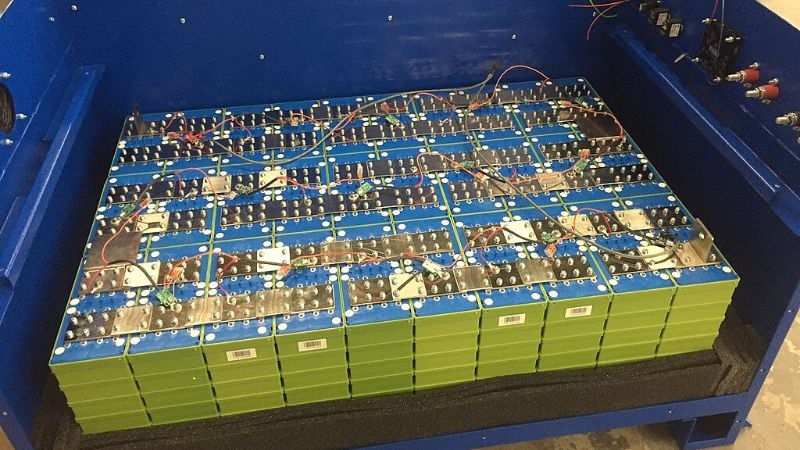
Lithium iron phosphate battery cells. Image used courtesy of Wikimedia Commons
Why Doesn’t Battery Capacity Measure Up?
Identifying what lithium ions do during charging and discharging is necessary to understand why batteries fail to reach their theoretical capacity. Examining the lithiation/delithiation process’ kinetics and any structural changes the cathode undergoes during charging/discharging may improve performance.
Researchers are still investigating the electrochemical kinetics of the biphase insertion mechanism within LFPs that drives electrochemical performance—the biggest discrepancy being the lower practical capacity. They want to view the delithiation process at the atomic level in LixFePO4 batteries to see how the lithium diffusion affected the capacity loss.
Probing Lithium-Ion Movement in LFP Cathodes
Researchers at Graz Technical University in Austria used transmission electron microscopes (TEM)—high-resolution microscopes that transmit a high-energy beam of electrons through a material—to track the lithium ions as they traveled through the LixFePO4 crystal lattice. The method allowed the researchers to map their arrangement and distribution throughout the cathode.
For the first time, this approach showed a phase distribution in partially lithiated lithium iron phosphate. The study showed that some lithium ions remained within the crystal lattice of the cathode after charging when they should have all migrated to the anode—forming segregated, partially lithiated regions in the cathode. The immobile ions left behind are responsible for the loss in practical capacity in LFP batteries.
Distortion and Slow Diffusion Behind Capacity Loss
The researchers were able to directly study the delithiation process using integrated Differential Phase Contrast Imaging (iDPC) that could visualize the light element distribution within the crystalline network of the cathode material. High-Resolution Scanning Transmission Electron Microscopy (HR-STEM) was then used to visualize the boundaries between the different phase domains.
The researchers focused on the [010] and [011] crystallographic planes of the cathode materials, as these regions have the biggest changes in lattice distance during lithiation. The researchers found slow lithium diffusion kinetics in the [010] direction that has not previously been reported.
Slow diffusion kinetics were found in this channel because it is a preferred diffusion path due to a lower diffusion energy barrier. That situation would usually promote diffusion out of the cathode. However, the diffusion was not a straight line but a long, tortuous path that slowed lithium diffusion. The research also found lithium vacancies within the lattice caused the oxidation of some iron ions from a Fe2+ to an Fe3+ state, forming a polaron (quasiparticle charge carrier) that remains near the vacancy site to compensate for the change in localized charge.
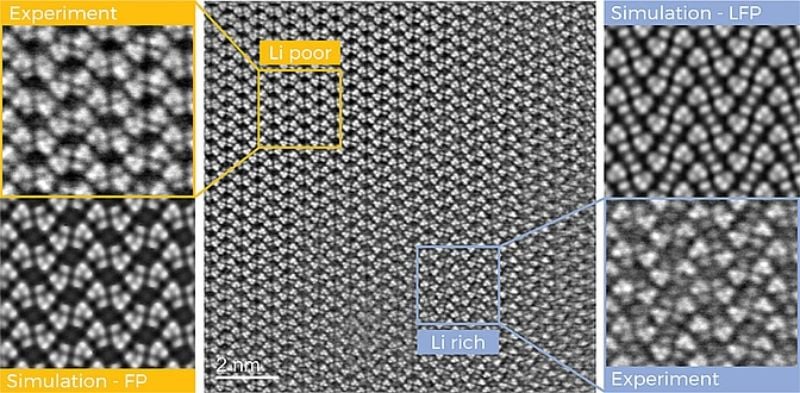
The researchers could identify rich and poor lithium areas within the battery material. Image used courtesy of TU Graz
The transition and change in these iron atoms’ oxidation state significantly change the bond lengths and angles between the iron and surrounding oxygen ions. This change manifests in localized distortions limiting lithium diffusion along the [010] crystal direction. The partially filled channels are one of the rate-limiting factors for lithium transport in LFP batteries, which reduces the practical capacity away from the theoretical value.
Additionally, the researchers found some visible rotation between the lithium-rich and lithium-poor phases, suggesting localized strain. This also resulted in a crystal mistilt of ≈0.5°–1.5°. These phase boundary deformations were also found to be partially responsible for reduced lithium diffusion.
Beyond LFP Batteries
During the study, the researchers took material samples from charged and discharged batteries to examine them with atomic-scale resolution. To build a complete picture, they used analytical techniques combining electron energy loss spectroscopy, electron diffraction, and atomic-scale imaging. These techniques are also applicable when researching all types of battery materials. LFP was chosen in this study due to the large disconnect between theoretical and practical capacity. However, various battery architectures could apply the same approach to capacity loss.