Facebook
 Google
 GitHub
 Linkedin
Charging Kit Enables Bidirectional EV Chargers to Power Homes
German startup Energy Island Power’s charging kit brings vehicle-to-home charging to electric vehicles with bidirectional capabilities.
Electric vehicles with bidirectional capabilities can power small devices, such as appliances and lights, with vehicle-to-load (V2L) technology. However, V2L is not sufficient to power an entire home. Although some automakers have made great strides in rendering vehicle-to-home (V2H) accessible, the tech is still far from standard. Energy Island Power aims to change the status quo.
This German startup found a way to lend V2H capability to EVs using a connection kit called Power Unit 3000. Set to launch in the second quarter of 2025, this device integrates an EV with a photovoltaic system’s home battery or a power generator.
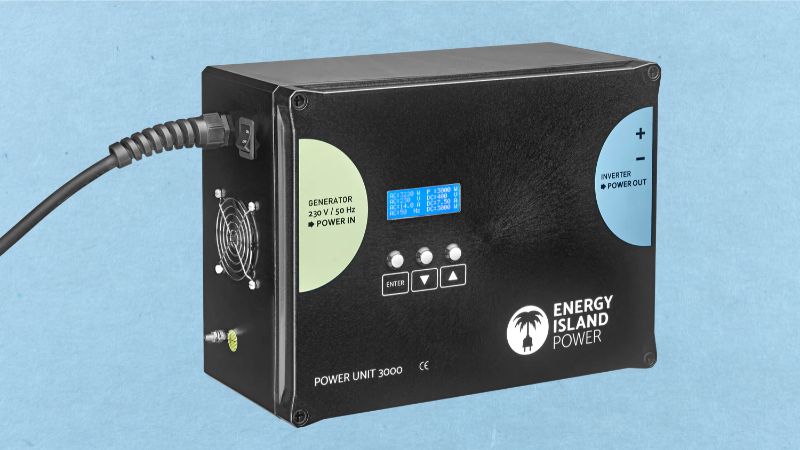
Power Unit 3000. Image used courtesy of Energy Island Power
How Does Power Unit 3000 Work?
Power Unit 3000 is a plug-and-play device whose setup depends on existing infrastructure.
The simplest installation involves a gas- or diesel-powered generator. Users can hook this unit between a 230 V generator and a solar inverter through its DC input with MC4 connectors.
This bidirectional charging kit has a microprocessor that copies how solar modules behave. The inverter converts the power it receives into a single-phase or three-phase AC and feeds it into the home battery. The output power is adjustable from 400 to 3,000 watts.
Users can turn off their generators once the battery fully charges, a departure from how conventional backup generators operate.
The company’s Control Unit should be part of the assembly when connecting an EV battery or a mobile battery. This device has two variants: one is compatible with E3DC power systems and the other with other inverters.
The E3DC home power systems model introduces automation, enabling users to specify the conditions in which Power Unit 3000 should charge the battery through the EV. Users can configure these settings on the E3DC app or the home power system’s screen:
- Identify the period when the battery should initiate electricity withdrawal.
- Decide whether the home battery should withdraw only during emergency power operation.
- Establish from and up to which SoC of the home battery should start and stop withdrawal.
The model developed for other inverters works with the clever-PV app, supporting intelligent integration with the solar energy system.
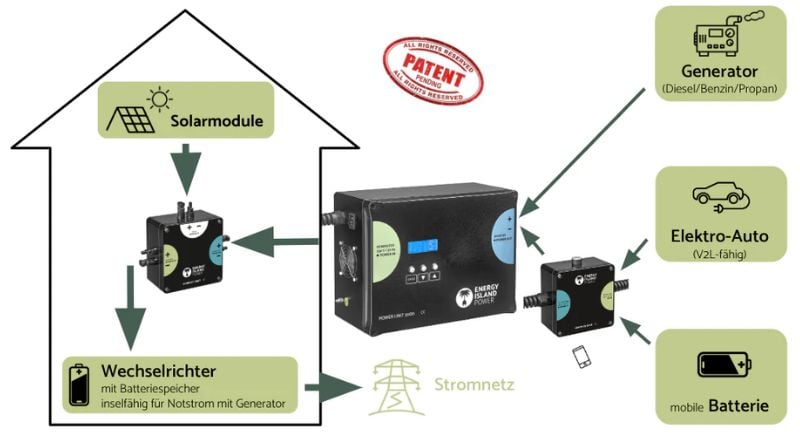
The Power Unit 3000’s energy flow. Image used courtesy of Energy Island Power
With the Connect Unit, users can permanently incorporate the kit into their home installation. This device is suitable when the inverter has no free DC inputs. Users install the Connect Unit between their PV system, home battery, and a 230 V power source. It reduces the need to touch connections to activate V2H.
Power Unit 3000 and its companion devices are plug-and-play and set-and-forget, requiring no modifications to any home installation. However, only qualified specialists should handle assembly for safety reasons.
Power Unit 3000 is compatible with V2L-capable EVs. The non-E3DC-specific Control Unit should work with any solar inverter clever-PV supports. The Connect Unit is incompatible with SolarEdge inverters.
Should V2H and PV Panels Operate in Parallel on the Connect Unit?
Drawing power from both V2H and PV may negatively impact PV panels’ ability to harvest solar power. However, doing so won’t overload the inverter as it consumes only up to its maximum power.
The Connect Unit combines the two energy sources instead of deactivating one in favor of the other. Inverters use maximum power point tracking to find the point at which the sum of the electricity coming from the PV system and Power Unit 3000 reaches the most it can handle.
V2H can tap another power source to draw less electricity from the grid, especially during peak hours, to conserve money. For this reason, users only need to turn on the connection kit at night when the panels aren’t generating any electricity to use their power sources efficiently.
How Reliable Is Power Unit 3000?
Energy Island Power manufactures Power Unit 3000 in Germany in accordance with ISO 9001, a globally recognized standard for quality management. ISO 9001 certification is synonymous with risk-based thinking and sound quality control processes, and as a certified company, it is subject to regular audits and reviews.
The product meets the European Union’s health, safety, and environmental protection requirements. It also complies with DIN EN 62109-1 VDE 0126-14-1:2011-04, which is the same safety standards that solar inverters must adhere to.
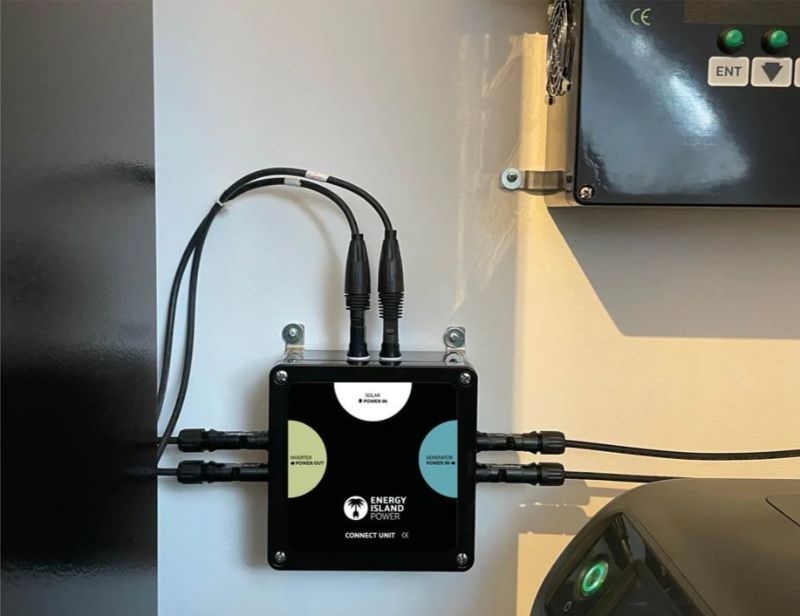
Connect Unit. Image used courtesy of Energy Island Power
The company backs the product with a guarantee to work as intended for five years or 5,000 operating hours, whichever comes first, on top of its statutory warranty. The unit is also highly repairable.
How Does Power Unit 3000 Compare to Other V2H Solutions?
Many automakers have rolled out V2H capability in their EVs. Notable examples include Ford’s F-150 Lightning, Tesla’s Cybertruck, Volkswagen’s 2024 ID.4, and GM’s Chevrolet Silverado EV, Equinox EV, and Blazer EV 2024 models.
This Energy Island Power innovation allows users to retrofit V2H capability to their homes as long as they have a V2L-capable EV and a supported solar inverter. Although it has interoperability limitations, it renders V2H accessible with minimal cost and disruption.
However, Energy Island Power notes that Power Unit 3000 doesn’t reduce round-trip efficiency to zero. The company estimates losses of about 20% from the inverter to the vehicle and back.
Energy waste usually worsens with battery usage. Although the percentage of losses may rise as the number of charges and discharges increases, it’s still less detrimental to the battery than driving. A constant but lower load from withdrawing and charging electricity has less power intensity, so less heat is produced.
Furthermore, using V2H more frequently can noticeably minimize standby power consumption. Automating the withdrawal process should also decrease energy losses.