Facebook
 Google
 GitHub
 Linkedin
Could Hidden Battery Power Boost EV Range?
Scientists have discovered why lithium iron phosphate batteries hold 25% less energy than predicted.
Lithium iron phosphate (LFP) batteries are considered a promising alternative to lithium-ion batteries thanks to their affordability, longevity, and reliability. However, researchers have grappled with a perplexing challenge: real-world LFP batteries have consistently fallen short of their theoretical capacity by up to 25%. This discrepancy has puzzled scientists and engineers, and understanding and resolving this issue could significantly impact the performance and adoption of LFP batteries in EVs and grid-scale energy storage.
Researchers at Graz University of Technology (TU Graz) have uncovered the root cause of this shortfall through microscopical analysis. Their discovery could resolve some LFP technical challenges, making them more viable for electric vehicles and storage systems.
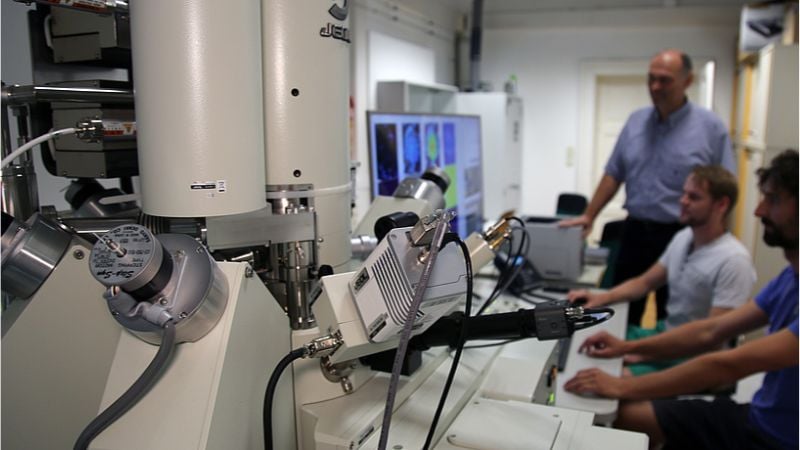
Research microscope. Image used courtesy of TU Graz
The LFP Dilemma
LFP batteries utilize lithium iron phosphate (LiFePO4) as the cathode material and a graphite carbon electrode with a metallic backing as the anode. They function like other lithium-ion batteries, with ions moving between the electrodes during charging and discharging. However, LFP batteries boast several benefits over conventional cobalt or manganese oxide-based lithium-ion batteries.
A primary advantage of LFP batteries is their enhanced thermal and chemical stability. Unlike cobalt-based batteries, which are prone to thermal runaway, LFP batteries are much less likely to overheat or catch fire.
Moreover, LFP batteries offer a longer cycle life than their cobalt and manganese oxide counterparts. They can endure more charge-discharge cycles before their capacity significantly degrades, often achieving several thousand cycles. This extended lifespan translates to a lower total cost of ownership, particularly in applications requiring frequent cycling, like grid storage or fleet vehicles.
Another notable benefit of LFP batteries is their stable discharge voltage. The flat voltage curve during discharge ensures that devices powered by these batteries receive consistent power delivery.
Despite these benefits, LFP batteries face notable challenges due to lower energy density than other batteries, such as nickel manganese cobalt. The lower energy density limits the amount of energy they can store. This has been a significant barrier, particularly in applications like EVs, where maximizing range is crucial. Recent research discovered that LFP batteries consistently deliver about 25% less storage capacity than their theoretical maximum.
Atomic-Scale Analysis of LFP
In a Graz University of Technology publication, researchers have uncovered the root cause of capacity loss in LFP batteries.
Using advanced atomic-level microscopy techniques, including electron energy loss spectroscopy, transmission electron microscopy, and electron diffraction measurements, the team tracked the movement and arrangement of lithium ions within the battery's crystal lattice structure.
_and_LiFePO4_(right).jpg)
Ion transport through the crystal lattice comparing FePO4 (left) and LiFePO4 (right). Image used courtesy of Šimić et al.
Their findings revealed that some lithium ions remain trapped in the cathode's crystal lattice even when the battery is fully charged, leading to a consistent underperformance compared to the theoretical capacity. The researchers discovered these trapped ions are unevenly distributed throughout the cathode, mapping their positions at a nanometer scale. This uneven distribution is attributed to distortions and deformations in the cathode's crystal lattice structure.
Electrifying Progress
This breakthrough in understanding LFP battery capacity limitations could significantly impact the EV and energy storage industries. By addressing the root cause of capacity loss, researchers can focus on developing strategies to mitigate the effects of trapped lithium ions and crystal lattice distortions. This discovery may lead to improved LFP battery designs, potentially increasing energy density without compromising cost-effectiveness or longevity.