Facebook
 Google
 GitHub
 Linkedin
Yokogawa Unveils Power Analyzer That Skips External Divider
The 2,000 VDC WT1500 precision power analyzer features four power channels and a 2 HMz wideband element. A multi-unit sync is available soon.
Yokogawa Test & Measurement will release the WT1500 precision power analyzer with a 2,000 VDC direct input, a first for the company's WT series. The product will be available on Aug. 19.
The instrument packs four power channels and four motor evaluation channels into a 19-inch, 2U chassis roughly 88mm high. It claims +/-0.038% total power accuracy at DC and 50/60 Hz, and offers a wideband input element going to 2 MHz. Direct measurement at 2,000 V removes the high-voltage divider that a conventional setup needs above 1,000 V.
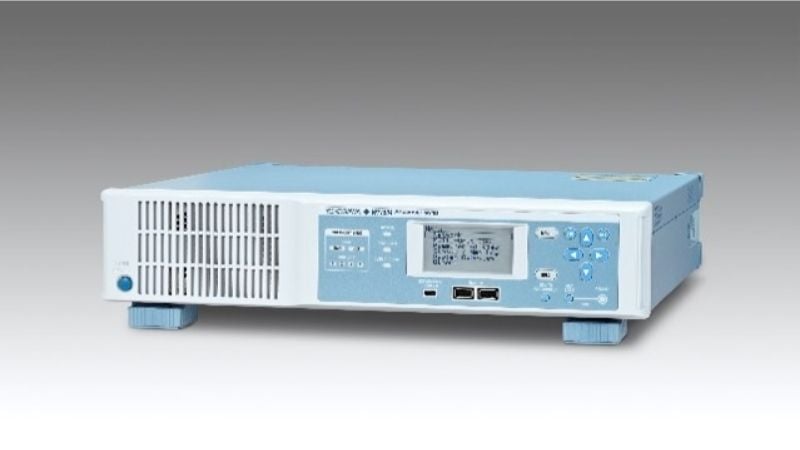
The WT1500 precision power analyzer. Image used courtesy of Yokogawa
Two Element Types, One Chassis
The WT1500 comes with a choice of input elements that can be mixed in a single unit and share a common current sensor input. The high voltage element handles up to 2,000 VDC with 300 kHz of bandwidth, aimed at power conditioning systems and energy storage.
The wide bandwidth element trades voltage ceiling for frequency response, topping out at 1,000 V but reaching 2 MHz. Above 1,000 V, Yokogawa requires the 758932 high-voltage safety terminal adapter and compatible cables.
Accuracy figures are quoted as +/-0.038% total for power at DC and 50/60 Hz, and +/-0.07% of apparent power at low power factor at 50/60 Hz, which Yokogawa describes as the best in the WT series. Both are total accuracy figures before current sensor error, which is added on top. Sensor selection will therefore dictate the real floor on a measurement, not the mainframe.
Channels, Synchronization, and Data Out
Motor analysis is an option rather than a default, configured at order time across five variants: /EM1 for up to two motors with encoder input, /RM1 for one motor with resolver, /EM2 for up to four with encoder, /RM2 for up to two with resolver, and a combined /EM1RM1. Resolver support is the addition Yokogawa emphasizes, since conventional setups measure power and resolver signals separately and synchronize them afterward on a PC.
Beyond four power channels, up to five WT1500 units can be chained under one main unit for 20 synchronized channels, using the /SY1 option with a 720941 optical transceiver module and 720942 fiber cord.
Yokogawa has indicated that /SY1 isn't available yet and will be added to purchased units through a later option upgrade license, so buyers who need 20 channels on day one won't get them from the initial launch. Interfaces present at release include IEEE 1588 time synchronization, CAN and CAN-FD output through the /CN1 option, low-latency UDP transmission, a web server, and remote control from a PC, monitor, or tablet.
Learn more about the 1500 precision power analyzer. Video used courtesy of Yokogawa
Utility-scale solar has already moved to 1,500 VDC strings, and Yokogawa cites operating voltages above that figure alongside multi-string architectures as the reason for the HV element. The closest modular competitor highlights this gap, with Hioki's PW8001 topping out at 1,500 VDC CAT II on its U7001 input unit, per Hioki's own specification. Anything above that has historically meant a divider in the signal path.
The 2 MHz wideband element addresses the fact that SiC and GaN inverters switch far faster than the IGBT designs power analyzers were built around, pushing harmonic content and switching-loss energy well past the few hundred kilohertz that older instruments capture. Yokogawa points the WB element at integrated e-axles and dual-inverter EV powertrains, where electrical and mechanical signals must be sampled together across multiple power paths.
Data centers appear in Yokogawa's target industry list, too, and the timing isn't accidental. NVIDIA’s 800 VDC rack architecture converts medium-voltage AC to 800 V DC at facility scale. It distributes it to compute racks, arriving with Kyber rack systems slated for 2027 and supported by vendors including ABB.
NVIDIA's own figures put the efficiency gain from that transition at up to 5% end-to-end, a margin small enough that verifying it requires instrumentation an order of magnitude more accurate. Solid-state transformers and DC-DC stages in those power rooms are exactly the kind of hardware a rack-mounted power analyzer gets pointed at during qualification.
Yokogawa hasn't published pricing, but the company will be showcasing the WT1500 at the CIGRE Paris Session from August 23 to 28.