Facebook
 Google
 GitHub
 Linkedin
Rearchitecting Data Center Power for AI with Solid-State Transformers
As AI workloads push data centers into megawatt-scale per rack density, conventional low-voltage power architectures are reaching architectural limits.
AI infrastructure is exposing a weakness in data center electrical design that has long been ignored: power systems were never built for sustained megawatt density driven by highly dynamic loads. Traditional IT environments behaved quasi-statically, allowing planners to hide inefficiency behind oversizing and thermal margin.
AI clusters remove that buffer. Fast ramp rates, persistent high utilization, and tightly coupled electronic loads push infrastructure into operating regions where conversion efficiency, impedance, and regulation bandwidth directly affect system behavior. Under these conditions, power delivery stops being background infrastructure and becomes a first-order performance constraint.
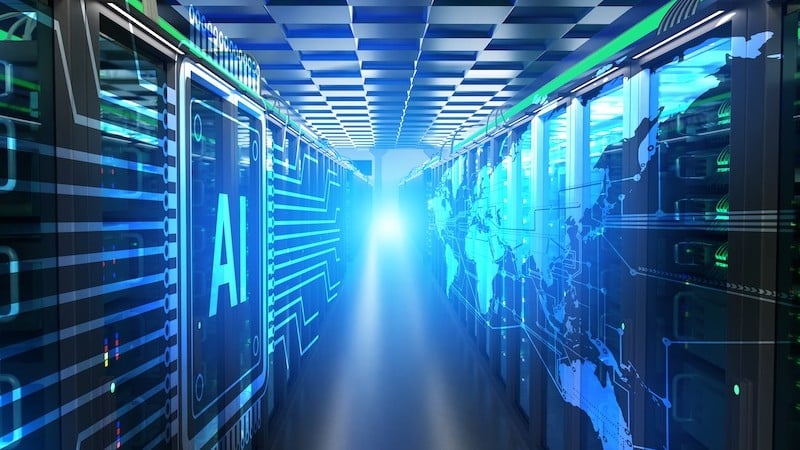
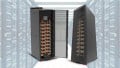
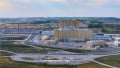
Figure 1. AI data centers require tremendous amounts of power, driving stakeholders to rethink their power delivery architectures. Adobe Stock image (licensed).
This shift is not incremental; it is structural. AI workloads concentrate power demand into fewer, denser zones while compressing deployment timelines. Infrastructure that once evolved gradually must now scale in parallel with compute cycles measured in quarters rather than years.
Electrical architecture is no longer judged solely on redundancy and nameplate capacity, but on its ability to respond predictably under sustained high load and rapid variability. As density increases, inefficiencies that were once tolerable become magnified across the facility, turning architectural assumptions into operational constraints.
From Multi-Stage AC Chains to VDC Architecture
The conventional architecture—medium-voltage transformer, low-voltage AC distribution, and rectification near the load—was built for compatibility, not high-density and high-efficiency. Each conversion stage accumulates loss and heat that must be removed somewhere, typically by expanding existing cooling capability rather than improving topology. Iron-core transformers tied to line frequency impose unavoidable limits on power density, while low-voltage distribution forces high-current copper paths that scale poorly with rack concentration.
These systems embed assumptions about slow aggregate load variation that AI clusters violate. Oversizing becomes a substitute for regulation, and at megawatt scale that approach stops being conservative engineering and starts becoming architectural drag.
Solid-state transformers (SSTs) reject the premise that medium-voltage interfaces must be passive magnetic devices that are made of copper and iron. By dropping a 13.8 kV – 35 kV medium-voltage feed directly into a regulated 400 VDC or 800 VDC backbone, the architecture bypasses the legacy low-voltage AC floor and its intermediate rectification stages.
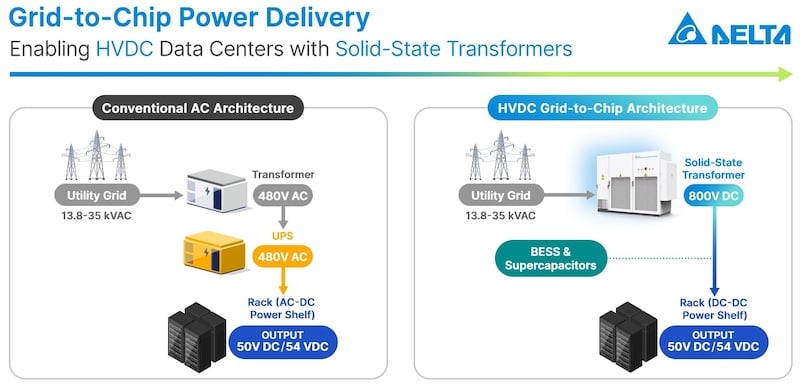
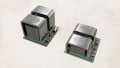
Figure 2. Solid-state transformers (SSTs) enable efficient grid-to-chip power delivery by directly converting MVAC to high-voltage DC power, simplifying the power path and improving data center efficiency.
Eliminating the AC floor shortens high-current paths and materially reduces copper mass and I²R distribution losses at megawatt rack density. This is not an incremental efficiency upgrade. It is a redistribution of where conversion happens and how it is controlled. DC becomes the primary facility domain rather than a localized byproduct near the rack.
Architecturally, an SST integrates an actively controlled medium-voltage front end, high-frequency isolation, and downstream DC regulation into a coordinated platform. In practical MV implementations, this interface is enabled by wide-bandgap devices such as silicon-carbide (SiC) MOSFETs.
Their higher switching frequency supports compact high-frequency isolation and topology simplification, but introduces engineering trade-offs in dv/dt management, EMI containment, insulation coordination, and digital protection strategy. High-frequency magnetics increase specific power density by orders of magnitude relative to line-frequency transformers.
More importantly, digital control operates at bandwidths relevant to AI load dynamics. Voltage regulation, fault response, and power quality become engineered behaviors rather than passive consequences of hardware.
From a benchmarking standpoint, the gains are architectural rather than cosmetic. Eliminating redundant AC stages reduces cumulative conversion loss. Minimizing low-voltage distribution reduces copper mass and I²R heating.
Losses become concentrated in controlled conversion stages that can be cooled deliberately instead of distributed throughout the facility. Trade is explicit: switching devices introduce complexity, but the system gains controllability, density, and scalability.
Modular Scaling and System-Level Implications
Because SST platforms are assembled from repeatable converter blocks, capacity scales through parallelization rather than transformer replacement. Infrastructure can grow in smaller increments aligned with compute deployment instead of leaping between oversized capacity steps.
Distributing power nodes closer to load zones shortens current paths and reduces distribution loss while improving layout flexibility. For AI facilities that expand iteratively, modularity is not aesthetic—it is operational.
Protection philosophy changes with this architecture. Converter-limited fault current invalidates the assumption that high short-circuit levels will clear faults passively. SST systems coordinate sub-cycle current limiting and selective shutdown through embedded control, turning protection into a deterministic timing problem.
Bi-directional power flow and routing are governed by embedded digital control, effectively rendering the MV interface software-defined rather than magnetically constrained. Validation shifts from breaker coordination studies toward verification of control behavior under low-fault-current scenarios. This is a different engineering discipline, closer to embedded systems validation than traditional switchgear design.
Grid interaction follows the same logic. Converter-based MV interfaces behave as controlled current sources rather than passive loads. Harmonics, power factors, and disturbance response are governed by control strategy. Utilities value predictability over theoretical capability, so acceptance depends on demonstrated stability and transparent modeling. An SST must prove it behaves consistently under grid events, not merely that it can.
Integration decisions extend beyond hardware selection. Engineers must explicitly define DC voltage domains, redundancy strategies, communication integrity, cyber security and supervisory control architecture. The power plant becomes a coordinated cyber-physical system in which software and electrical design are inseparable.
Where SST Provides Practical Advantage
SST architecture is most defensible where electrical performance directly affects compute capability: megawatt-scale AI zones with aggressive transient behavior and phased growth. Fast regulation improves voltage stability during load ramps, and modular capacity blocks align infrastructure investment with actual deployment. In these environments, architectural flexibility has measurable economic value.
Beyond performance, SST platforms introduce a different approach to infrastructure planning. Rather than committing to large, monolithic capacity additions, operators can deploy repeatable power modules that scale with demand, reducing stranded capacity risk during early build phases. This modularity supports phased expansion strategies common in AI campuses, where compute clusters are installed iteratively as new hardware generations arrive.
By aligning electrical growth with compute rollout, facilities can manage capital deployment more precisely while preserving headroom for future density increases. The advantage is not purely electrical—it is organizational, enabling infrastructure teams to respond to evolving compute roadmaps without repeatedly restructuring the underlying power topology.
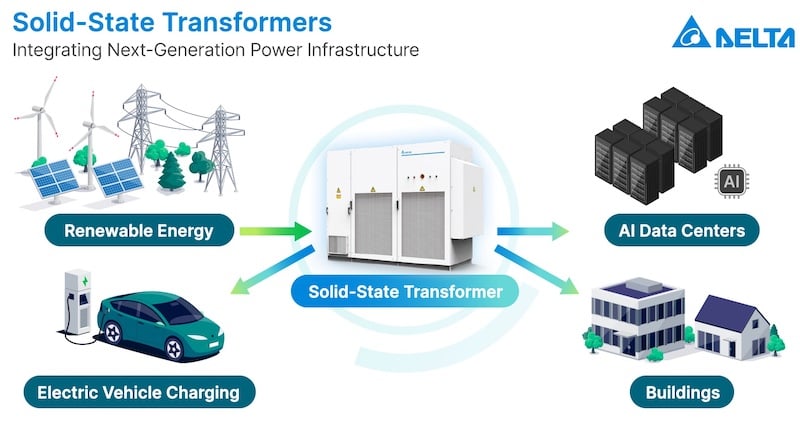
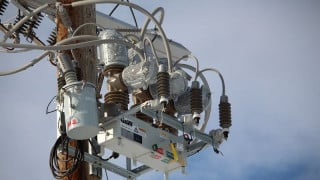
Figure 3. Solid-state transformers play a crucial role in next-gen power infrastructure.
Not every facility operates in that regime. Stable loads, predictable growth, and cost-sensitive deployments may see limited benefit from added control sophistication. Conventional transformers remain appropriate where inertia and simplicity outweigh dynamic performance. SST adoption is therefore a targeted architectural decision, not a universal upgrade path.
Redefining Power Infrastructure for the AI Era
The deeper implication is not the replacement of transformers but the redefinition of electrical infrastructure as an actively managed system. Regulation, protection, and performance become software-governed functions rather than fixed hardware characteristics. Engineering focus shifts from static margin to dynamic coordination.
As AI workloads continue to push density and variability, infrastructure that cannot respond dynamically becomes a constraint. Solid-state transformers represent one expression of a broader transition: power systems evolving from passive utilities into high-performance platforms that must scale and adapt alongside compute.
All images used courtesy of Delta Electronics, except where otherwise noted.