Facebook
 Google
 GitHub
 Linkedin
Wolfspeed Commercializes World’s First 10 kV SiC MOSFET
Compared to IGBTs, the MOSFET delivers greater power density, lower thermal load, and lower costs.
Wolfspeed has introduced the industry's first commercially available 10 kV SiC power MOSFET, targeting grid modernization, AI data center infrastructure, and industrial electrification. The CPM3-10000-0300A is the world's first 10 kV SiC MOSFET, delivering over 300% power density, 50% lower thermal load, and a 30% cost reduction over IGBTs.

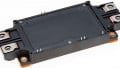
Wolfspeed's 10 kV Bare Die MOSFET. Image used courtesy of Wolfspeed
Why 10 kV, Why Now
Series-stacked IGBT topologies have long dominated medium-voltage power conversion/ Converting power at voltages between 3 kV and 15 kV requires stacking multiple lower-voltage devices in series. Each cell in that stack demands its own isolated gate drive, protection circuitry, and power supply, multiplying component count and failure points with every added cell.
However, the grid was not designed for AI. AI data centers are connecting to the grid at an unprecedented rate, and the power-conversion infrastructure between utility-scale generation and the low-voltage DC rails inside a data center has created a complex, expensive, and inefficient bottleneck.
10 kV silicon carbide (SiC) technology changes the equation entirely by replacing the stacked-cell workaround with a single high-voltage switch that simplifies architecture, reduces component count, and restores efficiency to medium-voltage power conversion.
What the Device Actually Delivers
The CPM3-10000-0300A is a Gen 3, industrially qualified bare-die SiC MOSFET designed for medium voltage and high-power conversion applications. It blocks 10,000 V and carries a continuous drain current of 20 A and an on-resistance of 305 mΩ.
That 305 mΩ RDS(on) at 10,000 V reflects what SiC's material properties make possible. Silicon's critical electric field is roughly ten times lower than silicon carbide’s, meaning a silicon device at this voltage would need a drift layer so thick that on-resistance would be impractical. SiC's superior field strength allows a thinner, more conductive drift layer at the same blocking voltage.
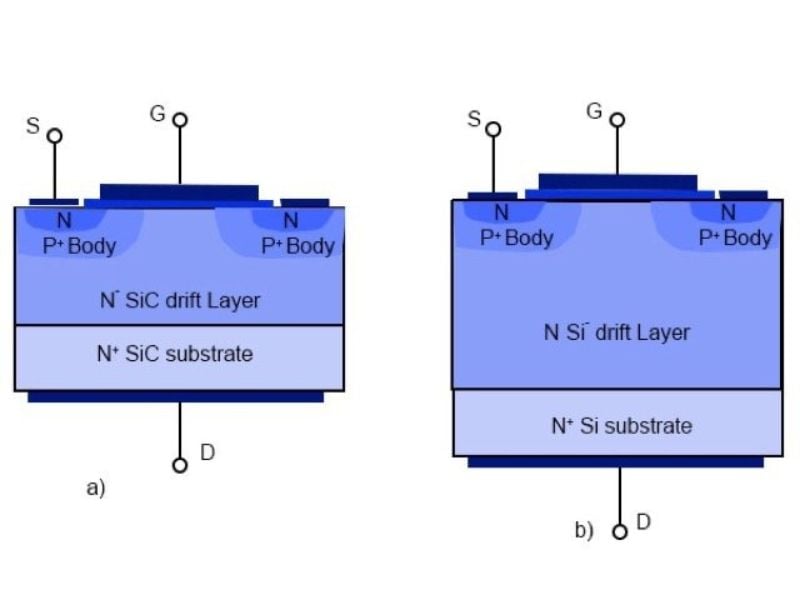
Cross-sectional comparison of MOSFET structures: (a) silicon carbide and (b) conventional silicon (Si). Image used courtesy of Top Diodes
The device supports junction temperatures up to 175°C, enabling operation in thermally demanding systems. It offers a rise time of under 10 ns, enabling operating frequencies up to 10 kHz, which is 16 times faster than conventional IGBT-based systems.
Wolfspeed addresses two failure mechanisms that prevented 10 kV SiC from reaching production. It is the world’s first 10 kV SiC MOSFET to mitigate bipolar degradation, a form of internal wear that caused earlier high-voltage SiC devices to degrade during normal operation. The company also sets a new benchmark for durability and performance with a TDDB lifetime prediction of 158,000 years at continuous 20 V gate bias voltage.
More information about the device can be found in the datasheet.
System Level Impact
The combination of switching speed, efficiency, and reliability translates into three concrete system-level benefits over conventional IGBT-based designs.
Higher switching frequency directly shrinks passive components: inductors, capacitors, and transformers scale inversely with frequency, so the jump from 600 Hz to 10,000 Hz enables a power density improvement of more than 300%.
The device achieves a 99% conversion efficiency. At high power levels, even a 1% improvement in efficiency represents a large absolute reduction in heat dissipation. Less heat means smaller heatsinks, simpler cooling systems, and lower infrastructure cost. This is particularly relevant in data centers, where cooling accounts for a significant share of total facility power.
Higher voltage per switch means fewer devices, fewer gate drivers, and simpler architecture, allowing three-level inverter topologies to be replaced by two-level designs and reducing overall system cost by approximately 30%.
A New Baseline
The commercialization of a 10 kV SiC MOSFET closes a gap that has existed in power electronics for years, not for lack of research, but for lack of a manufacturable, reliable device. Wolfspeed's vertical integration, from SiC crystal growth through thick epitaxy and finished die, is the manufacturing foundation that makes this possible.
As grid operators face simultaneous pressure from renewable intermittency, AI load growth, and aging infrastructure, the timing of this commercialization may prove as significant as the device itself.