Facebook
 Google
 GitHub
 Linkedin
Upgraded MOSFETs Target Power Density, Safety, and Efficiency
Rohm, Littelfuse, and Ideal Semiconductor each introduced high-performance MOSFETs.
Rohm, Littelfuse, and iDEAL Semiconductor have introduced high-performance MOSFETs targeting distinct application challenges. While each device is designed for a different use case, they are all shaped by broader industry efforts to develop more compact, efficient, and reliable power electronics.
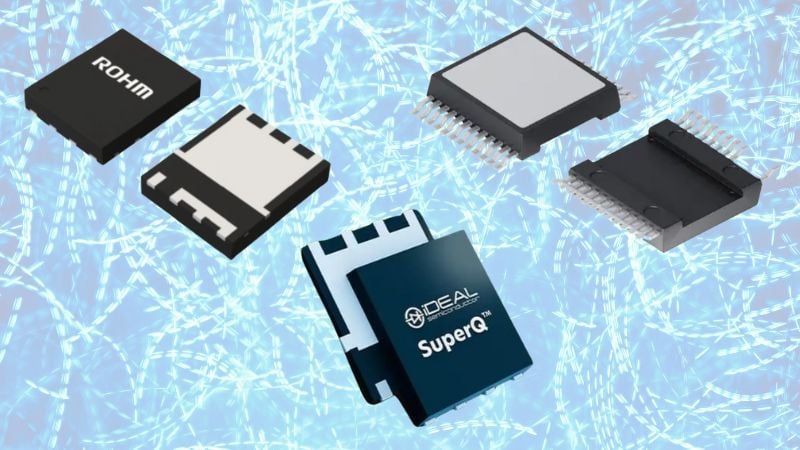
MOSFETs. Images used courtesy of Rohm, Littelfuse, and Ideal
Rohm Improves SOA Performance
Rohm has designed its RS7P200BM to address the growing need for reliable hot-swap power delivery in 48 V AI server architectures. In hot-swap circuits, devices need to safely handle transient inrush currents without thermal failure.
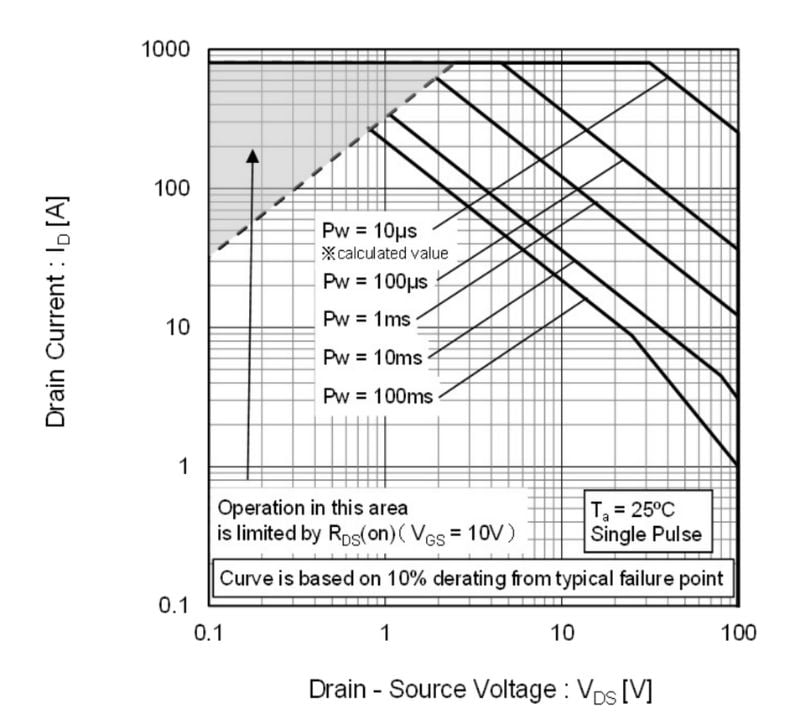
The RS7P200BM maximum SOA. Image used courtesy of Rohm
Rohm built the 100 V, 200 A devices into a 5 x 6 mm DFN5060-8S package. It combines a low on-resistance of 4.0 mΩ with a wide Safe Operating Area (SOA) that supports 7.5 A at 10 ms and 25 A at 1 ms under a 48 V drain bias. By suppressing heat generation during stress conditions, the RS7P200BM reduces system cooling requirements and improves overall power conversion efficiency. Compared to ROHM’s earlier 8.0 x 8.0 mm RY7P250BM device, this model also offers greater mounting density.
The RS7P200BM is designed to support the data center trend toward compact, efficient 48 V power systems.
Littelfuse Increases Current Density With Topside-Cooled 200 V MOSFET
Littelfuse has launched its MMIx1T500N20x4 family of X4-class ultra junction power MOSFETs.
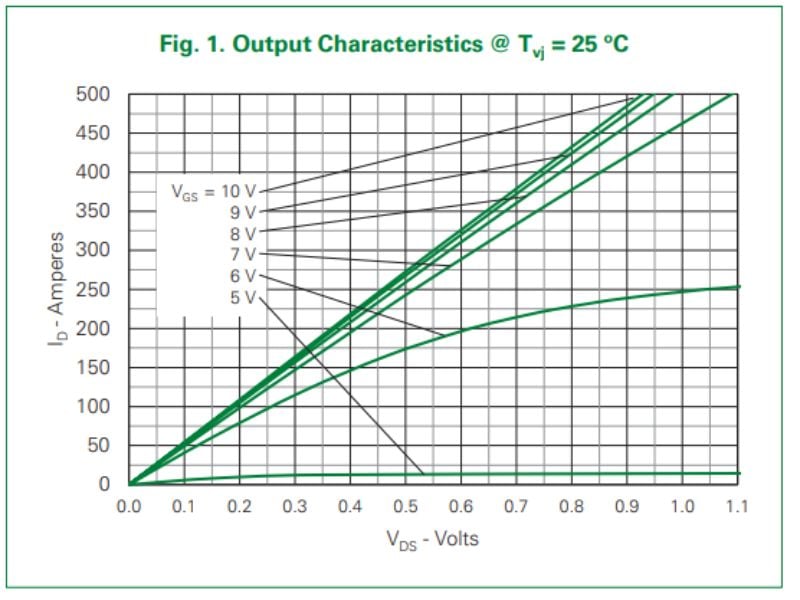
MMIx1T500N20x4 output characteristics. Image used courtesy of Littelfuse
A 200 V, 480 A MOSFET designed for industrial, charging, and energy storage applications, the device features an ultra-low RDS(on) of 1.99 mΩ and uses a ceramic-based SMPD-x package optimized for topside cooling. This combination reduces power losses and improves thermal performance, with the package offering a thermal resistance of 0.14°C/W and 2500 V RMS isolation. Littelfuse claims these characteristics are beneficial in high-current environments that rely on multiple paralleled MOSFETs.
The MMIx1T500N20x4 mitigates this by allowing designers to consolidate parallel paths into a single high-current device, reducing part count and improving reliability. Additionally, its low gate charge (535 nC) reduces gate driver demands, simplifying control circuitry. The net result is a device that enables higher power density, streamlined layouts, and longer system lifespan.
Available in both tube and tape-and-reel packaging, the MMIx1T500N20x4 is currently available for use.
Ideal Semiconductor High SCWC SuperQ Devices
Ideal Semiconductor’s SuperQ MOSFETs focus on solving short-circuit withstand capability (SCWC) in battery circuits.
Specifically, the iS15M2R5S1T, a 150 V device with a 2.5 mΩ on-resistance, is engineered for 72 V+ battery management systems used in e-mobility and power tools. In internal testing, the device sustained an 800 A peak short-circuit event, which Ideal states is 1.4x higher than competitors with identical voltage and resistance ratings. Ideal attributes this resilience to a proprietary cell architecture that widens the conduction region without compromising structural integrity.
By improving SCWC, the SuperQ platform lets designers halve the number of paralleled devices required to meet safety standards, reducing both PCB complexity and bill of materials costs. Meanwhile, efficiency is preserved through the device’s low conduction losses, which minimize thermal dissipation and extend battery runtime.
The SuperQ platform is already in volume production with variants up to 200 V.
Diverging Paths Toward Power Density
Rohm, Littelfuse, and Ideal Semiconductor each took different yet successful paths to improving MOSFET design. Rohm focused on SOA, Littelfuse on current capacity and thermal efficiency, and Ideal on short-circuit survivability. Collectively, these devices offer system designers more flexibility to address size, efficiency, or fault tolerance as primary design constraints in their next-generation power systems.
Related Content