Facebook
 Google
 GitHub
 Linkedin
Pursuing Cool: Understanding Cauer and Foster Thermal Chain Models
When designing and analyzing power electronic circuits in simulation tools, ensuring that such systems are kept sufficiently cool requires accurate thermal models. Engineers widely use lumped-element thermal models such as Foster and Cauer chains to predict device temperatures and heat flow. While these chains look simple, they have subtle complexities that can undermine model accuracy and thermal behavior.
This article is published by EEPower as part of an exclusive digital content partnership with Bodo’s Power Systems.
With the demand for ever-greater efficiency and reliability in power electronics, the need for accurate thermal models in simulation software is critical to improve thermal management. With growing computing power, high-resolution thermal FEM models of single devices are becoming increasingly feasible, enabling engineers to capture detailed thermal behavior and optimize cooling. However, such model complexity can hinder simulations at the system level, making efficient, performance-optimized models the preferred choice. In this field, thermal circuit models, especially chain-like networks of the Cauer and Foster type, have established themselves as a standard and powerful tool for modeling heat transfer dynamics and semiconductor junction temperatures. Despite their simple structure, these models are prone to typical pitfalls, often rooted in a misunderstanding of the basic principles behind Cauer and Foster chains.
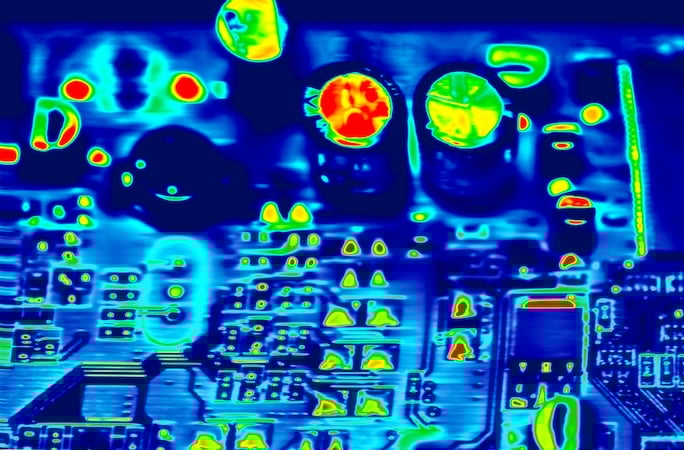
Image used courtesy of Adobe Stock
Understanding Cauer and Foster Thermal Chain Models
A chain-like circuit of the Cauer type is closely related to a physical representation of a thermal system. Derived from discretizing the one-dimensional heat equation, Cauer chains model the thermal path as a network of thermal resistances (Rth) and thermal capacitances (Cth). From this perspective, it becomes clear why each R-C pair in a Cauer chain can be thought of as representing a physical layer within the device. This direct correlation allows intuitive adjustment of the model based on material properties and geometric dimensions. For example, in a power semiconductor device, the heat generated at the junction must pass through several layers before dissipating into the ambient environment. By representing each layer with an R-C pair, the Cauer thermal chain captures the heat flow dynamics accordingly. Choosing more or fewer R-C pairs adjusts the resolution at which the one-dimensional heat path is discretized, allowing a balance between model complexity and the desired level of detail.
In contrast, Foster-type thermal chains offer an abstract approach to modeling temperature response, where individual R-C pairs are not related to the physical layers. Instead, the entire set of R-C pairs collectively represents the full thermal path, terminating at a constant temperature. There is a clear mathematical procedure for transforming a set of Foster Rth and Cth values into a corresponding set of Cauer Rth and Cth values, and vice versa, with flexibility in the arrangement of the Foster R-C pairs. As visualized in Figure 1, Foster chains lack a direct connection to the physical heat equation but, despite their abstract nature, they are widely used in practice because of their mathematical simplicity in describing thermal response to a step change in power input. This simplicity allows Foster Rth and Cth values to be extracted through curve fitting of the measured transient thermal impedance Zth curve. Yet, common pitfalls in measuring the Zth curve and obtaining suitable Foster Rth and Cth values from it are not always easy to spot. Here, we highlight a few key challenges and present solutions.

Figure 1. Relationships between the Cauer model, the Foster model, and the physical perspective on describing thermal paths. Image used courtesy of Bodo’s Power Systems [PDF]
Common Pitfalls in Measurement and Application
Analogous to electrical resistance, defined by Ohm’s law as the ratio of voltage across a resistor to the current flowing through it, R=U/I, thermal resistance can be characterized by the temperature difference across a thermal resistor relative to the heat flow passing through it, Rth=ΔT/P. For the transient case, it may then seem intuitive to treat individual parts of a thermal path as single resistor-like entities, that is, as one-port networks. This would imply, however, that the division Zth(t)=ΔT(t)/P results in a unique transient thermal impedance curve for the thermal path in question. Unfortunately, this is not the case. In fact, the shape of the Zth(t) curve can vary significantly depending on how the reference temperature at the end of the thermal path changes during the measurement. Figure 2 illustrates how ΔT(t) differs for two identical physical and thermal paths represented as Cauer chains, depending on how the path is continued. Since Cauer chains are internally connected to a thermal ground, they go beyond the concept of a simple one-port network.
Foster chains, in turn, are one-port networks that produce two identical temperature profiles when used in place of the Cauer chains shown in Figure 2. Foster chains should not be connected in series, as this fails to accurately capture the physics of thermal heat flow along the path, resulting in a flawed model for representing thermal behavior. Recognizing that Foster chains must represent the entire thermal path rather than individual segments highlights the importance of maintaining a constant temperature at the end of the path when measuring Zth(t) curves. While this may seem less intuitive, the ‘entire path’ can also refer, for instance, to a junction-to-case path–as long as the temperature at the case is kept constant during measurement. Such a measured curve between the junction and the case can then serve as the basis for deriving Cauer R-C parameters through a well-fitted Foster model. This resulting Cauer chain, with its close relation to the physical heat equation, can then be incorporated into a larger Cauer model that extends, for example, from the junction to the ambient environment. This avoids the series connection of Foster chains, which is incorrect, as described previously. Next, we dive into what it means to obtain a well-fitted Foster model.

Figure 2. A simple PLECS model demonstrating how identical thermal paths, represented as Cauer chains, show different thermal behavior depending on how the path is continued. Image used courtesy of Bodo’s Power Systems [PDF]
Subtleties in the Curve Fitting Process
The simplicity with which the Foster model describes Zth(t) also brings with it certain common pitfalls in the curve-fitting process. Given the mathematical function used to fit the Foster model to an impedance curve, Zth(t)=Σi Ri (1 – e-t/τi), with time constants τi =Ri Ci, it becomes evident that a single term in the sum can be split into two separate contributions with the same τ value without changing the shape of the curve. This subtlety can cause the curve-fitting algorithm to return multiple τ values that are very close to each other. In practice, this can become problematic when Foster parameters are provided for a thermal path intended for inclusion in an extended thermal network, such as junction-to-case Foster parameters. When these parameters are converted to a Cauer model for integration into a larger path, unrealistically large thermal capacitances can significantly impact the modeled heat flow and, consequently, the predicted junction temperature. One example is shown in Table 1, taken from an official datasheet of an IGBT device. Due to the closeness of the τ3 and τ4 values, the derived Cauer parameters result in a total thermal capacitance of 25 MJ/K–equivalent to around 65 tonnes of copper–significantly delaying heat flow from junction to case.
Table 1. Example Foster parameters for Zth,JC with close τ3 and τ4 values, provided in an IGBT device datasheet.
| i | 1 | 2 | 3 | 4 |
| ri [K/W] | 0.0039 | 0.04368 | 0.03203 | 0.00789 |
| τi [s] | 8.56Ε-4 | 0.0279 | 0.0913 | 0.0914 |
Another subtlety that arises from the Zth(t) fit function from the Foster model is that an additional R-C layer with a large τ and a small R can be added to the Foster chain without noticeably changing the shape of the Zth(t) curve. However, suppose the curve-fitting algorithm introduces an additional Foster layer in this way. In that case, it can lead to unrealistically large thermal capacitances when converted to a Cauer model, potentially causing a substantial delay in heat flow.
PLECS has a solution to avoid these subtle pitfalls when fitting a Foster model. With the release of PLECS version 4.9, we have introduced an algorithm that automatically detects these issues and allows users to fix them with a button. Figures 3a and 3b demonstrate how PLECS detects both issues in the example Foster parameters from an official datasheet and provides a fix.

Figure 3a. The new ‘Fix Coefficients’ feature in PLECS 4.9 automatically detects issues in Foster model parameters, highlighted in red. Image used courtesy of Bodo’s Power Systems [PDF]

Figure 3b. Preview of the fixed values displayed in a separate window. Image used courtesy of Bodo’s Power Systems [PDF]
The Next Level: Modeling Thermal Crosstalk
Building on the foundation of thermal chains, engineers have developed sophisticated networks to model more complex behavior, such as thermal crosstalk, where the heating of one chip affects the temperatures of neighboring chips. It is important to remember that this approach, which uses arbitrarily branched thermal chain networks, is valid only when assuming effective one-dimensional heat flow along the physical paths. Additionally, isolated measurement of these paths, with reference temperatures needing to be kept constant, is necessary to determine accurate R-C values for the chains. Given the practical challenges in achieving these conditions, we present a more accessible approach to modeling thermal cross-coupling using thermal chains.
Following a similar approach as with the choice between the physically-based Cauer model and the more abstract but useful Foster model, we aim for a black-box approach to thermal crosstalk, capturing thermal interactions without detailing the physical mechanisms by which nearby heat sources influence each other. Assuming that contributions from heat sources can be separated, we can ask how a unit step change in power applied at one chip affects the transient temperature increase at another. This approach naturally leads to the mathematical description of a thermal impedance matrix, where each matrix element provides the exact answer to this question. Moreover, this convenient matrix description allows for the direct and straightforward measurement of each transient thermal impedance matrix element.

Figure 4. Since PLECS 4.8, the Thermal Package Description option allows users to define a thermal impedance matrix, enabling the modeling of thermal crosstalk through the off-diagonal matrix elements. Image used courtesy of Bodo’s Power Systems [PDF]
While the concept of using thermal impedance matrices is not new in thermal modeling, a key challenge is to accurately account not only for the correct temperature behavior but also for the correct heat flow leaving a thermally coupled system so the thermal path can be extended in a physically meaningful way. In PLECS, we address this challenge by embedding Cauer chains within a state-space representation derived from a user-defined impedance matrix. The way in which the state-space representation is constructed ensures that the heat flows measured individually from each device are accurately recovered. Figure 4 shows how the thermal impedance matrix is integrated into PLECS within the Thermal Package Description window. By clicking on individual matrix elements, users can provide Foster or Cauer parameters to define each Zi,j(t) element.
A Simply Efficient Tool
Despite (or perhaps because of) their simplicity, thermal Foster and Cauer models are widely used as highly efficient tools for analyzing the thermal behavior of power electronic systems. Understanding the physical basis of the Cauer model and the abstract nature of the Foster model is invaluable for avoiding common pitfalls in measurement, curve fitting, and integration of thermal models. Recent advancements in PLECS include inbuilt mechanisms to detect common issues in modeling thermal circuits, support the development of more reliable models, and greatly simplify the modeling of thermal crosstalk. The pursuit of cool, after all, is about more than just managing heat–it is about using these models to improve reliability and performance, setting new standards for innovation in power electronics.
This article originally appeared in Bodo’s Power Systems [PDF] magazine.