Facebook
 Google
 GitHub
 Linkedin
Top 5 Ways Drone Inspections Boost Safety and Efficiency
Drone inspections can improve safety, cut costs, and deliver faster, data-rich assessments across power generation and transmission, transforming how operators maintain critical assets.
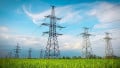
Power generation and transmission infrastructure are widely spread and difficult to inspect, often involving risky areas. Crews may have to climb wind turbines, walk under high-voltage transmission lines, cross solar farms in extreme heat, or access offshore power rigs during sudden weather changes. These operations are time-consuming, risky, and expensive due to downtime or helicopter usage.
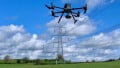
Drone inspections completely change the game. Unmanned aerial vehicles (UAVs) allow operators to collect more data, survey areas regularly, and keep teams safely on the ground. In-flight thermal, LiDAR, and high-resolution cameras provide better insight into equipment health, without the risks and delays of traditional inspections. Drones have become essential tools for utilities and renewable power operators. They enhance safety, accelerate inspection workflows, and improve asset performance.
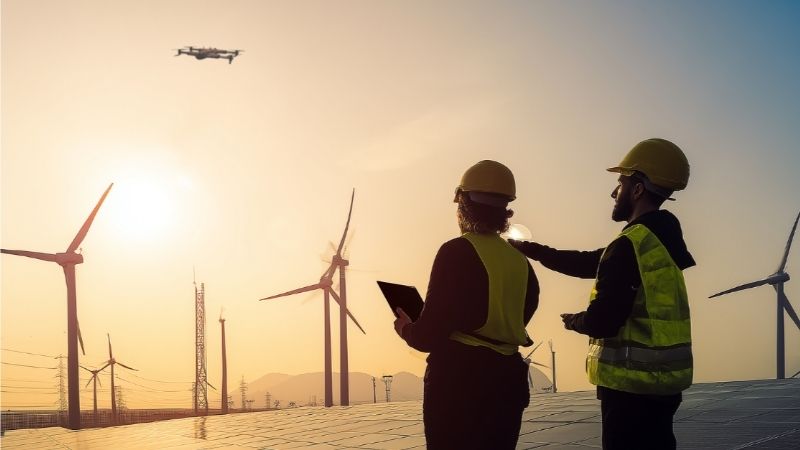
UAV inspections impact the power sector.
1. Enhanced Worker Safety
Conventional inspections usually expose crews to hazardous conditions. The risk rapidly accumulates, whether it is the work of climbing to the top of transmission towers, the rope-work of the wind turbines, or trying to squeeze into close spaces on power rigs.
Old Safety Risks
- High voltage systems: Heights and exposure to energized equipment
- Climbs on wind turbines: Violent winds, rotating machines, and high ladders
- Offshore power rigs: Small space for work, weather, unpredictable, and dangerous materials
- Substations: Small, hot-blooded, and dangerous infrastructure
How UAVs Reduce These Hazards
- Employees remain on the ground: Drones fly close to the asset, and technicians will not need to risk their lives on towers, ladders, and platforms.
- Reduced the number of rope-access or climbing jobs: Much of the work on blades and tower inspections can now be undertaken wholly using UAVs.
- Reduced reliance on helicopters: Low-altitude flights previously carried out by helicopters are now performed by drones, with less human exposure to air hazards.
- Immediate hazard identification: Teams spot issues through live video or thermal feeds without approaching the structure.
Industry Examples
Utilities like Duke Energy and turbine operators such as Vestas report fewer field-exposure hours and reduced hazardous climbs due to UAV inspections.
Overall Safety Impact
The change is not a complicated one; there are fewer climbs, less risky places, fewer incidents. Drones allow the substitution of risky operations with more remote processes that keep the crews safe without providing less accurate and reliable information.
2. Faster and More Frequent Inspections
Time saving is one of the most obvious benefits of drone inspections. Manual inspections are slow since crews have to construct gear, climb constructions, liaise with safety departments, or wait until the weather is good. UAV surveys commence nearly as soon as they arrive at the location.
Table 1. Manual vs drone (generalized comparison)
| Asset Type | Manual Inspection | Drone Inspection | Change |
| Wind turbine blades | Requires lengthy climbing and setup | Completed in a short flight | Much quicker |
| Transmission lines | Takes extended periods to walk or drive through | Covered efficiently in a single flight path | Significantly faster |
| Solar farm thermal checks | Slow, row-by-row physical scanning | Rapid aerial thermal sweep | Dramatically quicker |
| Substation walkthroughs | Requires careful, slow movement | Quick scanning with multiple angles | More efficient |
Why This Speed Matters
- Rapid understanding: Teams can access imagery and findings earlier and make faster decisions.
- Low preparation time: UAVs require a small setup and are capable of working within small windows.
- Increase the number of inspections annually: The operators can switch to regular instead of occasional monitoring.
- Reduced disturbance: Many inspections do not involve the closure of assets.
Real-World Effect
The utilities that employ UAV checks record significantly lower durations between the detection of a defect and its solution. Since drones are less complex to implement, the teams can do more frequent inspections and identify problems before they turn into outages or significant repair efforts.
Speed is turned into a competitive advantage: reduced waiting times, reduced downtimes, and a better understanding of asset health.
3. Cost Reduction and ROI
Drones assist in lowering the costs associated with the inspection in terms of labor, equipment, traveling, and downtime. Conventional approaches tend to demand massive crews, departmental climbing crews, costly lifts or helicopters, all of which are costly.
Where UAVs Reduce Costs
- Reduced labor cost: Reduced staffing and little climbing involve reduced specialized work.
- Minimal equipment is needed: No scaffolds, lifts, or aerial platforms are needed when performing most inspections.
- Less travel: Small drone teams will be able to serve remote locations without set-ups.
- Low downtime: Numerous assets remain active during the operation of the drones, and the production does not have to be lost in vain.

Drones lower inspection costs for labor, equipment, travel, and downtime.
Mini ROI Model—Generalized
Step 1: Faster inspections → Saves man-hours and minimizes working hours.
Step 2: Earlier fault detection → The problems become less costly to resolve at an early stage.
Step 3: Less unplanned downtime → Operators will not have to face losses related to unexpected failures.
Step 4: More strategic maintenance planning → Preventive and predictive maintenance strategies substitute emergency responses.
Example: Solar Farms
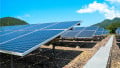
Drone thermal imaging by solar operators allows identifying poorly performing strings or damaged panels much earlier than they would be discovered during a manual examination. Early detection of these problems prevents loss of power production and saves the huge sum of money spent on massive repairs to the system.
Overall ROI Impact
The economic impact of UAV inspection increases in the long run. Power and energy companies benefit from saving time and reducing disruptions, as well as improved results in maintenance. This saves significant money compared to paying more money for the traditional, labor-intensive strategies.
4. Advanced Data Collection & Analytics
Beyond safety and speed, drones excel at delivering rich, multi-layered data. Traditional inspections rely heavily on human observation. UAV inspections leverage advanced sensors that reveal details invisible to the naked eye.
Table 2. Key technologies in modern UAV inspections
| Technology | What It Captures | Common Use |
| Thermal Imaging | Heat anomalies, hotspots | Solar farms, transformers, turbines |
| LiDAR | Precise 3D mapping | Transmission corridors, vegetation management |
| Multispectral Imaging | Reflectivity, panel health, and environmental metrics | Solar fields, land analysis |
| High-resolution Cameras | Detailed visual defects | Blades, towers, substations |
Why These Tools Matter
- Erosion of the blade is detected at an early stage and does not spread.
- Detect small corrosion or rust, which may not be visible at the ground level.
- Encroachment of spot vegetation on transmission paths.
- Fault test overheated parts in the solar strings.
- Offer regular data on tracking long-term assets.
AI + Drone Data
Nowadays, AI-based tools are used by many operators that automatically indicate:
- Cracks
- Hotspots
- Corrosion
- Loose hardware
- Erosion
- Alignment issues
It saves time by having to watch footage manually and also provides more consistent results.
Digital-Twin Integration
The data about drones is directly used in the digital twins virtual models of wind turbines, solar arrays, or transmission systems. Under regular UAV check:
- The model is continually updated.
- Overlapping of defects is done automatically.
- Predictive maintenance is more precise.
- It is possible to make decisions before they happen and not reactively.
The Value of Better Data
The inspection type UAV offers a detail that could not be matched with the manual inspections. Operators learn much more, analyse faster, and have a better perception of asset health-informed long-term planning.
5. Rapid Storm Response & Emergency Inspections
Where storms cause damage to power infrastructure, speed and accuracy are important. Ground crews can have difficulties accessing broken lines, and helicopters can be grounded because of weather conditions. UAVs are a safer and quicker alternative to inspections.
How a Drone-Based Storm Response Typically Works
Step 1: Deployment → The drone teams are also fast in arrival and are launched in affected zones. They do not require well-marked roads and huge machinery.
Step 2: Assessment → UAVs survey transmission lines, substations, or turbine farms to detect problems, including:
- Broken conductors
- Bent or leaning poles
- Flooded equipment
- Blade damage
- Vegetation hazards
- Fallen structures
Step 3: Real-Time Visibility → Captured data and live feeds enable the utilities to have an idea of the extent of the damage nearly instantly.
Step 4: Prioritization → The most pressing problems are sorted by the operators, including the threats to the population's safety or the equipment that may lead to further failures.
Step 5: Crew Dispatch → Repair teams go directly to the critical points, saving time wasted in searching for faults.
In many areas, utilities have reported that drone-based emergency inspections tend to bring sanity and order into a disorganized situation. UAVs are useful in minimizing the time spent on outages and avoiding extra hazards by identifying issues earlier and showing teams the most effective routes.
Conclusion
The development of drone inspections has become one of the turning points in the current power operations. They minimize the exposure of workers, accelerate inspection processes, reduce expenses, increase the quality of data, and reinforce storm response processes. The UAV inspections provide the power companies with a more intelligent and safer approach to maintain their property.
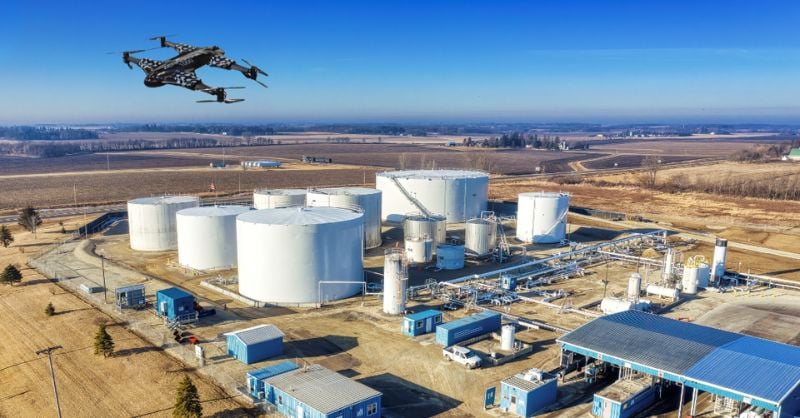
A drone inspection.
These benefits have multiplier effects. Drones will be even more necessary as organizations will depend increasingly on predictive maintenance, data-driven planning, and digital twins. Organizations that adopt UAV inspections are now placed in a stronger position in terms of reliability, a safer safety culture, and performance, and more effective performance in the long run.
Getting down to the use of drone inspections to support your power operations, in case you are willing to explore the idea, begin by taking a closer look at the applications and tools that can be used.