Facebook
 Google
 GitHub
 Linkedin
Pushing BESS Boundaries: Energy Density, Security, and VPPs
Battery energy storage system providers unveil technical improvements and fresh features.
From energy density improvements to operational security, the latest battery energy storage systems (BESS) bring significant advances to the market.
Will this BESS help stabilize power in Southern California? Video used courtesy of Southern California Edison
BESSes are increasingly vital in the global transition to intermittent wind and solar resources, offering the ability to discharge excess energy during peak demand. New estimates from IDTechEx report a fourfold increase in lithium-ion BESS installations from 2021 to 2023, led by the U.S. and China.
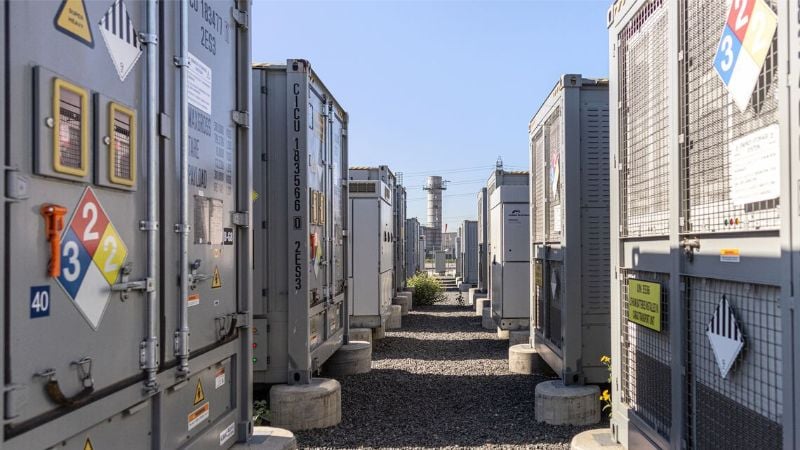
Containers in Southern California Edison’s 537.5 MW energy storage project. Image used courtesy of SCE/by Ernesto Sanchez
An Energy Storage System With Unmatched Energy Density
China-based Envision Energy has debuted its grid-scale energy storage system with an industry-leading energy density: 541 kWh per square meter.
After incorporating larger-capacity cells and optimizing performance, the system marks a substantial improvement from Envision’s earlier products, advancing from 315 Ah battery cells to 700 Ah units topping 8 MWh. It also offers a 96% round trip efficiency, a 16,000 cycle life (up from 12,000 previously), and a 1,500-2,000 V range, supporting two to eight hours of storage.
The system’s 20-foot containers house lithium-iron phosphate cells from Envision’s strategic partner, Japan-based battery manufacturer AESC.
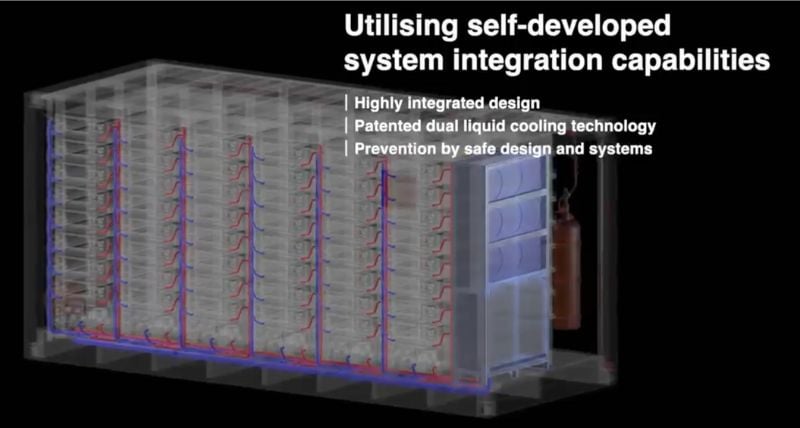
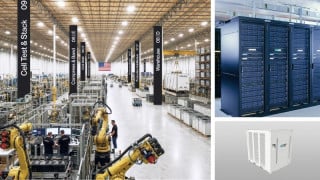
Envision’s ESS solutions. Image used courtesy of Envision Energy
The product is the latest addition to Envision’s energy portfolio, which includes large wind turbines and an artificial intelligence-enabled operating system pairing its ESS with smart grids.
Additionally, Envision expanded to the U.K., deploying its two-hour ESS across two projects totaling 82.9 MW/165.8 MWh of capacity.
California Unlocks 537 MW Energy Storage for Grid Reliability
Southern California Edison (SCE) has installed three ESSs with 537.5 MW of capacity—enough to power over 400,000 homes. The project spans three sites near existing substations. Each site has hundreds of containers, delivering up to four hours of output when fully charged.
SCE’s Reliability Utility Owned Energy Storage project was conceived in 2021 after California officials issued an emergency order directing utilities to add more capacity beyond their 15% resource adequacy reserves. This came after triple-digit heatwaves inflicted unprecedented strain on the state’s power grid, which lacked enough storage capacity to accommodate demand as customers cranked up their air conditioning.
Today, SCE’s growing portfolio of grid-connected batteries can quickly respond to the California Independent System Operator’s calls for capacity in high-demand events, including heatwaves. As of mid-2024, the utility oversees 3 GW of storage resources and has procured or installed another 8.1 GW. It plans to add 400 MW by 2028.
An AC Block with Enhanced Security and Sustainability
Finland-based Wärtsilä has expanded its BESS lineup with Quantum3, an energy storage system adding energy density improvements, beefed-up cybersecurity for the battery management system (BMS), and other features.
Quantum3 is an AC block, a relatively new category of storage products integrating batteries with power conversion systems. Wärtsilä’s offering uses string-based inverters to supply decentralized control with high efficiency and consistent availability. The string inverters pair with the company’s digital energy management system for fleet-level visibility and control.
Wärtsilä’s BMS brings enhanced cybersecurity functions, and Quantum3 adds a fire-proof design held in a 20-foot intermodal container. The product also provides sustainability features with low noise and an efficient cooling system.
_and_digital_energy_management_platform_(right).jpg)
Wärtsilä’s Quantum3 battery storage container (left) and digital energy management platform (right). Images used courtesy of Wärtsilä Corporation
Distributed Energy Management System for Virtual Power Plants
Kentucky-based Virtual Peaker will combine its distributed energy resource management system (DERMS) with California’s FranklinWH’s home energy products. Two utilities have deployed the integrated solution, including Oregon’s Portland General Electric for its smart battery pilot program.
This combination increases flexibility for virtual power plants, which tap into distributed energy resources like rooftop solar panels and home EV chargers to balance loads when needed. Utility customers usually get a financial incentive for participating.
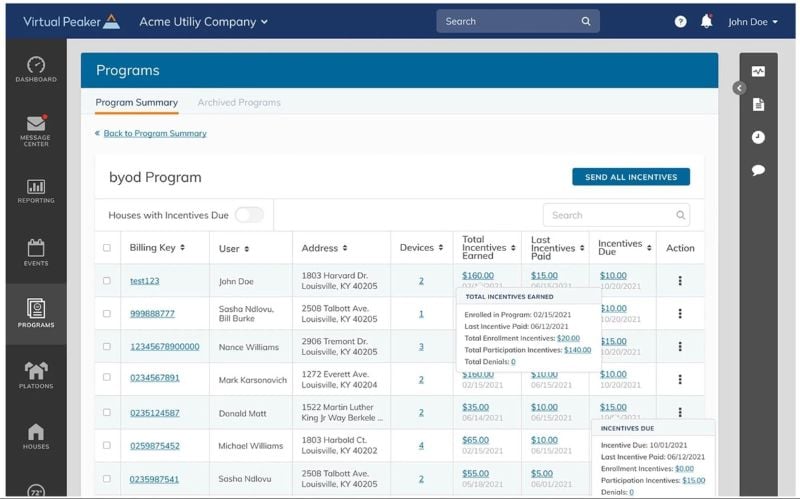
Virtual Peaker’s DERMS utility portal. Image used courtesy of Virtual Peaker
FranklinWH’s battery storage system provides energy flow balancing so utilities can better manage changing grid conditions, while Virtual Peaker’s grid-edge DERMS software manages loads efficiently. The platform includes a machine learning function and real-time control to support demand response programs.