Facebook
 Google
 GitHub
 Linkedin
Smart Motor Control Powers A New Era of Industrial Productivity, Efficiency, and Sustainability
Are you listening to what your motors are telling you? New motor control systems allow you to act on data insights to improve power efficiency, reduce maintenance, and minimize unnecessary downtime.
Motor controls have come a long way since their invention. Wide adoption in the early 20th century transformed industry by improving productivity in manufacturing, public utilities, and buildings. The impacts and benefits continue.
Beyond Start and Stop
Today, a new revolution of sorts is taking place. The controls needed to run the motors safely and reliably to operate the associated equipment are undergoing rapid digitalization. Once static and silent motor controllers meant only to turn and off the motor (and protect it if overloaded) have become dynamic devices that give a voice to what is happening with the motor and connected equipment.
What can we learn from these advanced motor controllers? They can tell us data-driven insights about load performance, including when devices need attention, energy use, and more. A far cry from being just an on/off switch, motor controllers now function to monitor the equipment's performance. They can house embedded, data-driven intelligence powerful enough to usher in a new era of industrial productivity, resilience, and efficiency.
Motor Control Concepts Applied to Non-Motor Loads
In fact, modern motor controllers are so versatile that they are just as applicable for non-motor loads to perform advanced load management functions. The benefits of these transformative load management capabilities cannot be understated.
For instance, in the context of lighting, load management could include using smart lighting systems to adjust brightness based on occupancy or natural light, thereby reducing overall energy consumption.
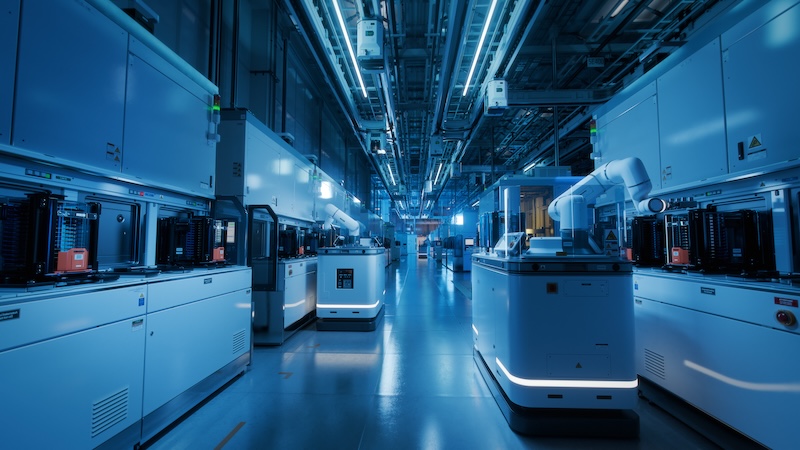
Lighting control opportunities increase as robot adoption increases. Image used courtesy of Adobe Stock
At Schneider Electric, we are celebrating a century of leadership in motor control as our TeSys brand of load management solutions turns 100 years old. We are also celebrating how technological breakthroughs will allow the industry to turn challenges into opportunities.
How an Aging Workforce Opens New Doors For The Entire Workforce
The National Association of Manufacturers fears that 1.9 million manufacturing jobs are expected to be unfilled over the next decade “if we do not inspire more people to pursue modern manufacturing careers.” What’s more, “brain drain” is a real thing, and most manufacturing firms are worried about this widespread “loss of institutional and technical knowledge.”
Where others see a pressing challenge, we see opportunity for OEMs and system integrators. As we enable the next generation of machines with embedded intelligence, we can open the door for more system integration and machine design projects.
It is worth noting, too, that the digitization of industry is essential for attracting a cadre of digital-native workers (such as electricians) who expect seamless, frictionless experiences with the technology they use to carry out their jobs. Thanks to digitalization and automation, this new generation of electricians can get up to speed and get trained with more digital, easy-to-install, and connected devices.
Easy Embedded Intelligence
This embedded intelligence does not have to be complex. It can comprise simple data insights that nevertheless go a long way toward making better machines and enabling optimal performance without the deep expertise traditional machines require. You could say that integrating connectivity into motor solutions enables an “easy button” for machine monitoring. Workers can see data on what’s happening with the motor and identify problems more quickly before a machine issue shuts down a line or industrial process.
An example of this is TeSys island, an intelligent motor controller that combines:
- Contactor
- Overload relay
- IO
- Advanced measurement
- Protections
This is a compact, all-in-one device that’s simple to wire. It has built-in connectivity that boosts the operator’s productivity by easing the installation process and reducing connectivity time.
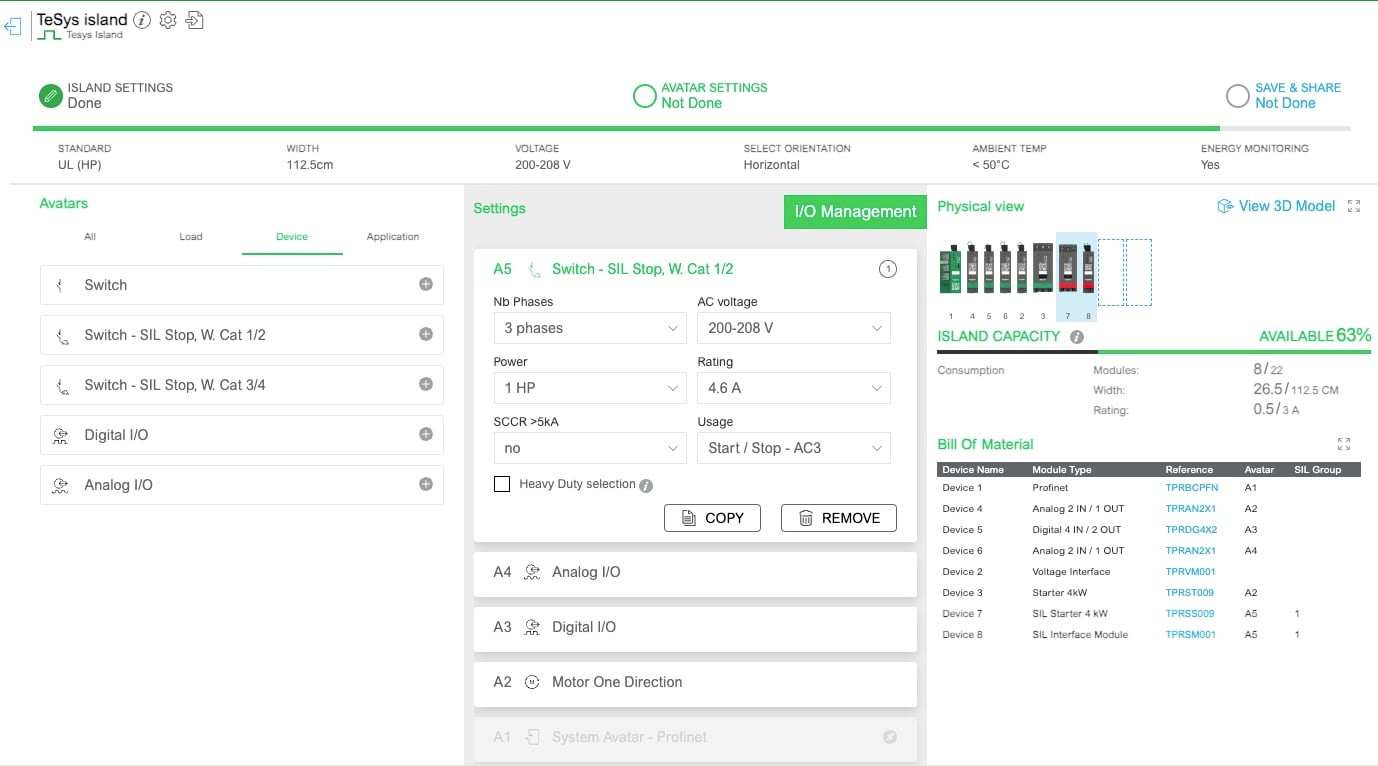
TeSys island system online configuration tool. Image used courtesy of Schneider Electric [click to enlarge]
Visibility to machine performance is readily available to improve worker productivity. Whether across a production line or within a building, facility managers turn to smart motor controls to operate buildings more efficiently and, in many cases, remotely.
A Practical Example: Load Shedding
Think about load shedding, for instance. Many facilities still rely on a person running around to turn lights on and off to realize energy efficiencies and/or regulate temperature flow.
With embedded connectivity and intelligence, motor controllers can handle load management, shedding unnecessary loads remotely and enabling differentiated management for different types of loads. The true transformation here is better, more precise control of loads.
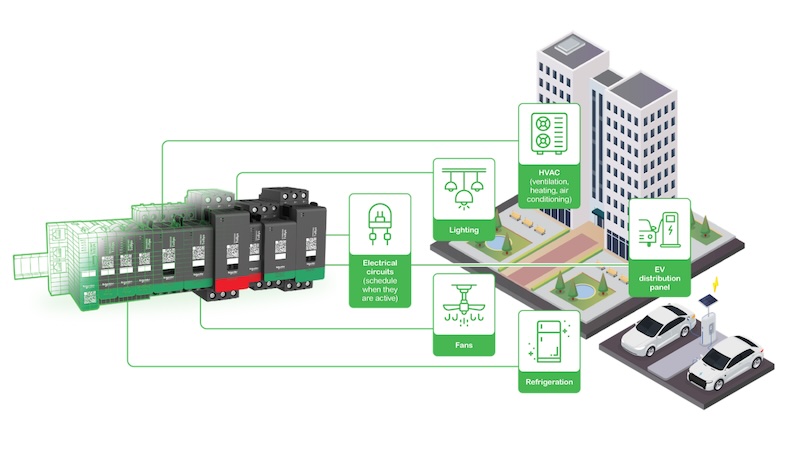
TeSys island system applied to building power control. Image used courtesy of Schneider Electric
In this new world of industry, OEMs and system integrators can stand at the forefront of innovation wherever machines are used. Parker Precision Automation, a full-service electrical controls and automation company, is one such example. Due to labor shortages, their customers often have trouble finding and staffing skilled operators and maintenance technicians.
By leveraging TeSys island, Parker empowers its customers to realize smarter, more efficient machines. They monitor critical equipment operations, deliver instant alerts, provide data-driven insights, and facilitate remote management. These systems provide visibility and control that are consistent with today’s operational and revenue expectations. Additionally, the simple control connection architecture cut labor by 25% and build times by two-thirds.
More Than a Power Meter
Perhaps the most exciting advancement of smart motor control technology is the ability to monitor energy use more precisely than ever, ultimately allowing operators to improve energy management for reduced CO2 emissions. While a power meter at the top of your equipment is extremely accurate, it measures just total power.
The innovation of the TeSys family of smart devices brings measurement down closer to the motor so you can have individual (and more precise) readings of each motor/load instead of just one in aggregate.
What’s more, equipment routinely needs maintenance, during which it is not unusual for the equipment to increase its energy usage, either in a larger effort required or in a longer run time to accomplish the same amount of work. Both are very difficult to detect without visibility of energy consumption at each load location in the equipment.
Now, by seeing each load point, asset managers can more sufficiently and effectively manage the entire system to meet sustainability KPIs. This granularity allows energy stakeholders to see specifically which loads are abnormally high so they can manage them more intelligently, address any related maintenance issues, and/or make energy-saving adjustments.
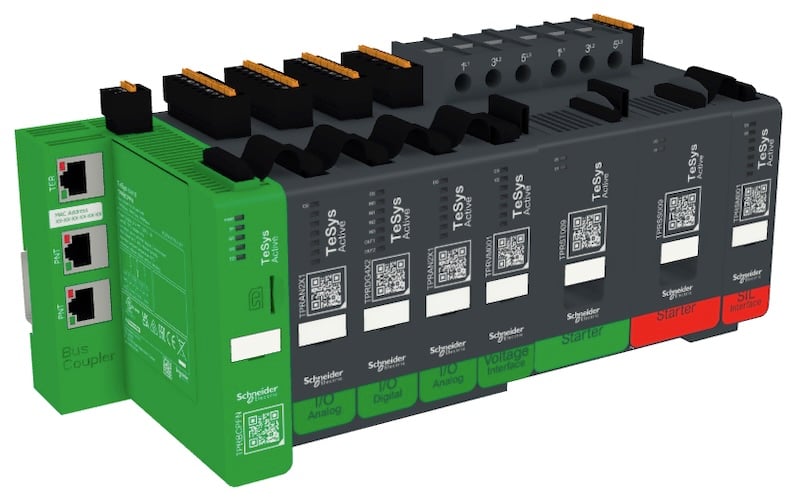
A 3D image of a TeSys island system created using the online configuration tool. Image used courtesy of Schneider Electric.
Not only does the smart motor control result in more efficient energy consumption of machine loads, but the starter itself is now designed to require less energy to operate due to low-consumption coils (in some cases, up to 91% less energy).
A New Era of Smart Motor Control
With 100 years of TeSys advancements at work, Schneider Electric is transforming industrial motors once again for the greater good of productivity, efficiency, and sustainability. It is not just the data itself that is transformative; it is the actionable insights from the smart control data that matter to your end users.
Data enables faster operational, maintenance, and efficiency actions based on predictive analytics. New technology enables you to build panels faster and install them in the field more easily, ultimately helping your customers. It also allows you to provide additional digital services since you can monitor the equipment.
Once a future-forward capability, predictive maintenance is now table stakes for OEMs and system integrators tasked with giving operators the data they need to reduce downtime, extend the lifespan and TCO of their equipment, and realize greater energy efficiency. Why not take advantage of today’s evolved smart controls—dynamic devices that can give a voice to what your motors and the associated equipment are trying to say? Giving your end users a way to hear what’s happening under the hood will accelerate their productivity, efficiency, and sustainability initiatives.