Facebook
 Google
 GitHub
 Linkedin
Toshiba Launches 6.5 kV, 2 kA Press-Pack IEGT for HVDC Converters
The ST2000JXH35A raises validated turn-off and short-circuit test voltage to 4.5 kV, targeting reduced series device counts in high-voltage converter stacks.
Toshiba has introduced the ST2000JXH35A, a 6,500 V/2,000 A press-pack injection enhanced gate transistor (IEGT) designed for high-voltage converters in DC power transmission systems, industrial motor drives, and static synchronous compensators. The device expands Toshiba’s high-power IEGT portfolio and is aimed at applications where converter valves are built from long series strings of high-voltage switching devices.
The company’s product announcement emphasizes validated high-voltage switching robustness. According to Toshiba, the ST2000JXH35A has successfully undergone both turn-off and short-circuit testing at 4,500 V, representing an increase from the 3,600 V turn-off test voltage specified for its predecessor in this class, the ST1700JXH26A.
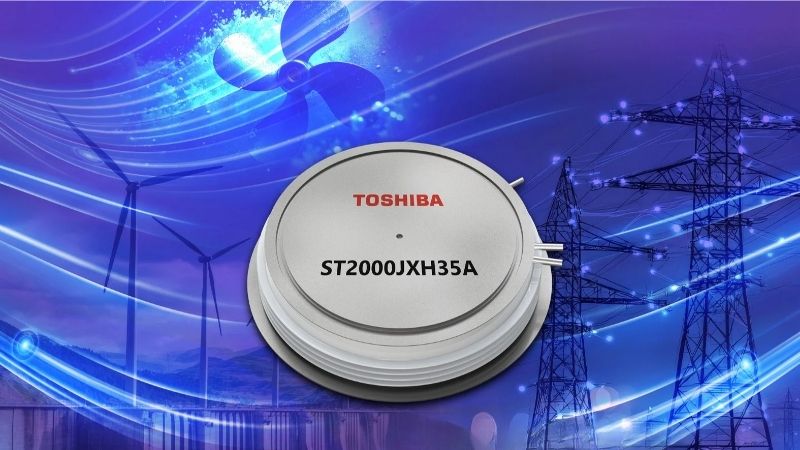
The ST2000JXH35A. Image used courtesy of Toshiba
Reducing Series Device Count in +/-500 kV Systems
An individual device’s blocking voltage is only part of the equation in HVDC converter design. Engineers typically derate devices relative to their maximum rating, and multiple devices are connected in series to withstand the full system voltage. The number of devices in each string directly affects valve height, clamping structures, insulation coordination, and auxiliary balancing networks.
Toshiba provides an example for a +/-500 kV DC transmission system. In that scenario, a 6,500 V device operated at 3,000 V would require 334 series-connected units to reach the required blocking capability. By comparison, a 4,500 V device operated at 2,000 V would require 500 units. That equates to a 33% reduction in the number of series devices when using the higher-voltage class component under the stated assumptions.
A reduction at this scale means fewer devices, which consequently translates into shorter valve stacks, reduced mechanical hardware, and lower overall assembly weight. Toshiba explicitly references offshore converter stations, where mass and volume naturally influence transportation and installation costs. A 33% cut in series device count, in practice, also reduces the number of interconnections and associated grading components, simplifying overall stack design.

The 6500 V press-pack IEGT. Image used courtesy of Toshiba
Press-Pack Construction and Fault Behavior
Toshiba offers the ST2000JXH35A in its 2-168B1S press-pack package with external dimensions of 168 mm x 168 mm x 35.8 mm.
Press-pack devices are widely used in HVDC and FACTS systems due to their mechanical clamping and double-sided cooling capabilities. Unlike wire-bonded module packages, press-pack devices rely on pressure contacts rather than bond wires for current conduction, which can improve current handling and long-term reliability under high thermal and mechanical stress.
Another desirable characteristic is the predictable failure mode. In high-voltage series strings, a device that fails short can be tolerated by system redundancy and protection schemes more readily than one that fails open. While Toshiba focuses on validated short-circuit testing at 4,500 V, the broader industry rationale for press-pack adoption remains tied to fault management and service life in converter valves designed to operate for decades.
Toshiba lists a maximum collector-emitter saturation voltage of 3.25 V at 2,000 A with a junction temperature of 125°C and a gate-emitter voltage of 15 V. Typical switching energy values are specified as 12.3 J for turn-on and 15.6 J for turn-off under the stated test conditions. The gate-emitter voltage rating is +/-20 V.
Trench IEGT Structure and Application Scope
Toshiba attributes the performance improvements to a newly developed trench-type IEGT chip with an optimized cell structure. IEGT devices are designed to enhance carrier injection in the drift region, reducing on-state losses at high current densities while retaining voltage-driven gate control similar to conventional IGBTs. In applications such as HVDC converters and large motor drives, conduction losses and turn-off robustness often take primacy over considerations like switching frequency.
Toshiba lists the target applications as DC power transmission systems, industrial motor-drive equipment, and static synchronous compensators. All three share the requirement for high blocking voltage, high current capability, and stable behavior under abnormal conditions such as short circuits. In these environments, incremental increases in validated turn-off and short-circuit test voltage can directly expand allowable operating margins or reduce the number of devices required to meet system voltage targets.
Ultimately, the ST2000JXH35A is an incremental but meaningful step within Toshiba’s press-pack IEGT product series. By combining a 6.5 kV rating with 2,000 A current capability and 4.5 kV validated turn-off testing, the device can support more compact and potentially lower-mass converter valve designs in high-voltage infrastructure projects.