Facebook
 Google
 GitHub
 Linkedin
Which Offshore Transmission Technology Should States Adopt?
Demand exceeds supply for offshore wind transmission converters, cables, and installation vessels. What do experts recommend?
Expanding high-voltage direct current (HVDC) transmission is essential to meeting the nation’s offshore wind expansion goals of 30 GW by 2030 and 110 by 2050. However, several obstacles remain as the global demand for offshore HVDC equipment and resources surpasses supply. Innovations that looked promising years ago, such as 400 kV HVDC transmission and alternating current (AC) mesh solutions, can no longer fulfill these accelerated timelines.
DNV, a Norway-based conglomerate providing certification and testing for the offshore wind industry, recently submitted a letter to state agencies and governors outlining realistic offshore HVDC transmission strategies. In the short term, states could procure 320 kV HVDC symmetric monopoles without DC or AC interlinks, leveraging well-established technology and larger vessel fleets to install offshore converter stations. Starting with monopoles, this blueprint would set the foundation for a 525 kV HVDC network with DC interlinks transferring intra- and inter-regional power.
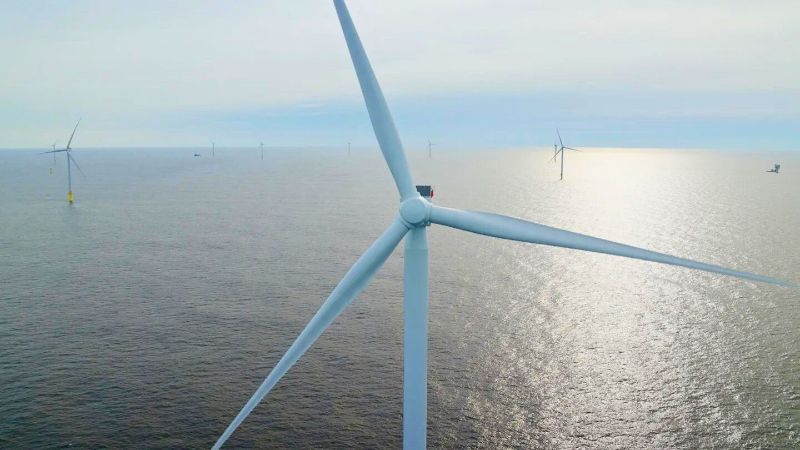
One of the nation’s first commercial-scale wind farms recently came online in New York. Image used courtesy of South Fork Wind
The letter’s signatories include leading HVDC converter manufacturers Hitachi Energy, GE Grid Solutions, and Siemens Energy, appearing alongside 10 renewable energy and transmission project developers such as EDF Renewables, Equinor, Shell, and Atlantic Shores Offshore Wind.
Their recommendations come as coastal states have committed significant resources to offshore wind expansion, exceeding national targets. According to Brattle Group, 11 states’ procurement will top 50 GW through 2035 and 77 GW by 2045. Delivering offshore power to 129 million people living in coastal counties—40% of the population—requires many submarine cables, grid interconnection points, onshore infrastructure upgrades, and more transmission equipment to reach load centers.
According to DNV, connecting 525 kV HVDC bipole circuits through the Mid-Atlantic from the Northeast requires reducing the size and weight of offshore platforms for 525 kV HVDC bipoles, defining technical and operational expectations for DC interlinks between the bipoles, and locating interconnection points or navigation channels for bipole reservations.
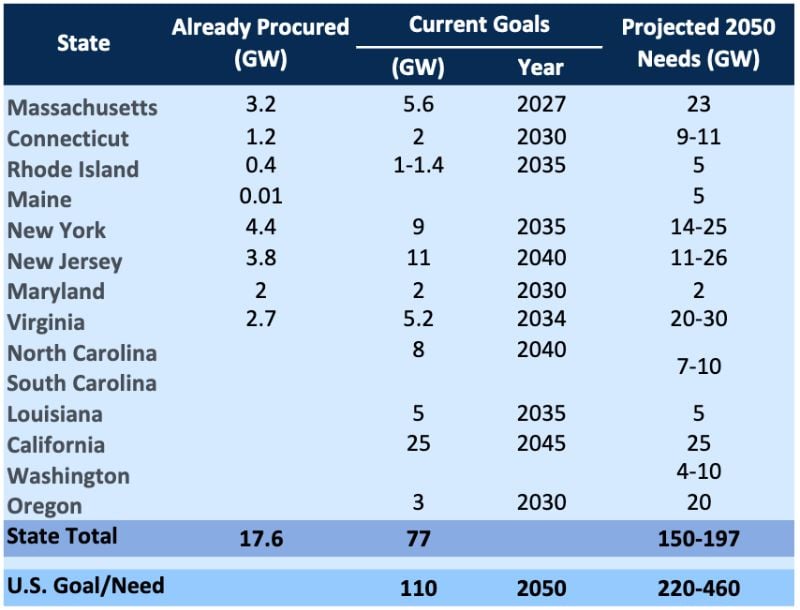
State offshore wind commitments and projected energy needs. Image used courtesy of Brattle Group (Page 6, Table ES-1)
DNV Recommendations: 320 kV HVDC Now, 525 kV Later
HVDC is the preferred transmission technology for offshore wind projects because DC cables can stretch long distances (49 to 62 miles) with lower active power losses than HVAC. In AC power transfer, offshore voltages can only reach 220 kV unless several cables are used. However, unlike AC, HVDC requires converters and large offshore substations to house electrical components.
Two common HVDC export configurations include a 320 kV symmetric monopole design with 1.3 GW of maximum transmission and a 525 kV bipole supporting up to 2 GW. At least two cables are typically required for subsea transmission. Monopolar designs comprise an HV cable and a lighter return cable, while bipolar designs have both cables operating at high voltages. According to National Grid, four to six cables are typically needed to meet the capacity of a comparable AC or DC overhead line. In existing cable technology, continuous power transfer is limited to 2 GW on a single DC bipole circuit. However, a double-circuit overhead AC line could support 6 GW.
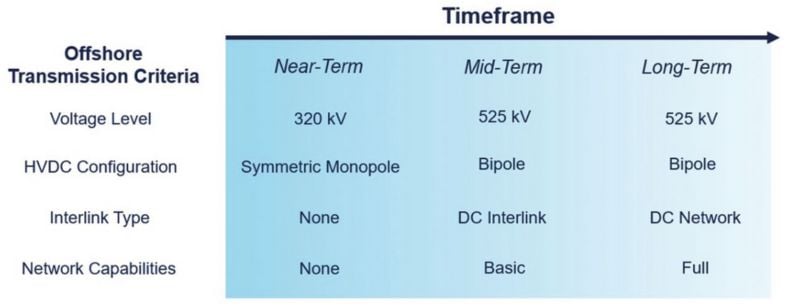
Offshore transmission technology outlook from DNV. Image used courtesy of DNV
In the near term (between five and eight years), DNV suggests states should focus on 320 kV HVDC symmetric monopoles without AC or DC interlinks. While 400 kV monopoles were considered, current supply chain bottlenecks limit commercial availability. On the other hand, 320 kV equipment is well-established, with more vessels available to install the offshore converter stations compared to other designs.
DNV also argued that adding a meshed network to the system design increases complexity and uncertainty for suppliers. Meshed offshore grids require multi-terminal HVDC connections to ensure interoperability between wind farm clusters, an innovation currently being explored in European waters. The U.S. is likely decades away from such a build-out, with only a handful of offshore wind plants online. The Department of Energy is evaluating the feasibility of an interregional meshed transmission network in the Atlantic. Still, today’s vessels are insufficient for a large-scale meshed network in the U.S.
Scaling Up to 525 kV: TenneT Standardization
Enabling the connection of 525 kV HVDC bipole circuits from the Northeast through the Mid-Atlantic could support a 2 GW expansion through the region. To meet reliability standards and contingency reserve levels, DNV suggested developers work with grid operators to use demand response and storage resources to address HVDC export losses.
Within the mid-term (eight to 12 years), DNV predicts that intra-regional 525 kV bipoles with DC interlinks will become the predominant transmission technology based on the growing number of projects procured by TenneT, a transmission system operator serving the Netherlands and part of Germany.
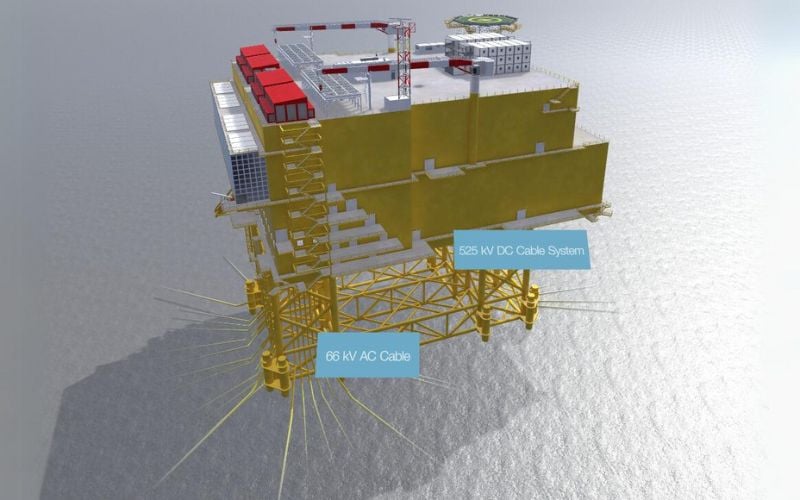
European standardization programs emphasize a 2 GW offshore wind transmission system using 66 kV AC cables and a 525 kV DC cable system. Image used courtesy of TenneT
TenneT and five major suppliers designed a 525 kV HVDC voltage source converter platform to network to multi-terminal equipment and standardized around a 2 GW cable capacity. In a single cable package, the 2 GW standard more than doubles the transmission capacity of existing technologies. For example, a 28 GW system needs less than half as many connections (only 14).
TenneT touts a one-size-fits-all standard featuring a 66 kV direct link to wind farms, an offshore converter station, and a 525 kV cable system to transmit energy to land and an onshore converter unit. In a new approach to DC systems built before 2025, this concept combines the functions of AC substations and HVDC converters. Since the stations convert electricity from AC to DC, they don’t need an intermediate AC substation between the offshore station and the wind farm. Thus, a direct connection saves on costs and reduces the environmental footprint.
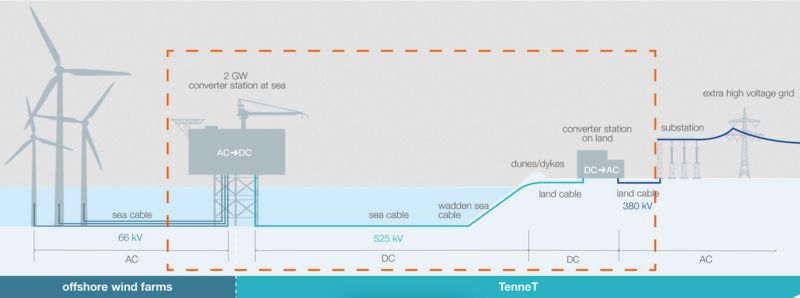
TenneT’s standardized offshore transmission system design. Image used courtesy of TenneT
After AC to DC conversion, electricity is then sent to shore through a 525 kV system bundled with four cables, including a negative and positive 525 kV pole, a fiber-optic cable, and a metallic return. The cables run underground to the onshore converter station, where the 525 kV DC transitions to 380 kV AC. This voltage matches the onshore grid, enabling electricity to flow to millions of households and businesses.
While such a design is possible for the U.S., challenges hinder near-term deployment, including interconnection contingency reserve regulations and the lack of available installation vessels or transport barges to handle the large weight and size of a 525 kV platform. Still, DNV’s signatories are confident these barriers can be addressed quickly, and 525 kV HVDC bipoles with DC interlinks can be delivered around the mid-2030s.