Facebook
 Google
 GitHub
 Linkedin
Toshiba Adds 60 V, 100 V N-Channel MOSFETs in 3 Compact Packages
The 60 V and 100 V parts pair low on-resistance with small footprints as industrial systems migrate from 12 V and 24V rails toward 48 V distribution
Toshiba Electronics Europe has expanded its N-channel power MOSFET portfolio with nine new devices aimed at the power lines inside industrial equipment. The lineup includes three 100 V parts for 48 V systems and six 60 V parts for 24 V systems, each offered in a choice of three small surface-mount packages.
The release is aimed at engineers building programmable logic controllers, inverters and servo motors, and servers, along with smaller appliances.
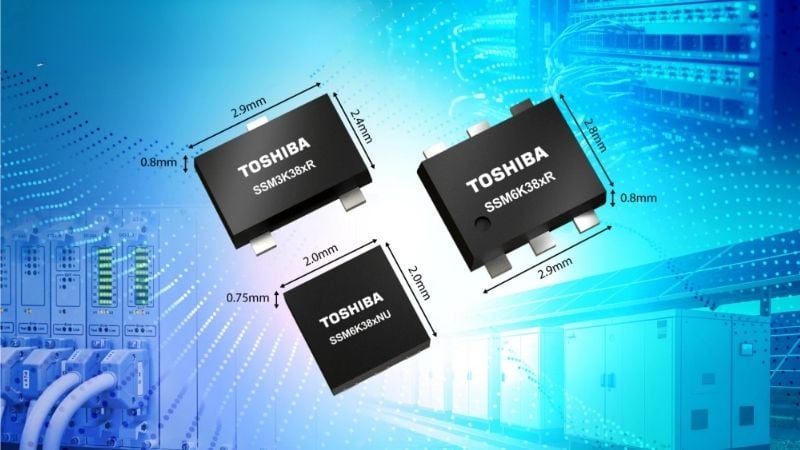
Packaging options. Image used courtesy of Toshiba
Packaging Balances Size and Voltage Needs
The products reflect a steady change in how industrial gear distributes power. Equipment that once ran on 12 V and 24 V rails is increasingly moving to 48 V to reduce current and, with it, resistive loss along the line.
Higher rail voltage reduces the current required to deliver a given amount of power, thereby reducing the I^2R heating that accumulates in connectors, traces, and switching devices. As Toshiba frames it, rising supply voltages call for higher efficiency, lower losses, and smaller package sizes at the same time, a set of demands that often pull against one another in a real design.
A smaller package dissipates heat less readily, so shrinking the footprint usually means accepting a hotter device or a higher on-resistance. Holding on-resistance down while keeping the body compact is what lets a designer recover board space without paying for it in efficiency, and it is the balance Toshiba is trying to strike across all nine parts.
Why 48 V Lines Need 100 V Silicon
A 48 V rail doesn’t stay neatly at 48 V. Inrush current and load transients push the line voltage well above its nominal value. Toshiba notes that surges can drive a 48 V line to somewhere between 50 V and 80 V. Designing with a 60 V MOSFET on such a rail leaves little headroom once those excursions are accounted for.
To address this issue, Toshiba specifies 100 V-rated devices for 48 V systems. The three 100 V parts carry a drain-source on-resistance of 198 milliohms and a 2 A drain-current rating, giving designers margin against surge events without forcing them onto physically larger packages.
The six 60 V devices serve the two 4 V systems that remain common across factory automation and appliances. They split into two tiers: a higher-current group rated at 99 milliohms of on-resistance for heavier loads, and an auxiliary group rated at 200 milliohms for lighter switching duties.
Across both voltage classes, Toshiba's emphasis is on holding on-resistance low even as the packages shrink, since on-resistance is the figure that most directly governs how much energy the device wastes as heat during conduction.
Three Packages, Nine Parts
Rather than ship a single footprint, Toshiba offers each electrical variant in three package styles so engineers can match the part to the constraint that’s most pressing for a given design.
- The SOT-23F is the general-purpose option, measuring 2.9 mm by 2.4 mm, with 1 W of power dissipation for designs that prioritize ease of layout.
- The TSOP6F, at 2.9mm by 2.8 mm, raises power dissipation to 1.5W, the highest of the three, for applications that need to move more heat out of the device.
- The UDFN6B is the space-saving choice, with a 2.0 mm by 2.0 mm footprint and 1.25 W of dissipation for layouts where miniaturization is the priority.
The nine part numbers map cleanly onto that grid. The 100 V family comprises the SSM3K387R, SSM6K387R, and SSM6K387NU. The 99-milliohm 60 V family covers the SSM3K388R, SSM6K388R, and SSM6K388NU, while the 200-milliohm 60 V family rounds out the set with the SSM3K389R, SSM6K389R, and SSM6K389NU.
In each case, the SSM3K prefix denotes the SOT-23F package, the SSM6K with an R suffix the TSOP6F, and the NU suffix the UDFN6B. Despite the compact dimensions, Toshiba says all three package types keep on-resistance low enough to meaningfully reduce power consumption in the end equipment.
Availability
The nine devices are now available through distribution, with live ordering listed at Farnell and other channels. Toshiba positions the launch as another step in a broader effort to widen its N-channel MOSFET range for high-efficiency, miniaturized power designs across the industrial sector, a segment where the migration to 48 V architectures shows no sign of slowing.