Facebook
 Google
 GitHub
 Linkedin
Rohm Brings 750 V SiC MOSFETs to TOLL Package
The SCT40xxDLL family targets high-density power systems with improved thermal performance and reduced height.
Rohm has started mass production of a new family of 750 V silicon carbide MOSFETs in a TOLL package, a move aimed at designers of high-density server power supplies, energy-storage converters, and compact PV inverters.
The SCT40xxDLL series enters volume production with six devices that combine SiC switching behavior with a low-profile, leadless outline. The goal is to support rising power requirements in systems whose mechanical envelopes cannot grow.
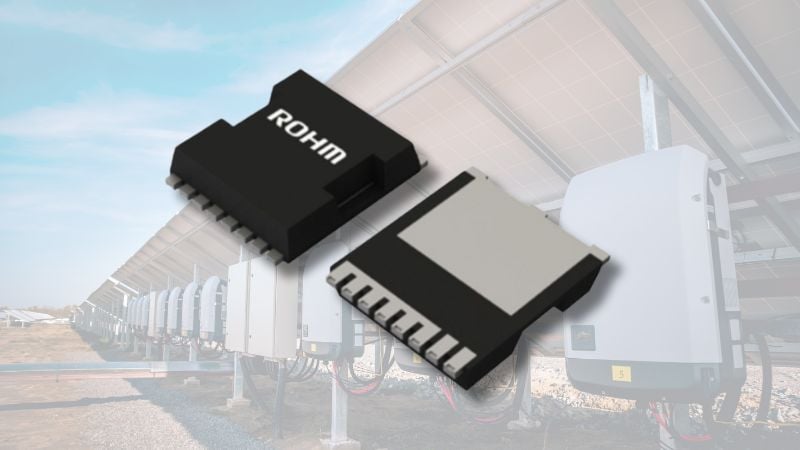
The SCT40XXDLL series. Image used courtesy of Rohm
TOLL and Thermal Performance
Rohm’s package choice, TOLL, is already established across power devices, but the company’s implementation is tuned for designs that must meet strict height budgets. The SCT40xxDLL parts reduce component footprint by about 26% compared with their TO-263-7L predecessors at equivalent ratings and drive the package height down to 2.3 mm, which is roughly half the profile of those earlier devices. This aligns the new series with the sub-4 mm limit common to “pizza box” power supplies in AI servers and dense industrial equipment.
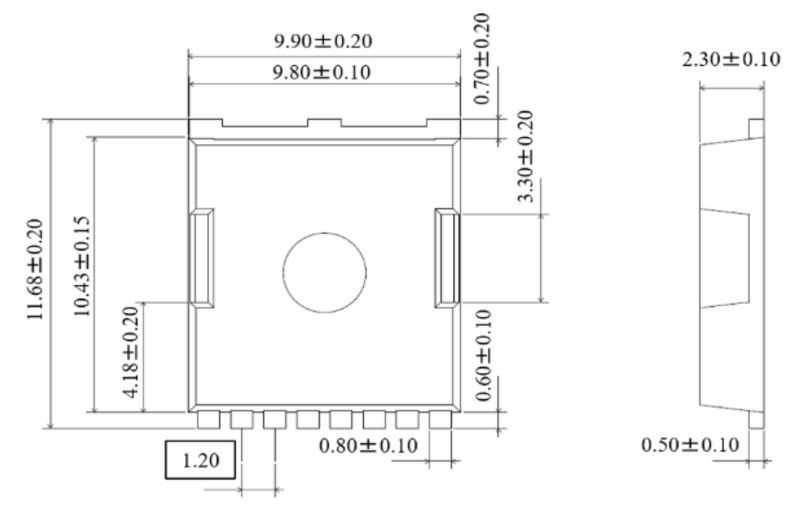
Package dimensions. Image used courtesy of Rohm
Thermal performance receives the same treatment. According to Rohm, the TOLL devices improve thermal conductivity by about 39% over the TO-263-7L equivalents. That increase can translate into a higher allowable power dissipation, reduced heatsinking requirements, or more room to maneuver when trading off switching losses against conduction losses.
For systems that operate with restricted airflow or stringent acoustic limits, any gain in thermal margin directly broadens the set of viable mechanical designs.
Extending TOLL to 750 V
A notable aspect of the SCT40xxDLL line is its voltage rating. Standard TOLL MOSFETs in the market typically top out at 650 V. Rohm lifts that ceiling to 750 V, which introduces additional surge headroom and helps accommodate the transient environment common to AC-DC front ends and energy-conversion hardware.
The higher rating also supports the use of lower gate resistance values. Designers who are optimizing switching losses will often trim gate resistance aggressively, and the additional voltage margin provides more confidence in those adjustments.
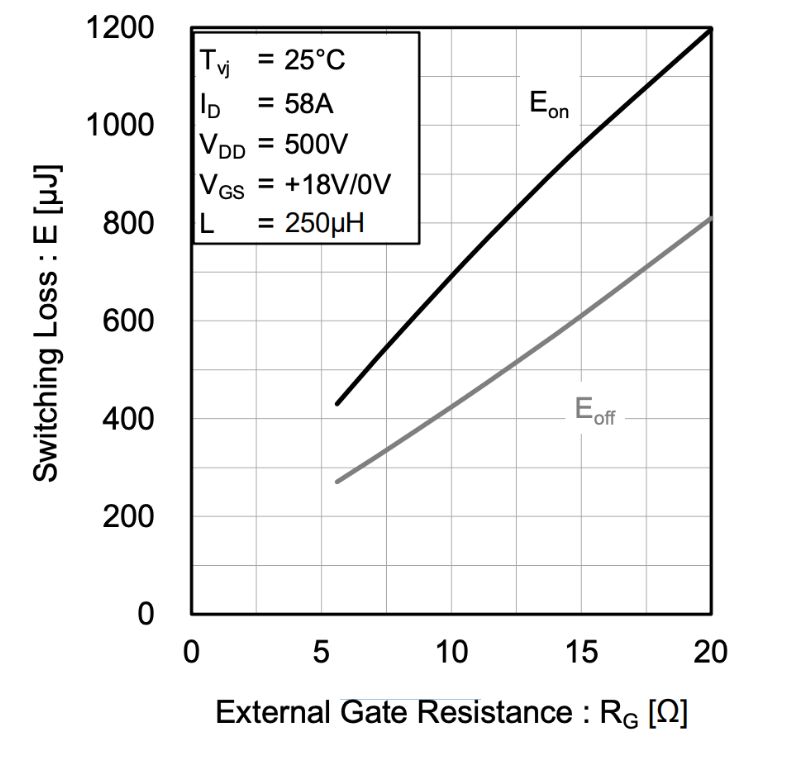
Gate resistance. Image used courtesy of Rohm
This focus aligns with the application list Rohm highlights. AI servers and modern data-center supplies increasingly rely on totem pole PFC stages for efficiency gains, but they must fit into narrow chassis heights while handling higher power levels. PV inverters continue to push for tighter mechanical integration and higher DC bus voltages in smaller units. ESS converters face fluctuating load profiles and cable-induced spikes that make voltage margin valuable.
The combination of a low-profile package, stronger thermal capability, and a boosted voltage rating positions the new series as a single mechanical footprint that can address these varied demands.
Reducing lead inductance inherent to TOLL packages also factors into layout and EMI behavior. Lower parasitic inductance helps tame voltage overshoot during fast transitions, which is especially relevant for SiC devices that switch at high speeds. In practical designs, those reductions can simplify snubber networks and allow for more predictable switching waveforms.
These details become noticeable when power designers are trying to consolidate multiple stages into a thin enclosure or maintain efficiency while raising switching frequencies.
A Six-Part Line Up
The SCT40xxDLL family covers a range of on-resistances from 13 megaohms to 65 megaohms. This allows the same package format to address both high-power and auxiliary power stages.
The lower-resistance parts target the PFC and primary DC-DC sections of server, ESS, and inverter systems, while the higher-resistance parts offer options for intermediate voltages and support circuitry that still benefit from SiC’s efficiency and temperature stability. All six devices are rated for junction temperatures from -40°C to +175°C.
Rohm has also published simulation models for each device, which should streamline early evaluation and comparison against existing SiC or silicon parts. Accurate models can remove several steps in the prototyping cycle for teams facing pressure to shrink mechanical footprints without compromising efficiency or thermal stability.
The SCT40xxDLL family’s introduction reflects the direction much of the power-conversion market is heading. Efficiency improvements are now expected at the device level, but the mechanical and thermal constraints of the systems that host those devices are tightening at a faster pace.
Rohm’s combination of a thinner package, higher voltage rating, and improved thermal conductivity provides an incremental but practical foundation for the next generation of compact front-end and conversion stages.