Facebook
 Google
 GitHub
 Linkedin
Floating Hydrogen Hub To Accelerate Port Decarbonization
The world’s first grid-independent hydrogen power hub, featuring solar and 45 MWh of battery storage, has been validated.
Elire Maritime and consortium partners in the U.K. have validated a floating hydrogen power hub that can supply clean electricity to ships at berth without requiring existing onshore grid power.
According to the International Maritime Organization (IMO), in 2018, shipping emitted 1,056 million tonnes of carbon dioxide, about 3% of total global emissions. The IMO estimates that by 2050, shipping emissions could comprise between 90 and 130% of 2008 emissions based on business-as-usual scenarios. This shows that with no changes to current operations, emissions are expected to remain the same or increase slightly.
The power hub addresses the largest obstacle ports face in decarbonization: access to reliable grid infrastructure. Many ports struggle to scale or modify onshore power due to capacity constraints, prolonged upgrade timelines, and high costs. Instead of relying on existing infrastructure, the power hub brings clean energy directly to the boats.
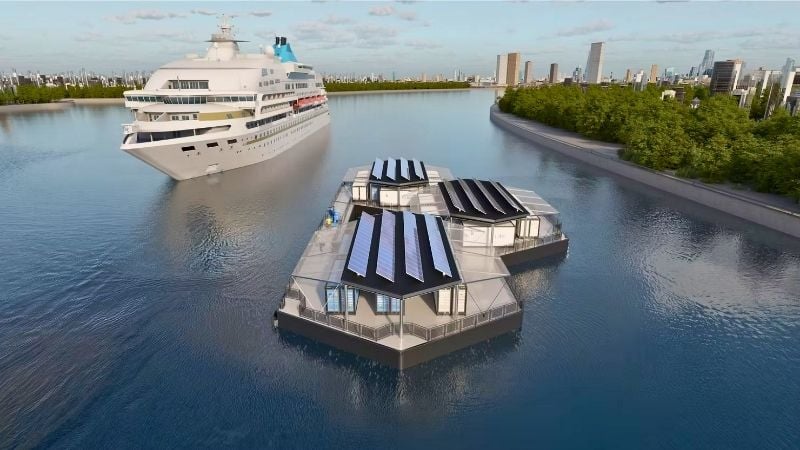
The floating hydrogen power hub. Image used courtesy of Elire
Direct Power to the Ships
Traditional shore power projects often require major expansions and years of permitting before they can begin operating. These bottlenecks have slowed the adoption of cleaner technologies, even as regulations and industry pressure to reduce emissions continue to grow. The hydrogen power hub addresses these challenges by moving energy infrastructure directly onto the water.
Three interconnected floating platforms, measuring about 1,200 square meters, combine hydrogen storage, fuel cells, battery energy storage, onboard renewable energy generation, and advanced power electronics. The platforms can deliver up to 5 MW of continuous clean electricity to vessels while supporting standard shore power connections, 6.6 kV and 11 KV, used by large maritime assets.
Hydrogen Storage
The platform uses approximately 16,500 to 17,600 pounds of hydrogen per week, stored in modular, low-pressure containers within the floating structure. The system currently includes seven onboard hydrogen storage tanks and requires refueling roughly twice per week.
Rather than generating power solely on demand, the platform uses modular 1.3 MW fuel cells to continuously charge onboard battery systems, allowing clean electricity to be rapidly supplied to vessels at berth. An additional 146 kW of onboard solar capacity helps offset energy demand and improve overall hydrogen efficiency.
The hub can deliver about 91 MWh of energy per week.
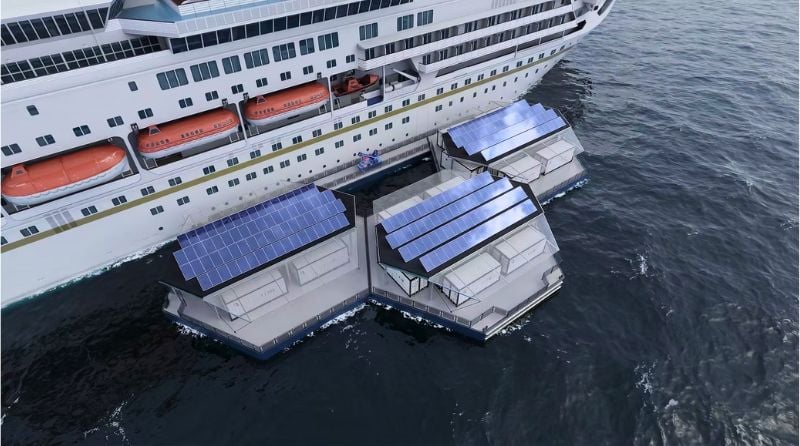
Hydrogen power hub. Image used courtesy of Elire
Estimated Emissions Saved
An emissions analysis during the feasibility stage estimates that the system can reduce vessel emissions by approximately 77% compared to conventional onboard diesel generation. This reduction estimation accounts for the emissions associated with the production and storage of the hydrogen.
The analysis estimates savings of roughly 47 tonnes of carbon dioxide per vessel each week, equivalent to approximately 2,444 tonnes annually, while also significantly reducing nitrogen oxides, sulfur oxides, and particulate matter emissions. Through deploying this floating clean-energy infrastructure widely, the consortium projects the technology could help avoid up to 500,000 tonnes of carbon emissions globally over the next decade.
Validation Process
A specialized consortium of academic and industrial partners conducted the hydrogen power hub's six-month validation program.
The University of Strathclyde conducted wave tank testing to verify the platform's stability, structural integrity, and multi-platform interconnectivity. Triton Anchor completed the mooring analysis and anchor system validation. Schneider Electric assessed the grid-independent AC/DC electrical architecture and battery energy storage management.
Ricardo and Rux Energy verified the hydrogen-to-power integration systems and end-to-end gas handling. Ricardo also led the feasibility-stage emissions-reduction analysis that confirmed a 77% reduction in vessel greenhouse gas emissions.
Scaling Up and Shipping Out
The maritime consortium expects the global market opportunity for the hydrogen power hub to be at least 62 TWh annually, particularly in ports where existing shore power infrastructure is limited or cost-prohibitive.
While hydrogen production is currently more expensive than diesel generation, the scale and technology are expected to become less expensive as demand continues to rise. Following successful validation, Elire Maritime is advancing discussions for future deployments across the U.K., Europe, Australia, and Asia.