Facebook
 Google
 GitHub
 Linkedin
How Do Inverters Contribute to Grid Resilience?
As renewable energy grows, advanced inverters plus battery energy storage systems are keys to grid stability.
The transition to renewable energy aims to reduce carbon emissions and reliance on fossil fuels. Reaching net-zero goals requires integrating renewable technologies, such as battery energy storage systems (BESS), to store energy for low production or high demand.
Inverters make the current grid-compatible and are key to efficient renewable energy use. But how do inverters contribute to grid resilience and stability?
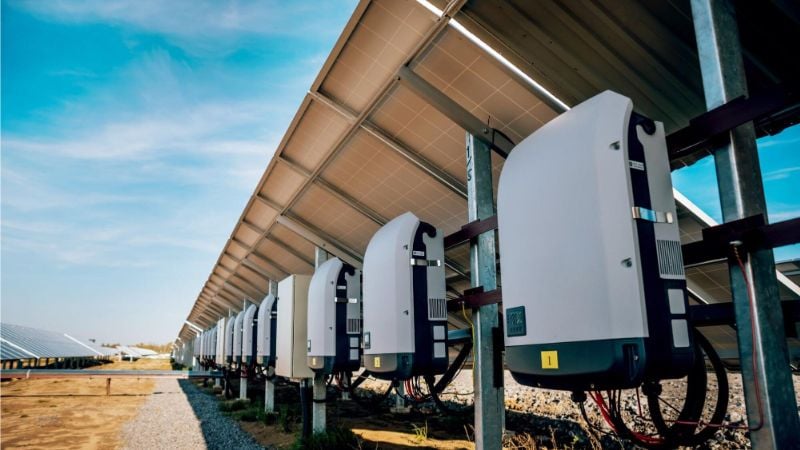
Solar energy inverters. Image used courtesy of Adobe Stock
Why Are Inverters Used With Renewable Technologies?
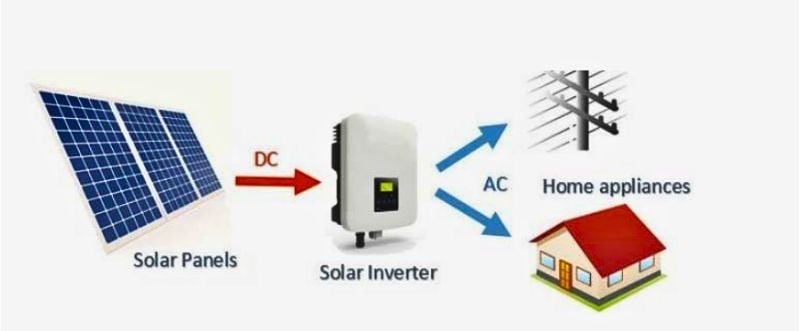
Inverters are a crucial component when connecting renewable energy systems to the grid, as inverters convert the direct current (DC) produced by solar cells and wind turbines into alternating current (AC). The grid uses AC to transmit energy over large distances, so any generated renewable energy needs to be converted; otherwise, it cannot be added to the grid.
DC has a constant unidirectional voltage, whereas AC electricity flows in two directions because the voltage shifts from positive to negative. Inverters are a class of power electronic devices that can regulate power flows to change the current from DC to AC and back. Inverters come in many forms, from string inverters connecting to multiple energy harvesting systems to central inverters and microinverters connecting to a single energy harvester.
The Development of Inverters
Inverter technology has undergone continuous innovation in line with the increasing need and interest in integrating renewables. Modern-day inverters must match grid capabilities with continuously changing energy demands.
In the 1990s, inverters could not provide grid support or help maintain grid stability. During the 2000s, inverter technology developed sufficiently to support the grid, sparking a turning point in integrating renewables. In the 2020s, grid-forming inverters have become so advanced that their use is no longer isolated to providing energy, and they have essentially become active grid management devices.
Grid-scale solar inverter. Image used courtesy of National Renewable Energy Laboratory
Inverters and Resilience
Inverters ensure grid stability, and combining grid inverters with BESSes can help meet modern-day power grid networks’ growing stability demands.
Advanced inverters today are voltage-controlled devices that can function like generators and manage power frequencies in the wake of power outages and blackouts. BESSes are also important in the grid because they can store energy when the sun or wind is high for later use when the power generation capacity is much lower (during nighttime for solar, for example). When combined with BESSes, the inverters have much higher efficiency and response times than synchronous power plants.
Advanced inverters can restart grids during a power outage using a black start process. This capability adds an extra layer of stability and resilience to the grid during these scenarios. Advanced inverters that can restart the grid reduce the reliance on network reinforcement and redispatch methods and allow grids to be stable when completely powered by renewable energy.
Inverters, Storage, and Renewables Integration
With more renewable energy introduced to the grid, the eventual aim is to reduce carbon emissions. Inverters are key to this goal because they can enable and manage energy distribution into the grid. Using BESSes will be important alongside inverters, as they allow energy to be stored during peak harvesting times (so it doesn’t get wasted) and utilized in lower-generation times or crises when the energy is most needed.
Combining advanced inverters and BESSes will help to prevent demand from outstripping supply in an all-renewable grid, protect the grid against any outages or power demand spikes, improve the overall resilience of the grid by quickly responding to grid events, and enable a large-scale adoption and management of renewables.