Facebook
 Google
 GitHub
 Linkedin
Bringing Lightweight Solar to Commercial Rooftops
Solivus installs rooftop solar where conventional solar panels won’t work.
Many business owners want to reduce energy costs and decrease reliance on carbon-based energy sources, but their buildings and warehouses may be difficult to access with conventional rooftop solar. To meet this need, U.K.-based Solivus partners with innovative, lightweight solar solutions manufacturers to bring rooftop solar to these commercial buildings.
See where this cricket club stadium installed ultra-thin, lightweight solar panels. Video used courtesy of Solivus
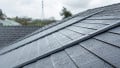
The company has just completed a significant lightweight solar installation at an Astute Electronics warehouse at Astute’s Hertfordshire, U.K. headquarters. The installation uses several hundred ultra-thin solar panels and is expected to generate enough power to supply 30% of Astute’s total warehouse energy needs. The project will reduce facility energy costs and create the potential for new revenue streams by selling excess power back to the grid.
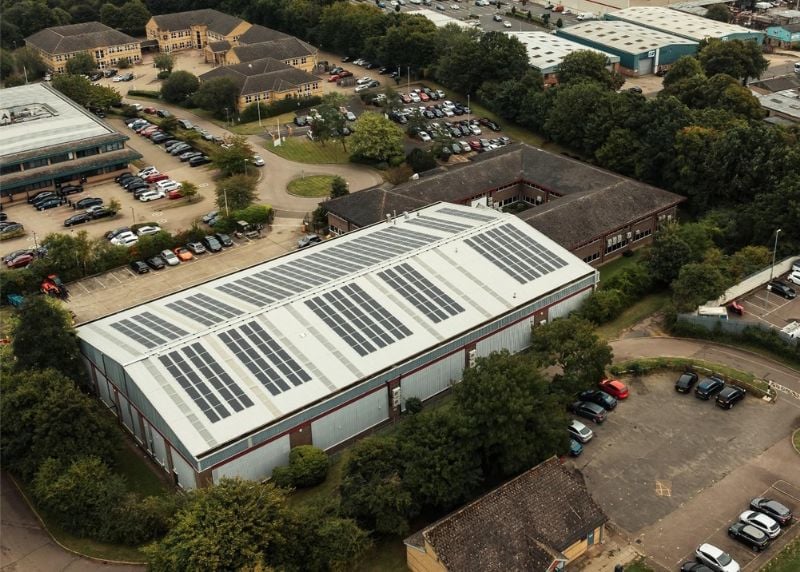
Astute warehouse lightweight solar installation. Image used courtesy of Solivus
Untapped Opportunity for Rooftop Solar
According to Solivus, the energy operating commercial buildings contributes to about 40% of total global carbon emissions. While many warehouse owners and operators are eager to explore rooftop solar as a locally generated power source, many cannot move forward due to weight constraints or concerns over aesthetics.
Estimates indicate that up to 40% of buildings cannot safely support the weight of conventional solar panels on their roofs. Warehouse structures will often use metal-sheeted rooftops with limited load-bearing capabilities.
According to the U.K. Warehousing Association, warehouses account for one-third of commercial roof space, yet only 5% of warehouses deploy rooftop solar panels. With more than 420,000 warehouses across the U.K., estimates indicate that warehouse solar generation, if fully deployed, could eliminate 2 million tons of carbon dioxide emissions per year and save up to £3 billion annually.
Using the latest lightweight solar panel technologies available, Solivus addresses this market opportunity and drives broader rooftop solar adoption in otherwise inaccessible warehouses and other commercial buildings.
For warehouse owners, rooftop solar helps meet carbon emission goals, improve energy security, and reduce electricity costs.
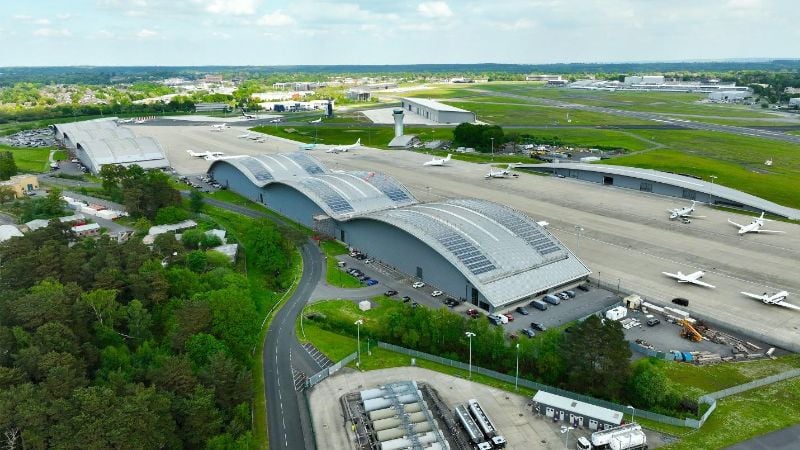
Lightweight solar installation at Farnborough Airport, U.K. Image used courtesy of Solivus
The Ultra-Thin Solar Promise
Solivus’ ultra-lightweight commercial solar solutions weigh about 70% lighter than traditional panels. This weight helps avoid many commercial buildings’ weight-bearing structural limitations. It reduces project costs since the panels can be installed using conventional techniques that do not require penetrating the roof. The thin panels are also less intrusive and more aesthetically appealing.
The building block of Solivus’ lightweight solar solution is a 1 x 2-meter fiberglass board with a thickness of about 4 mm. It has ultra-thin (1 mm thick) photovoltaic (PV) cells embedded in it.
Ultra-Thin Solar Research and Development
Research continues to develop ultra-thin and lightweight PV cells. MIT engineers have developed ultralight fabric solar cells that can turn any surface into a solar energy source.

Ultra-thin solar cells. Image used courtesy of MIT
The flexible solar cells are thinner than human hair and are affixed to fabric materials for mounting to the host surface. Made from semiconductor inks using standard printing processes, the cells are a fraction of the weight of traditional panels. They can generate 18 times more power on a per-unit weight basis.