 Facebook
 Google
 GitHub
 Linkedin
Navitas Unveils UHV SiC Power Module To Advance Energy Efficiency
The G4H08MT23GB4 full-bridge module combines a 2300 V rating with 8 mΩ on-resistance, trimming conduction losses in solid-state transformers, grid-scale storage, and megawatt EV charging.
Navitas Semiconductor has broadened its ultra-high-voltage (UHV) silicon carbide line with the G4H08MT23GB4, a 2300 V full-bridge power module built in the SiCPAK G+ form factor, extending the 2.3 kV and 3.3 kV UHV portfolio it began sampling in late 2025.
The family relies on the company’s fourth-generation GeneSiC Trench-Assisted Planar (TAP) architecture to deliver efficiency and power-density gains in solid-state transformers, grid-scale battery energy storage, solar inverters, and megawatt EV charging infrastructure.

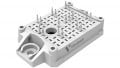
2300 V, 8 mΩ full-bridge SiCPAK G power module. Adapted from image used courtesy of Navitas
TAP Architecture and Core Ratings
The G4H08MT23GB4 is a full-bridge module rated at 2300 V with an 8 mΩ on-resistance. Navitas credits its fourth-generation GeneSiC Trench-Assisted Planar architecture for the figure, which the company describes as leading among devices built in the SiCPAK form factor.
On-resistance is usually quoted at 25°C, but converters run hot, and SiC RDS(on) climbs with junction temperature. Navitas’ technology whitepaper puts TAP’s climb at up to 20% lower than competing devices at elevated temperatures. This thermal headroom lets a designer run more current through the same heatsink, or the same current through a smaller one.
TAP keeps the channel on the wafer surface, as a conventional planar MOSFET does, but places shallow trenches in the source regions rather than at the gate, tightening cell pitch without standing the gate oxide in the field concentration a trench-gate device sees at its corners.
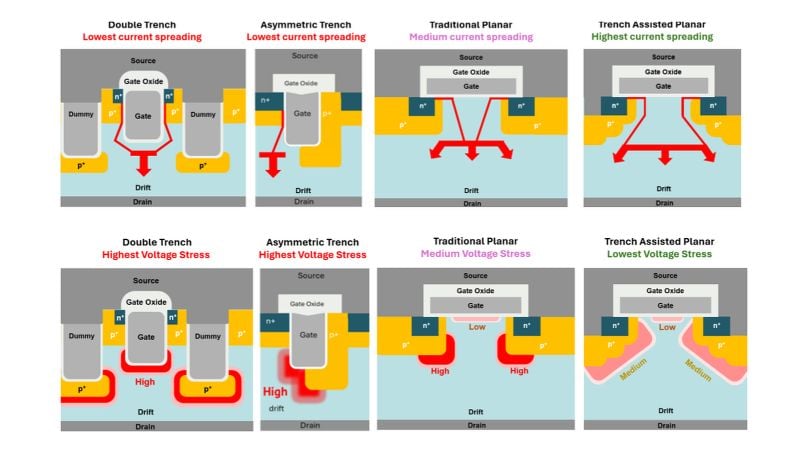
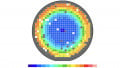
Comparing SiC MOSFET cells in current spreading and voltage. Image used courtesy of Navitas
Navitas ties a cluster of benefits to the resulting field profile. Flattened field peaks cut voltage stress, which Navitas links to higher avalanche capability and longer life under high-voltage, high-temperature, and high-dV/dt stress. Better current spreading supports low on-resistance, a protected oxide keeps threshold voltage stable, and no trench-gate capacitance reduces switching loss. The modules are rated to a maximum virtual junction temperature of 175°C.
Four Variants and What They Change
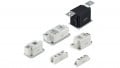
Navitas is sampling the family in four order codes, built from two independent options. The HC suffix fits press-fit pins that carry twice the current per pin of standard press-fit connections. The T suffix ships the module with thermal interface material already applied, standardizing a mounting step that otherwise varies depending on who performs it.
Both variants carry the same published per-MOSFET ratings: 239 A DC at a 25°C heatsink, 196 A at 75°C, 169 A at 100°C, and 350 A pulsed.
- G4H08MT23GB4 — standard press-fit pins, no pre-applied TIM
- G4H08MT23GB4-T — standard press-fit pins, TIM pre-applied
- G4H08MT23GB4HC — high-current press-fit pins, no pre-applied TIM
- G4H08MT23GB4HC-T — high-current press-fit pins, TIM pre-applied
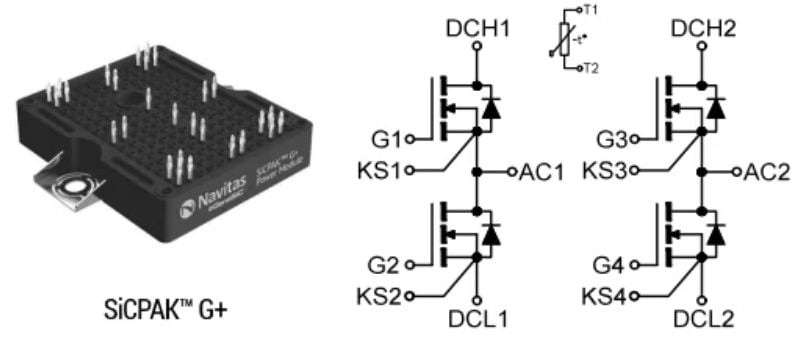
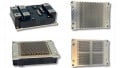
The SiCPak G+ package and internal full-bridge topology. Image used courtesy of Navitas
Navitas also supplies the EVB-UHVSIC-GB-E-DPT-1 double-pulse test system on request, letting engineers characterize switching behavior before committing to a board layout. All four are available for sampling now.
Advanced Construction and Extended Reliability
Several design changes optimize the family for demanding high-power duty. An aluminum nitride active-metal-braze substrate spreads heat while holding isolation above 5 kV, and epoxy-resin potting replaces the silicone gel used in conventional modules. Navitas says the epoxy-resin eases internal stress, seals out moisture and contaminants, and conducts heat ten times better than gel.
The family will be qualified to AEC-Plus, an in-house benchmark the company says goes beyond AEC-Q101 and JEDEC requirements. Two additions target what static testing misses: dynamic reverse bias and dynamic gate switching, both representing the fast-switching mission profiles these converters run in service.
Static high-temperature, high-voltage tests—HTRB, HTGB, and HTGB-R—run more than three times longer than standard. The benchmark also extends power and temperature cycling and adds HV-H3TRB humidity qualification across modules, discrete devices, and known-good die.
The target list spans most of what sits between a grid connection and a DC bus: solid-state transformers for data centers, utility-scale storage and solar, megawatt charging, hydrogen electrolysis, industrial drives and high-voltage supplies.
Looking Ahead
The 2300 V tier is not where Navitas intends to stop. The company has called its current UHV line a step toward 10 kV SiC, a class that would reshape how many devices a medium-voltage converter needs in series.