Facebook
 Google
 GitHub
 Linkedin
Advanced Energy Launches Next-Gen Modular Power Converter Platform
The latest AC-DC conversion platform from Advanced Energy allows for rapid system configuration and power scaling with optimized performance.
As renewable energy sources dominate the energy landscape, DC energy storage devices like batteries and capacitors are emerging as the backbone of a sustainable future. AC-DC converters play a pivotal role by converting AC from renewables to DC for battery charging. However, these converters have challenges such as efficiency optimization, voltage regulation, and size reduction.
Advanced Energy has launched next-generation high-power modular AC-DC conversion platforms with enhanced flexibility. This article explores the challenges engineers face in designing AC-DC converters and how Advanced Energy’s smart modules could provide a ready-to-use solution.
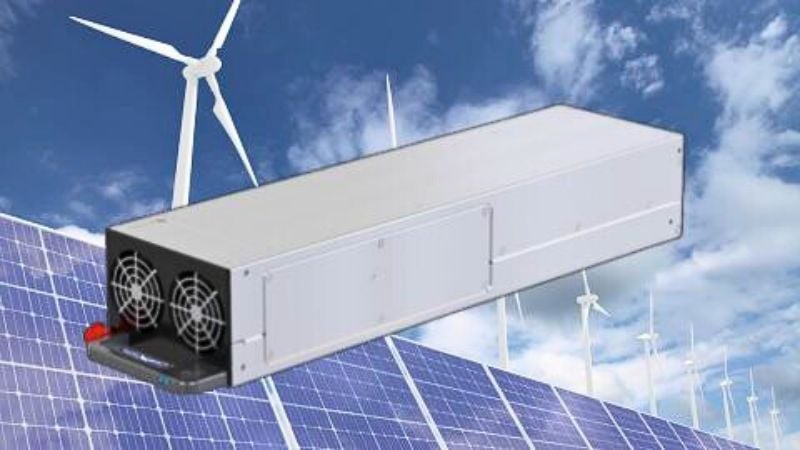
Advanced Energy’s AC-DC power converter. Image used courtesy of Advanced Energy
AC to DC Conversion Essentials
AC-DC converters serve several purposes across various industries, including electronics, household appliances, automotive systems, power distribution networks, and renewable energy installations. Their primary function is to convert AC voltage into DC voltage, enabling the operation of DC-powered devices and battery energy storage. For example, AC power is generated by renewable energy systems, and AC-DC converters are essential for ensuring stability and suitability of voltage for powering loads or charging batteries.
The AC-DC conversion process involves several stages to ensure effective power transfer. Transformers are utilized for voltage step-down and isolation. They are crucial for matching the input voltage to the desired output level and ensuring electrical safety by isolating the output from the input. The AC input undergoes rectification using diode bridges or rectifier circuits, transforming it into pulsating DC voltage. Subsequently, filtering components such as capacitors smooth the output waveform to form DC voltage, reducing ripples and enhancing stability.

Schematic of an AC to DC converter. EEPower image
AC-DC converter designers face numerous challenges in optimizing power factor, efficiency, thermal performance, size, and scalability. Key components like diodes and capacitors introduce power losses (and heat generation), while transformers influence overall size. Balancing conduction and switching losses is critical, necessitating attention to semiconductor switching and VI ratings. Scalability further complicates the design, demanding robust thermal management like package selection, heat removal by forced convection, and heat sink design for reliable operation across varying loads and conditions.
Powering Possibilities with Evergreen
Advanced Energy has introduced Evergreen, a cutting-edge modular high-power platform.
From a technical perspective, these modules are impressive. They offer a maximum AC input (3-phase) of 528 VAC and achieve a 0.98 power factor with over 95% efficiency. With a power density of 38 W/in³, an integrated isolation transformer between input and output, a maximum DC output voltage of 60 VDC, and a peak current of 183 A, these devices could be suitable for high-power critical applications.
According to the company, these modules offer an output power of 10kW, 2.5x greater than existing solutions. The platform integrates the 10 kW FCM10K air-cooled, hot-swappable module (2 U x 3 U footprint) and the 30 kW FCM30K shelf to handle this power. Customers have the luxury to scale total system output by connecting multiple shelves on a standard 19” rack, catering to demanding precision high-power applications.
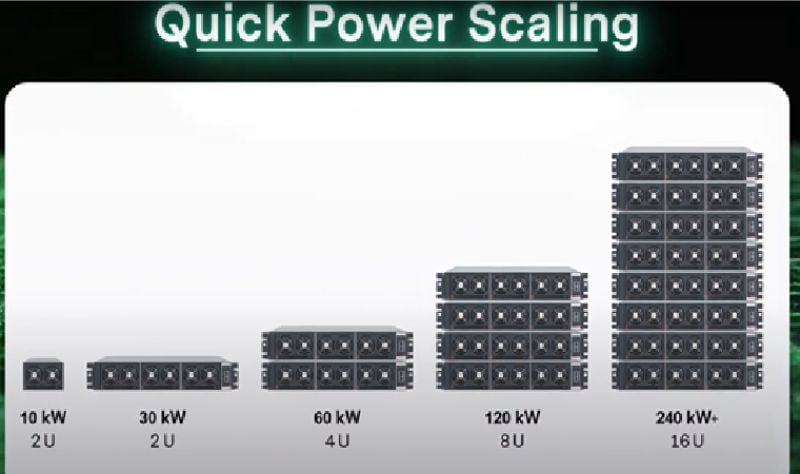
The power scaling feature of Evergreen. Image used courtesy of Advanced Energy
A notable aspect of this design is its modular design approach, which offers optimized performance, instant customization, and power scaling capabilities. The platform's flexibility and performance make it optimal for front-end AC-DC conversion in various applications, including industrial, medical, semiconductor manufacturing, hyperscale computing, test and measurement, and defense.
Evergreen's Impact and Potential
Overall, Advanced Energy’s Evergreen platform is designed to reduce time to market and costs while ensuring high reliability, repeatability, and efficiency. With centralized system communication and control and mobile device compatibility soon to be implemented, the company hopes to enable wireless functions such as identification, configuration, status monitoring, diagnostics, and retrieval of "black box" data.