Facebook
 Google
 GitHub
 Linkedin
Robotics and a Huge Solar+Storage Farm Reshape the Solar Future
Two companies are developing robotics to automate labor-intensive construction tasks, while Google is investing in a massive, domestically sourced solar-plus-storage project
The U.S. solar industry is entering a new phase of scale, with developers pursuing increasingly large projects while turning to automation and robotics to address the labor and logistical challenges of building them. Recent developments include two robotics companies looking to automate the labor-intensive work required to build solar farms faster and more efficiently and a massive Google-backed solar-plus-storage project that leans heavily on domestic manufacturing.
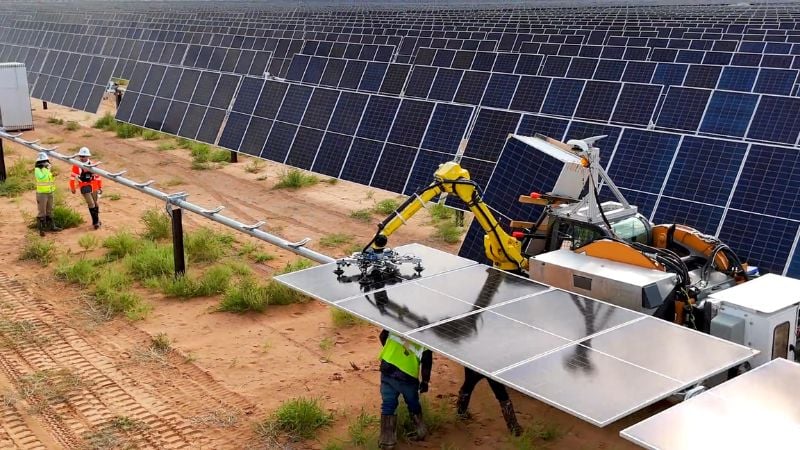
Automated solar panel pick-and-place. Image used courtesy of Gritt
Xpanner Intros Excavator-based Automation for Solar Panel Installation
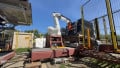
Xpanner has launched X1 Panel Lift, an excavator-based automated system designed to handle solar panel lifting and placing, allowing installation crews to spend more time on higher-value tasks such as alignment, fastening, and quality control.
The system is designed around existing construction equipment rather than requiring solar developers to adopt an entirely new type of machinery. The X1 uses a single excavator-based workflow to transport boxes of photovoltaic panels, pick up individual modules, and move them into position for installation. By automating the repetitive material-handling portion of the process, Xpanner claims the system can reduce the physical demands placed on workers while helping crews work more efficiently.
Watch the X1 Panel Lift in action. Video used courtesy of Xpanner
The approach addresses a growing challenge for the solar industry. As utility-scale solar projects grow in size, the amount of manual labor required to move the modules across large construction sites can become a significant constraint on project timelines and costs. At the same time, the industry faces a shortage of skilled workers capable of supporting the rapid expansion of solar deployment.
Rather than attempting to automate the entire installation process at once, Xpanner is focusing on a specific bottleneck. While the X1 handles the work, human crews can complete other tasks requiring greater precision and judgment. The company describes the system as powered by robotics and physical AI, combining automated equipment with human workers rather than replacing the entire installation crew.
Gritt Integrates AI To Bring More Robots to Solar Construction
Gritt has developed AI-powered robotics designed to automate physical, labor-intensive construction tasks, beginning with solar plant installation.
Unlike traditional industrial robots built for controlled factory settings, robots building a solar facility must operate in unstructured, dynamic environments where terrain and material placement constantly shift. Gritt’s advanced AI-powered robots can adapt to variable conditions and handle multiple material manipulation and construction tasks using a single platform rather than separate, single-purpose machines.
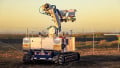
Gritt's hardware utilizes standard, off-the-shelf heavy machinery retrofitted with minimal custom hardware and interchangeable tool attachments. The physical platform integrates spatial-perception sensors and onboard computing to gather real-time data overlays for pick-and-place, transport, and structural assembly tasks.
Powered by a single AI backbone, the robotic equipment is designed to operate as a multi-functional system capable of performing multiple construction jobs rather than relying on separate, specialized machines.
The Gritt robot. Video used courtesy of Gritt
Solar construction is the company's initial focus because utility-scale solar projects contain many repetitive, physically demanding activities that take place across large sites. The robots are planned to drill posts, build mounting racks, and fasten solar panels. Automating several of these steps could eventually create a more integrated robotic construction workflow, reducing the amount of manual labor required to build a solar farm.
Gritt currently has two active systems that can install solar panels at up to five times the efficiency of a typical eight-person crew. The company has contracted to install 2.8 GW of solar panels over the next 18 months for customers that include three of the top 10 U.S. power construction companies, and aims to have 48 systems operational within the next six months.
The startup has emerged from stealth with $34 million in funding and a plan to use robotics to automate some of the most labor-intensive tasks involved in building solar plants before expanding to other areas of construction.
Google Backs Largest Solar-Plus-Storage Development in the U.S.
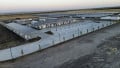
The Steel River Energy Center, expected to be the largest solar-plus-storage facility in the U.S., has begun construction in Mississippi County, Arkansas. The Google-backed project will initially deliver 1.6 GWdc of solar generation and 1.9 GWh of battery storage to the regional grid. When completed in 2029, the project will generate 2.5 GWdc, along with 2.9 GWh of new battery storage.
According to Google, the project developed by Cypress Creek Renewables will power the equivalent of more than 315,000 homes annually. Google has signed a virtual power purchase (VPP) agreement that covers the project’s initial output and a long-term commitment to help fund and develop it.
Google has been investing in local energy projects as it expands its AI and cloud infrastructure. The VPP doesn’t mean Google will directly consume the electricity that Steel River generates, but the long-term contract provides financial certainty for the developer while allowing Google to support the addition of new renewable generation to the grid.
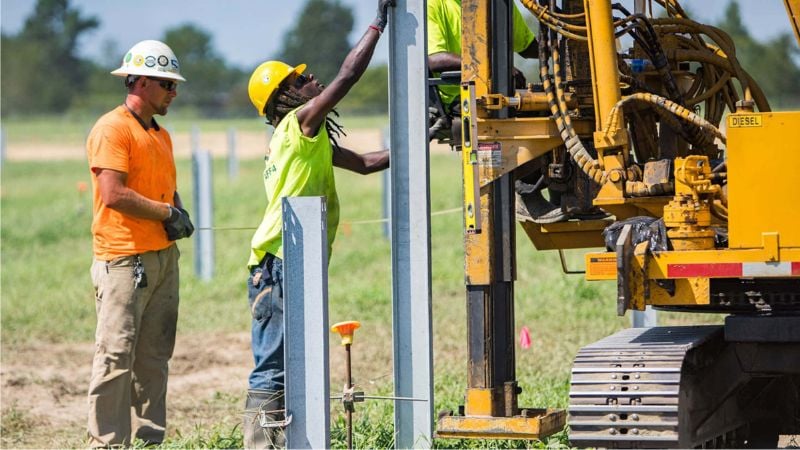
Construction begins on the Steel River Energy Center. Image used courtesy of Cypress Creek Energy
The project will use domestic manufacturing, an increasingly important choice as developers navigate changing U.S. trade policy and tax-credit requirements. Arizona-based First Solar will supply the photovoltaic modules, and steel will be sourced from Arkansas. Batteries will use 100% American-made steel, including approximately 400,000 steel pilings fabricated by Southern steel mills.