Facebook
 Google
 GitHub
 Linkedin
EPC Launches Its First 7th Gen GaN 40 V Power Transistor
EPC2366, aimed at low-voltage, high-current applications, enters mass production for high-density 40 V systems.
Efficient Power Conversion (EPC) has started volume production of its first seventh-generation eGaN power transistor, the 40 V EPC2366. The device marks the introduction of EPC’s Gen 7 platform into mass production, with a special emphasis on low-voltage, high-current power-conversion applications that traditionally rely on silicon MOSFETs.
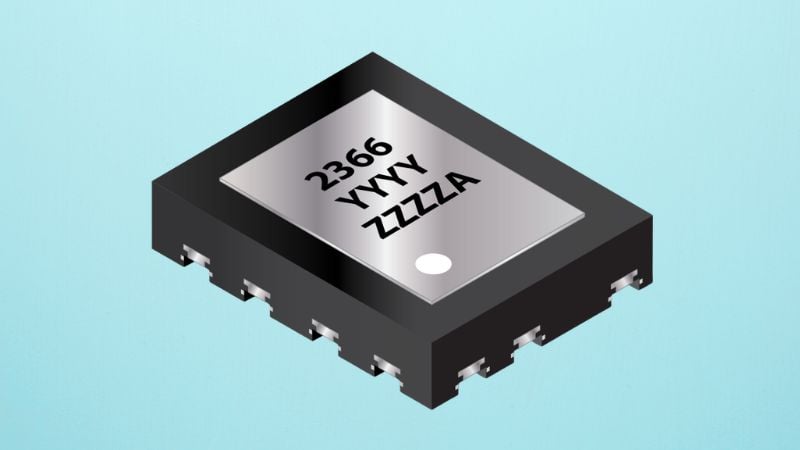
The EPC2366. Image used courtesy of EPC
EPC’s Seventh-Generation Architecture
The EPC2366 operates at a maximum drain-to-source voltage of 40 V and tolerates transient excursions up to 48 V, positioning it squarely within low-voltage, high-current power architectures. Within this operating range, the device achieves a typical RDS(on) of 0.84 mΩ and an RDS(on) x QG figure of merit of 12.6 mΩ·nC.
These two parameters jointly determine performance in synchronous rectification and DC-DC conversion stages, as a low RDS(on) reduces I2R conduction losses at high load currents and a low gate charge minimizes the energy required to charge and discharge the gate during each switching transition.
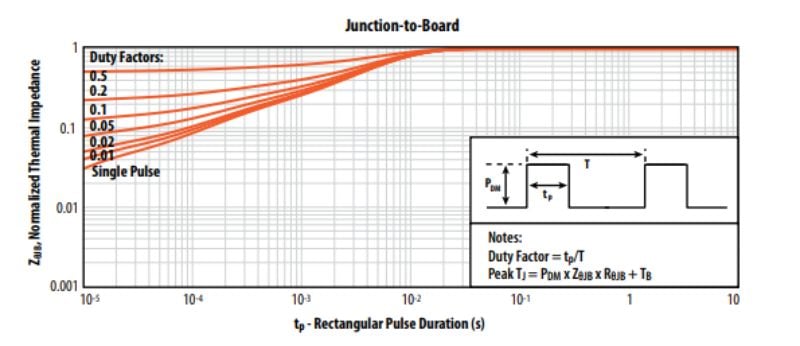
Typical transient thermal response curve of the EPC2366. Image used courtesy of EPC
This electrical performance supports continuous drain currents up to 88 A and pulsed currents up to 360 A, matching the needs of high-current rails in AI server power supplies and advanced motor drive systems.
To manage thermal stress, EPC places the EPC2366 in a 3.3 x 2.6 mm PQFN package with a junction-to-case thermal resistance of 0.6°C/W. The combination of sub-milliohm on-resistance and low junction-to-case thermal resistance therefore supports compact multiphase converters and high-current synchronous rectification stages without expanding board area.
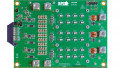
For design validation, EPC offers the EPC90167 half-bridge development board, which integrates two EPC2366 devices in a low-parasitic layout.
RDS(on) x QG Figure of Merit
In low-voltage, high-current converters, device performance depends on the balance between conduction losses and switching losses. RDS(on) determines the static voltage drop across the device when it conducts current. At high load currents, conduction loss scales with the square of the current, which makes milliohm-level reductions in on-resistance materially important.
However, lowering RDS(on) often requires increasing die area, which tends to increase total gate charge, QG. Gate charge determines the energy required to transition the device between on and off states. Each switching event consumes energy proportional to QG and the applied gate voltage. At high switching frequencies, gate-drive losses and switching transition losses can rival or exceed conduction losses.
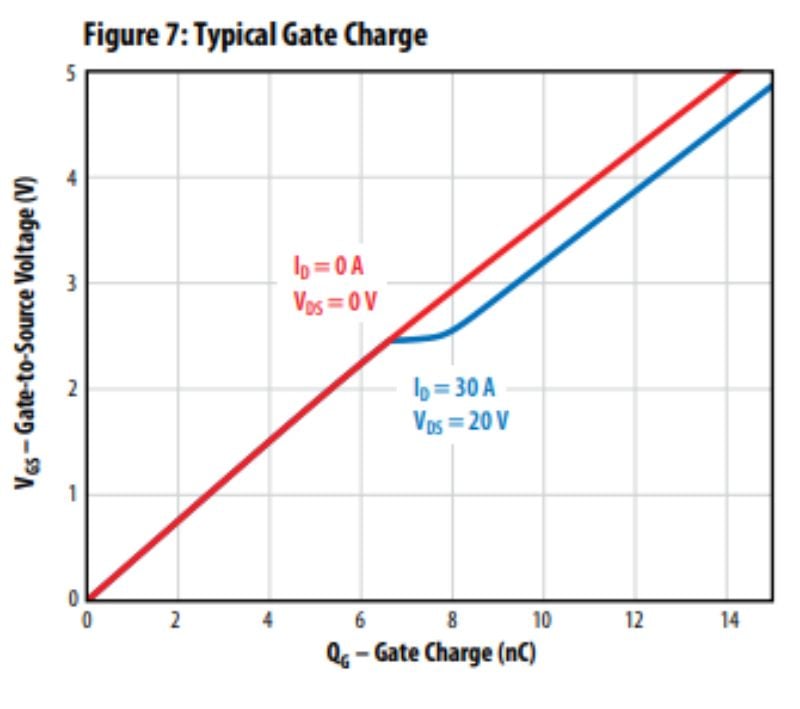
VGs versus gate charge for the EPC2366. Image used courtesy of EPC
The product RDS(on) x QG provides a compact metric to compare power devices in applications where both parameters significantly affect efficiency. A lower figure of merit indicates that the device can achieve low conduction loss without incurring a proportional increase in switching loss.
In multiphase buck converters and synchronous rectifiers operating in the hundreds of kilohertz to megahertz range, this balance directly influences achievable efficiency, thermal rise, and power density.
Optimizing this figure of merit requires process-level improvements in channel mobility, charge distribution, and device geometry. In GaN devices, the lateral structure and high electron mobility enable low channel resistance with comparatively low gate charge. This combination makes GaN particularly suited to low-voltage applications that demand both high current and high switching frequency within a constrained board area.
Toward Higher-Density 40 V Power Stages
By combining high continuous and pulsed current ratings with a compact PQFN package and low junction-to-case thermal resistance, the EPC2366 gives designers an additional option in the 40 V class for high-density layouts. The device is in volume production and available for immediate ordering through distribution channels, with evaluation boards also in stock for design validation.
Related Content