Facebook
 Google
 GitHub
 Linkedin
Briefs: Collaborations in Solar, Batteries, and Nuclear Fusion
Google, RWE, Tandem PV, nextTC, Integrals Power, Denchi, Factorial, SK On, and Oak Ridge National Laboratory are partnering for next-gen technology in solar, batteries, and fusion.
The energy industry has shifted its priorities to renewable energy generation, e-mobility, energy storage, and nuclear generation. In the latest developments, companies are partnering to meet these needs by increasing manufacturing and developing new technologies.
In solar energy, Google and RWE will join forces to build a 155-MW solar farm in Oklahoma, and Tandem PV will advance its solar cell manufacturing with nexTC’s coating technology. In batteries, Integrals Power and Denchi Group are leading a project to make lithium manganese iron phosphate batteries for electric vehicles and military purposes, while Factorial Energy and SK On are partnering to advance solid-state battery production. Finally, Oak Ridge National Laboratory is leading a public-private initiative to accelerate fusion technology.
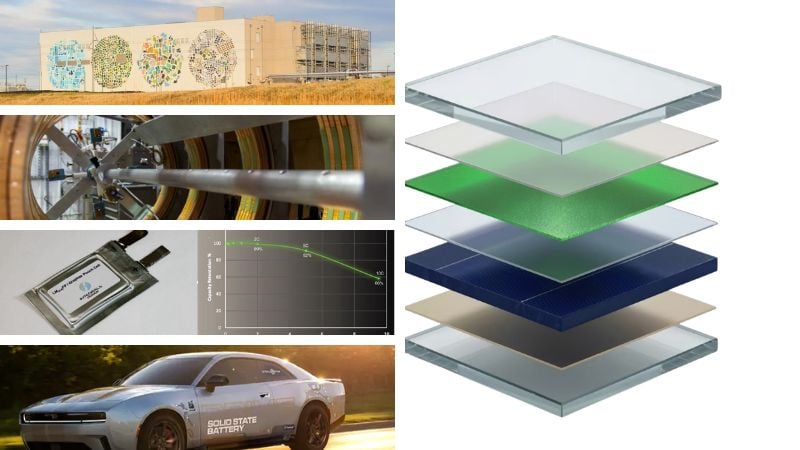
![]() The future of solar, batteries, and nuclear fusion.
The future of solar, batteries, and nuclear fusion.
Google Contracts To Purchase Power from Oklahoma Solar Farm
Google has signed a 15-year power purchase agreement with RWE for the entire electricity output of the 155-MW Crooked Creek Solar project in McCurtain County, Oklahoma. Google will use the solar power for its operations in the Southwest Power Pool regional market while adding 155 MW of generation capacity to the shared power grid.
Construction on Crooked Creek Solar will begin later this year, with full operations in 2028.
In Oklahoma, Google owns eight data centers in Mayes County, northwest of Tulsa, with a ninth building under construction. It also has a hyperscale data center campus in Stillwater and is planning a four-building hyperscale campus in Muskogee.
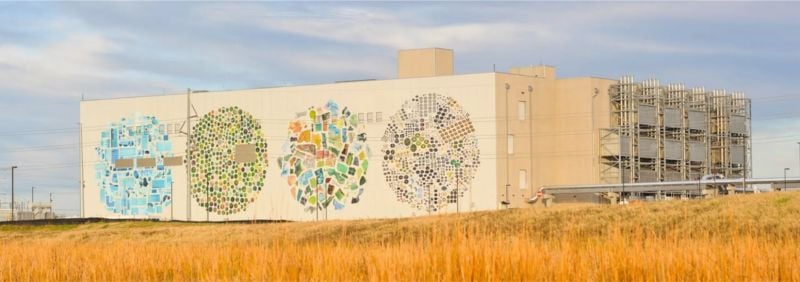
Google data center building in Mayes County, Oklahoma. Image used courtesy of Google
Crooked Creek Solar is RWE's first solar installation in Oklahoma. RWE currently manages the 148-megawatt Boiling Springs wind farm in Woodward County. Six separate power projects representing 1.6 gigawatts of combined capacity remain in active development across Oklahoma. Corporate donations and civic sponsorships from RWE to local organizations in the state exceed $100,000 to date.
Tandem PV Acquires nexTC To Advance Perovskite Manufacturing
Perovskite solar developer Tandem PV has acquired the nexTC Corporation to bring advanced thin-film metal oxide coating capabilities into its solar panel production. The deal gives Tandem PV access to nexTC’s coating technology, technical expertise, and intellectual property.
NexTC makes a solution-based transparent oxide coating that can be added to perovskite tandem solar panels. The ultrathin layers allow sunlight to reach the silicon cell and increase module efficiency and durability. Tandem PV expects the technology will enhance its manufacturing processes.
.jpg)
Tandem PV’s layered solar cells, including a perovskite layer (green). Image used courtesy of Tandem PV
Tandem PV makes solar panels by pairing a thin perovskite absorber layer with standard silicon to capture distinct regions of the solar spectrum. This tandem architecture boosts power yield per unit area, cutting the required land footprint, labor overhead, and balance-of-system hardware per deployed watt.
In the acquisition, NexTC’s founder and CEO, Cory Perkins, will join Tandem PV.
Integrals Power Teams Up With Denchi Group on £2M UK LMFP Project
Integrals Power and Denchi Group have partnered on a £2 million U.K. government-funded initiative to advance manganese-rich lithium manganese iron phosphate (LMFP) battery technology for defense platforms and electric vehicles.
The 30-month project aims to deliver localized supply chain security, lower manufacturing costs, and eliminate reliance on critical minerals like cobalt and nickel. The resulting LMFP cathode materials feature 80% manganese content, offering up to 20% higher energy density than traditional lithium iron phosphate (LFP) cells.
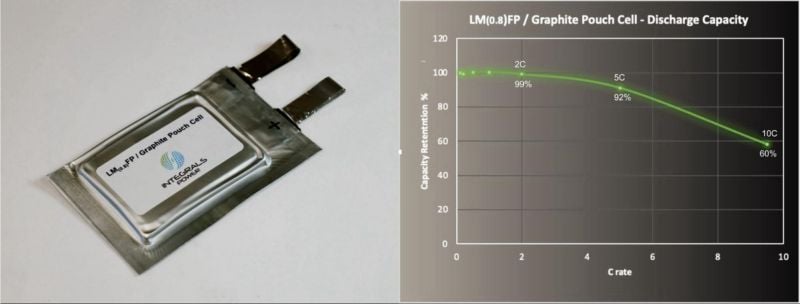
The LMFP pouch cell. Image used courtesy of Integrals Power
Integrals Power will synthesize hundreds of kilograms of patented LMFP active cathode powder at its Milton Keynes plant. The material will feed into pouch cell production and cylindrical cell fabrication in 21700 and 4695 form factors. Manufacturing will take place on the UK Battery Industrialisation Centre's Flexible Pilot Line in Coventry.
Denchi will build the completed cells into pack assemblies at its Thurso, Scotland site. Initial field testing will retrofit Denchi's 1.35 kg, waterproof BB-2590 military power packs, swapping out existing nickel manganese cobalt (NMC) units. The project serves as an end-to-end U.K. supply chain demonstrator for tactical communication hardware, sensor arrays, uncrewed aerial vehicles, and defense backup power systems.
Factorial Energy and SK To Work on Plan for Solid-State Battery Production
U.S.-based Factorial Energy and South Korea’s SK On have signed a memorandum of understanding to assess mass-producing solid-state batteries on existing lithium-ion manufacturing lines. The collaboration aims to bring solid-state batteries to market while lowering production costs, improving thermal safety, and expanding electric vehicle driving ranges.
Factorial’s proprietary quasi-solid-state electrolyte chemistry functions directly alongside high-capacity nickel-rich cathodes and lithium-metal anodes. SK On manages over 200 GWh of global battery manufacturing capacity across its active industrial footprint.
The deal avoids expensive factory retooling while preserving baseline plant throughput by adapting solid-state processing to conventional coating, slitting, winding, and packaging machinery. This compatibility aims to address bottlenecks that restricted solid-state battery adoption across commercial transportation platforms.

Demo car using Factorial’s solid-state batteries. Image used courtesy of Factorial Energy
Factorial engineers its solid-state platforms for applications such as mobility, aerospace, and hyperscale data centers.
ORNL, Rutherford Energy Create Shared Testbed for Nuclear Fusion
Oak Ridge National Laboratory (ORNL) and Rutherford Energy Ventures LP have created the Fusion Upscaled Leveraged Consortia for Rapid Acceleration (FULCRA), a partnership to build a shared testbed infrastructure for nuclear fusion. FULCRA aims to accelerate fusion energy commercialization by fostering cost-effective facilities and reducing reactor risks.
The FULCRA project will join public and private investments to create testbeds at national laboratories. The facilities will allow scientists to validate fusion subsystems, such as fuel-breeding blankets, plasma-facing components, reactor shields, and radiation-compatible sensors and control systems.
_tests_materials_for_use_in_fusion_devices..jpg)
The Material Plasma Exposure eXperiment (MPEX) tests materials for use in fusion devices. Image used courtesy of ORNL
The project will run for 18 months in two phases. The first phase will focus on assessing fusion-enabling technologies, breeding systems, and neutron sources. Phase 2 will develop the financial structure, technical blueprint, and operating framework for a pilot facility at ORNL, with plans to replicate the facility at other national laboratories.