Facebook
 Google
 GitHub
 Linkedin
Research Team Breaks 33-Year Ambient Pressure Superconductivity Record
University of Houston researchers have pushed a cuprate superconductor’s ambient-pressure Tc from 133 K to 151 K using rapid decompression in a diamond anvil cell, breaking a record held since 1993.
Physicists at the University of Houston have achieved a superconducting transition temperature of 151 K at ambient pressure in the mercury-based cuprate Hg1223, breaking a record that had stood since 1993.
The result represents an 18 K increase over the previous record of 133 K held by the same material in its untreated form. The team used a technique called pressure quenching to trap a high-pressure superconducting state at normal atmospheric conditions.
The breakthrough paves the way for room-temperature superconductivity, which could be useful in power grids and energy systems to optimize flow without resistance.
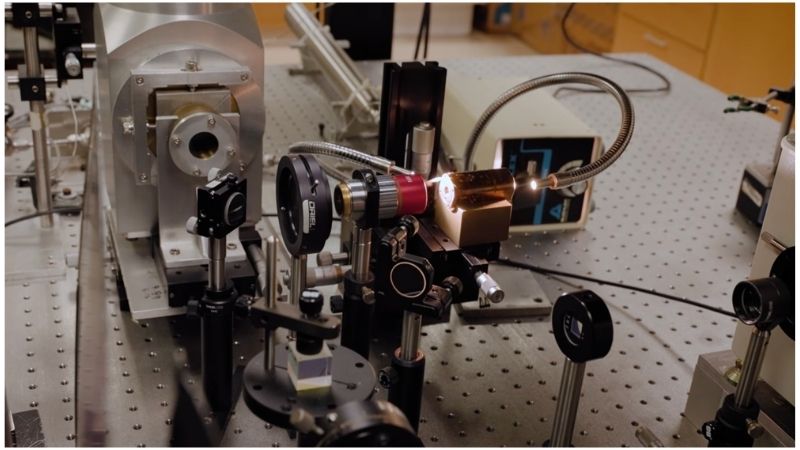
The researchers’ superconductivity work. Image used courtesy of University of Houston
Pressure Quenching
The technique borrows a principle familiar from materials science, where rapid pressure changes are used to create synthetic diamonds. The pressure-quench protocol (PQP) had three stages.
First, the team loaded a single crystal of Hg1223 into a diamond anvil cell and increased the pressure to between 10 and 30 GPa, which raised the material's Tc above 150 K. Second, while the sample was still under pressure and cooled to liquid-helium temperature (4.2 K), the pressure was rapidly released. Third, the team measured the Tc of the recovered sample at ambient pressure.
Across five experiments on four separate crystals, the retained ambient-pressure Tc ranged from 139 K to 151 K, depending on the quenching pressure and temperature used. Quenching from 18.9 GPa at 4.2 K produced the highest result of 151 K. Quenching at the warmer temperature of 77 K yielded a lower retained Tc of 139 K, suggesting that colder quench temperatures are more effective at locking in the high-pressure phase.
Learn more about the experiment. Video used courtesy of University of Houston
Synchrotron X-ray diffraction at Argonne National Laboratory's Advanced Photon Source showed that the crystal structure of the pressure-quenched material remained tetragonal, the same as pristine Hg1223. However, the diffraction peaks were noticeably broader, indicating the presence of strain and structural defects introduced during the rapid decompression.
The team believes these defects help stabilize the metastable high-Tc phase. Supporting this interpretation, the researchers' density functional theory calculations identified a Lifshitz transition at around 12.5 GPa, where new Fermi pockets appear, and the electronic density of states rises sharply. That electronic transition may create an energy barrier that prevents the material from reverting to its lower-Tc equilibrium state.
A Metastable State with Limits
The pressure-quenched phase is not permanent and remained stable for at least three days when stored in liquid nitrogen at 77 K in this study. However, the retained Tc degraded when the material was heated above approximately 200 K. Thermal cycling to room temperature reduced a 147 K sample to 143 K. One experiment produced an unreproduced observation of a possible transition near 172 K, but the team has not been able to replicate it and treats the result as unresolved.
These stability constraints are the main practical limitation of the work. The material must be kept cold to preserve its enhanced properties, and the samples are small, on the order of 100 microns, constrained by the diamond anvil cell geometry. The researchers note that refining the quench parameters and understanding the role of oxygen content and vacancies in stabilizing the phase are priorities for follow-up work.
What Comes Next?
The result has piqued the interest of the condensed matter community. The work appeared in the Proceedings of the National Academy of Sciences.