Facebook
 Google
 GitHub
 Linkedin
Grid-Forming Inverters Stabilize Grids With High Renewables
Kauaʻi’s 2021 oscillation event and a 2023 repeat test show how grid-forming controls can replace lost inertia and damp harmful frequency swings
A U.S. national laboratory determined that grid-forming inverter controls can materially improve grid stability after studying a real disturbance on Kauaʻi, Hawaii, where batteries and solar plants already made up a large share of the island’s power mix. The work centers on an early-morning generator trip in late 2021 that produced a fast frequency drop and an unexpected high-frequency oscillation, and a 2023 repeat event that behaved differently after deploying inverter control changes.
The National Laboratory of the Rockies (formerly the National Renewable Energy Laboratory) led the study, working with Kauaʻi Island Utility Cooperative (KIUC), AES Hawaii, and university partners.
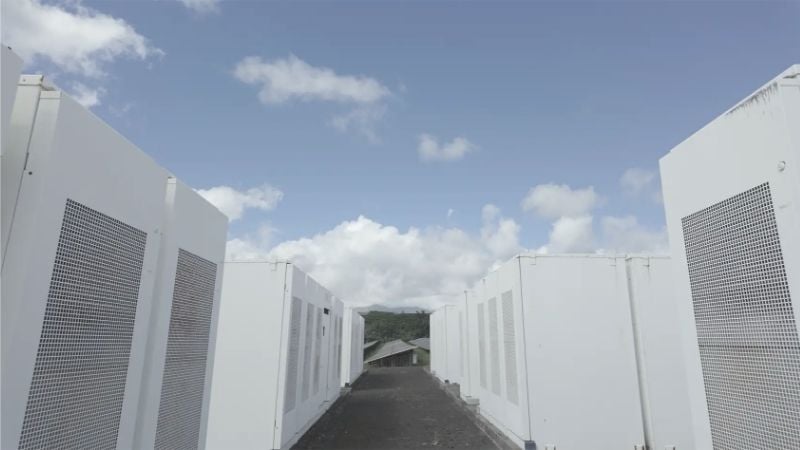
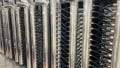
Battery storage units. Image used courtesy of National Laboratory of the Rockies/Connor O’Neil
An Inverter-Era Failure Mode
When an oil-fired generator tripped offline before dawn in November 2021, KIUC’s grid experienced a frequency dip that the island’s battery-backed solar plants quickly responded to. Analysis and follow-on reporting describe battery response within 50 ms, containing the decline within 1.5 seconds and returning frequency to 60 Hz within one minute.
That recovery, however, was far from clean. During that first minute, an 18-20 Hz oscillation propagated across the transmission system, pushing frequency and voltage back and forth. NLR’s account describes the oscillation as sloshing through lines about 20 times per second and dropping around 3% of customers off service until it dissipated.
A lack of control behavior, rather than battery power, caused the problem. The island’s solar-plus-storage plants were built before grid-forming inverter controls were widely available, and several sites used grid-following control schemes. Grid-following inverters synchronize to an existing grid waveform and inject current based on measured voltage and frequency. That’s fine when the grid is “stiff” but becomes harder when inverter-based resources dominate, and the system’s effective inertia falls.
Grid-Forming Controls Stopped the Oscillations
After the 2021 event, KIUC and NLR launched a multi-year effort to identify the oscillation source and harden the system. The team combined utility sensor data, detailed electromagnetic transient modeling, and hardware testing.
NLR pulled data from phasor measurement units and digital fault recorders, and then built a high-detail electromagnetic transient model of Kauaʻi’s grid to replay the oscillation and identify which inverter parameters were instigating it. Purdue University contributed small-signal validation, while NLR used its ARIES platform to validate proposed control changes with hardware-based testing.
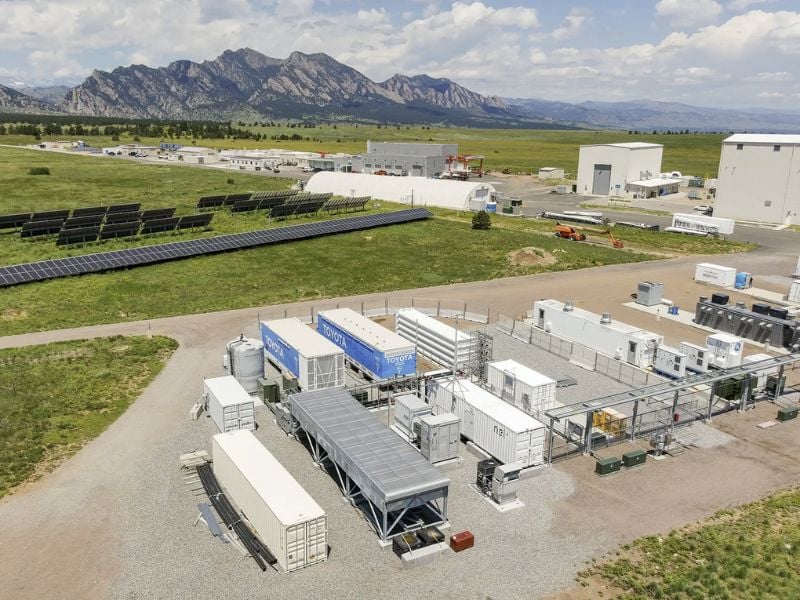
NLR’s mock power system, used to model Kauai’s grid instability. Image used courtesy of NRL/Josh Bauer and Bryan Bechtold
Further analysis from arXiv described parameter-sensitivity studies across dozens of controller parameters and proposed mitigation options, including adjusting inverter-level droop constants and phase-locked loop gains. KIUC later converted one of the grid-following resources to grid-forming mode, which they observed to mitigate the oscillations.
By 2023, grid-forming controls had been added at the inverter-based plants. When a similar generator trip occurred again, NLR reports that the oscillation did not recur. In NLR’s words, a grid-forming inverter does not chase the grid. It aims to “hold its own frequency and voltage constant,” providing synthetic inertia that can stand in for the stabilizing effect of rotating machines.
Measuring ‘Grid Strength’ in Real Time
NLR and partners have also developed a way to quantify stability in real time by injecting small, controlled disturbances through an inverter-based battery plant and observing how the grid responds.
With KIUC’s consent, the team sent test pulses through the island’s grid using an AES Hawaii inverter-based plant and measured the response with custom sensors built with the University of Tennessee, Knoxville. The objective was to estimate how resources react to instability and, effectively, quantify each resource’s contribution to inertia and overall strength. NLR’s conclusion from that work was that grid-forming inverter-based resources significantly enhance grid stability.
The broader question is whether these results can be standardized. NLR points to the UNIFI Consortium, a DOE-funded effort to standardize grid-forming approaches by producing validated models, requirements, and test methods, while also creating a feedback channel between utilities that need accurate models and manufacturers that often treat inverter behavior as proprietary.
Outside the lab, industry groups are also pushing for earlier adoption. The Energy Systems Integration Group (ESIG) has recommended deploying new large-scale batteries with grid-forming software to avoid costly retrofits later, arguing that proactive deployment can mitigate reliability challenges as synchronous generation retires.
Kauaʻi offers a rare case study where a stability problem was captured in the field, reproduced in models and hardware, mitigated with control changes, and then re-tested by real events. Ultimately, it is a concrete example of what grid-forming controls can fix, and the tooling utilities may need to measure and validate that behavior before the next disturbance forces it.