Facebook
 Google
 GitHub
 Linkedin
Exclusive Interview: Quino Energy CEO Touts Flow Battery Advantages
Quino Energy’s CEO Eugene Beh discusses flow batteries’ role in grid stabilization and shorter-duration energy storage.
Energy storage is rapidly becoming standard in renewable energy projects, microgrids, and industrial backup systems. While lithium-ion batteries may be the most popular energy storage method, they are not the only choice. Interest is growing in flow batteries, which are safer and often less expensive.
EEPower spoke to Eugene Beh, CEO of Quino Energy, which manufactures organic redox flow batteries for energy storage. Beh explained the importance of energy storage and the unique advantages flow batteries offer.
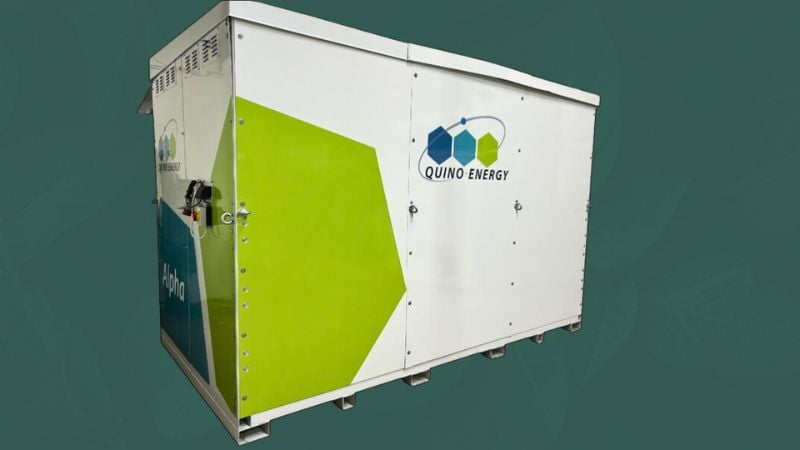
Quino’s flow battery. Image used courtesy of Quino Energy
Energy Storage and Grid Stabilization
Energy storage can serve as backup power for homes and businesses, but it also plays a larger role. As electrification expands, storage has become crucial for grids in providing reliable and stable power to meet demand.
“How we consume energy is changing,” Beh said, remarking that electric vehicles, industrial processes, and homes are all being electrified. “These things used to be very fossil fuel heavy … and that means the grid has to be totally transformed. The only way to do that is with renewables plus storage.”
Renewable energy will continue to grow, Beh said. “Solar and wind, especially solar, are the lowest cost generation options there are,” he explained. “Even solar plus storage is cheaper than, say, new natural gas or nuclear. … Developers just want to go to renewables bcause it’s lower in costs, and it happens to be in terms of carbon emissions.”
However, adding more renewables to the grid can create imbalances in supply and demand. Solar and wind can’t generate energy 24/7. Beh said, imagine everyone coming home from work and turning on their air conditioning simultaneously or charging their EVs.
“The spike in demand is very fast,” Beh pointed out.
When this happens, if energy generation isn’t sufficient, utilities can tap energy storage systems to make up the difference.
Conversely, renewables tend to produce more energy than the grid needs at certain times of day.
“That’s led to things like the infamous duck curve in California, for example,” Beh said. The duck curve illustrates how power demand tends to dip sharply during daylight hours, when renewable systems usually produce the most energy, and rise quickly in the morning and evening.
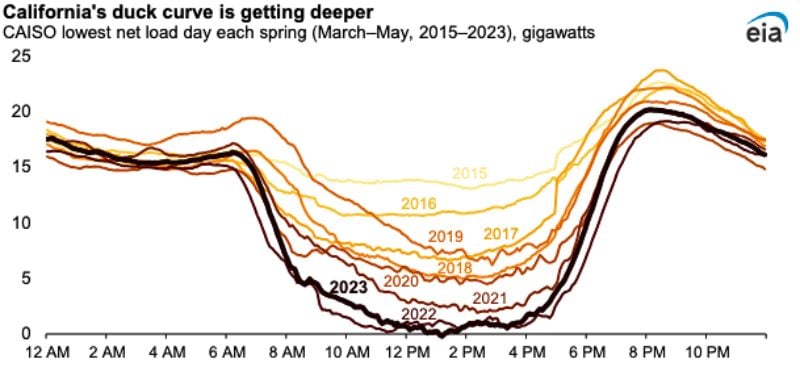
California’s duck-shaped curve, showing energy demand by time of day. Image used courtesy of Energy Information Administration
When demand drops, energy storage systems can store excess electricity for use later when demand increases.
Advantages of Flow Batteries
Grid-scale renewable energy developments typically use numerous units filled with lithium-ion batteries, or less often, sodium-ion batteries. Flow batteries can offer advantages that conventional batteries lack. Most importantly, they are not subject to thermal runaway and fire propagation, like lithium-ion.
“They don’t catch fire, so they’re safer,” Beh explained. “They can be manufactured in the United States, and they have low costs.”
They also outshine battery storage in terms of cycle life. While frequent charging cycles degrade conventional batteries, they don’t affect flow batteries, Beh said. This makes them ideal for applications that make multiple shallow cycles per day, such as data centers.
“The load profile of these data centers are very spiky, so they go up and down a lot,” Beh said. “With flow batteries, you can cycle them zero to 100% and they will not degrade.”

Data center energy demand will soon outpace other industry sectors. Image used courtesy of Energy Information Administration
This quality makes flow batteries a good choice for industry and commercial buildings needing short-duration batteries for backup or power management.
Moreover, flow batteries are easily scalable without taking up floor space or real estate. The flow battery can be easily adapted to short- or long-duration needs. The storage capacity can be increased by increasing the storage tank vertically.
Quino’s Organic Flow Batteries
Flow batteries use two separate tanks containing liquid chemicals in a fuel stack. When the fuel is oxidized through a chemical reaction, it creates electricity. The process can be reversed to store it.
Most flow batteries use vanadium, which is expensive and vulnerable to supply chain problems.
“Primary sources of vanadium come from Russia and China, which isn’t great from a North American perspective,” Beh said. “So people in the U.S. have to extract it from other sources, and that makes it more expensive.”
In contrast, Quino Energy’s flow batteries use organic chemicals, which results in lower overall prices. Quino uses coal tar and ferrocyanide, which are abundant in the U.S. The energy is stored in quinones, which are redox-active molecules that easily convert between a reduced hydroquinone and an oxidized quinone form. These are sourced from natural organic substances, such as henna, certain dyes, and vitamin K1.
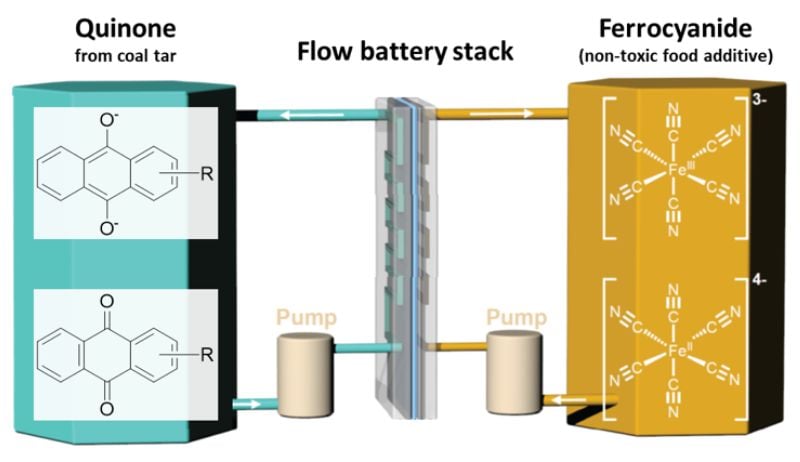
Quino’s flow battery structure. Image used courtesy of Quino Energy
Another advantage is that Quino’s chemistries don’t corrode steel storage tanks. Quino is proposing to create flow batteries from unused tanks in oil refinery facilities. When not used for oil, these huge tanks often store lubricants or other harsh chemicals. Quino believes they can be repurposed to create giant flow batteries.
Flow Batteries and the Future
Energy storage needs will intensify as generation and use increase and diversify. Grids will need long-duration energy storage to integrate renewable energy sources and accommodate industrial and residential electrification. Industries such as data centers and critical facilities like hospitals will need short-duration storage.
While conventional battery storage can meet these needs, flow batteries are a flexible alternative that may save costs and space and reduce carbon footprints.