Facebook
 Google
 GitHub
 Linkedin
Understanding Transient Recovery Voltage in HV Power Systems
This article explores how transient recovery voltage influences high-voltage circuit breaker performance and examines how circuit configurations like transformer-fed faults impact TRV characteristics.
Circuit breakers form an essential part of high-voltage power systems to prevent damage resulting from fault currents. When these breakers interrupt current flow during faults in high-voltage systems, an occurrence of a temporary voltage surge across its contacts causes reliability issues if not well managed. This surge, known as transient recovery voltage (TRV), forms a natural response between the circuit breaker and its surrounding electrical network, influencing the successful interruption capabilities of the circuit breaker during faults.
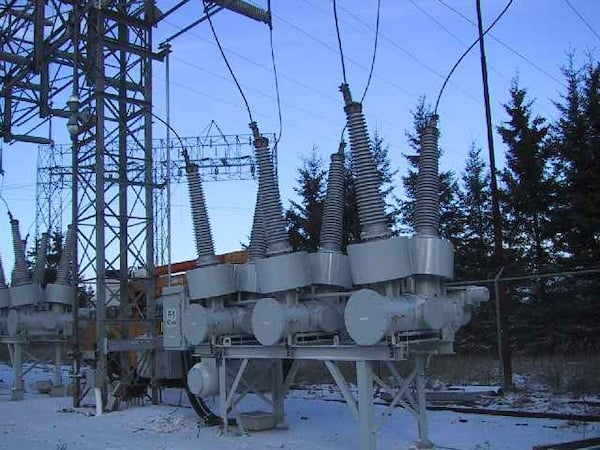
Figure 1. A 3-phase SF6 high voltage circuit breaker. Image used courtesy of Wikimedia
TRV Impact on Circuit Breaker Performance and Reliability
When TRV rises too fast in high-voltage circuit breakers, and the withstand voltage is exceeded, the insulation medium of the breaker is often affected, leading to the breaker’s dielectric breakdown from overvoltage transients due to failed breaker interruptions. When designing these high-voltage circuit breakers, the TRV level is a critical aspect of consideration to ensure performance in the event of fault currents. Another important aspect to consider in the design process is the rate of rise of recovery voltage (RRRV), which represents the speed at which an increase in TRV is evaluated to ensure the breaker handles fault current interruption without experiencing excessive transient stress.
When it comes to reliability, uncontrolled TRV induces switching surges in extra high voltage transmission networks, potentially damaging insulators and transformers within the network. Higher frequency of TRV exposure reduces the lifespan of equipment within the power systems, warranting the need for proper TRV management to prevent damage from excessive overvoltage.
Transient Recovery Voltage Basics
In high-voltage circuit breaker switching, TRV occurrence is due to the redistribution of electrical energy from storage components like capacitors and inductors within the power system before the circuit breaker clears the fault current. TRV is evaluated by considering the natural oscillation frequency (ω) and the damping coefficient (α), which determines the speed of oscillation decay. This evaluation is essential in choosing the right breaker for your power system that can handle a certain TRV threshold.
\[V_{TRV(t)}=V_{peak}(1-e^{-at}cos\,cos(\omega t))\]
RRRV affects the circuit breaker's performance as a higher RRRV leads to a slower buildup of the dielectric strength of the breaker’s gap. RRRV is evaluated by considering the highest voltage (peak TRV voltage) across the circuit breaker’s contact after a fault interruption and the time taken to reach the peak TRV. Most breaker design, however, comes with standardized RRRV value ratings to handle different voltage levels.
\[RRRV=\frac{V_{peak}}{t_{peak}}\]
Factors like higher voltage levels influence the peak TRV voltage in the system, which are characterized by higher peak values. Another factor that influences peak TRV is the type of fault that occurs, such as line-to-grid, line-to-line, or transformer-fed faults. Once a breaker clears a fault, the natural oscillation frequency of the TRV is influenced by the system's equivalent capacitance (C) and inductance (L). This TRV frequency can, therefore, be evaluated as follows:
\[f_{TRV}=\frac{1}{2\pi}\sqrt{\frac{1}{LC}}\]
The TRV oscillations are classified as either critically damped, characterized by a smooth power transition, or underdamped, which has high RRRV, high oscillations, and high stress to the circuit breaker.

Figure 2. TRV waveform shows the initial RRRV region, peak TRV, and the frequency of oscillation. Image used courtesy of Bob Odhiambo
Transformer-Fed Faults and Their Impact on TRV
Transformer-fed faults occur when there is a short circuit in the transformer windings rather than directly from a fault in the transmission line or generator. The electrical characteristics of the transformer, including leakage inductance (Llk) or stray capacitance (Cs), significantly differ from line-fed faults. The leakage inductance in the transformer-fed faults comes as a result of the primary and the secondary winding having imperfect magnetic coupling. This results in magnetic energy storage, which affects TRV during fault occurrences. Slower TRV rise time and an increased oscillatory behavior are caused by higher leakage inductance. This inductance, when paired with stray capacitance within the transformer windings, forms a resonant LC circuit, which affects TRV damping and frequencies. The capacitance level in the transformer acts as a low-pass filter, naturally damping high-voltage transients. When it comes to oscillations, these transformers exhibit high TRV waveform oscillation frequency.
When assessing the impact of transformer-fed faults on TRV, the winding configuration is a crucial factor to consider. These configurations, whether star (Y) or delta (Δ), directly influence the damping, magnitude, and TRV oscillation frequency in the event of fault occurrence. These effects are the results of how the winding configurations handle impedance, fault current, and grounding.
In delta-connected transformers, transient voltage is redistributed among the three power phases of the closed-loop circuit. This allows for the circulation of fault current within the delta loop, ensuring a reduction in voltage spikes at the circuit breaker’s terminal. During transient events, this type of transformer configuration provides a balanced phase voltage, thanks to a natural path for zero sequence currents from the delta connection. This means that symmetry is maintained in the TRV waveform with respect to the ground, ensuring less voltage stress on the circuit breakers. Compared to star-wound transformers, delta-wound transformers feature lower leakage inductance that causes a rise in the TRV waveform's oscillation frequency. The internal circulating current in the delta loop allows for quick damping of energy in the event of transient faults due to stray capacitance that controls the TRV peaks.
In star-wound transformers, the grounding of the winding’s neutral point significantly influences TRV characteristics, as this type of configuration exhibits higher TRV peaks. When the star-wound transformer is grounded, zero sequence currents are restricted, and all fault currents are forced to flow through the neutral impedance and line conductors. With this grounding, additional impedance is introduced, which influences the TRV oscillation by lowering frequencies and increasing magnitudes due to slow energy dissipation. Despite the star-grounded transformer winding having higher TRV peaks, there is improved control of fault currents, unlike in the ungrounded star configuration, which lacks a direct path for the flow of fault currents. This lack of a direct path in the ungrounded star configuration causes a floating neutral condition that leads to possible overvoltage in the power system or unstable TRV transients.
When it comes to practical consideration of the type of configuration to use in a high-voltage power system, the ability to handle TRV is essential. Delta-configured transformers are common in high-voltage transmission systems due to their ability to naturally limit TRV peaks and offer less stress to the circuit breakers. In contrast, star-grounded transformers work well in areas where the stability of the high-voltage system and fault detection are important. This type of transformer, however, needs additional TRV mitigation measures like damping circuits and surge arrestors to prevent damage to the power system.

Figure 3. TRV waveform comparison of star and delta wound transformers, indicating lower peak TRV for star-wound transformers. Image used courtesy of Bob Odhiambo
Ensuring Safe and Reliable Circuit Interruption in High-Voltage Systems
With the growing evolution of high voltage networks, analysis of TRV characteristics remains vital for the development of future protection schemes. By understanding the effects associated with transient recovery voltage, power engineers can make appropriate choices on the circuit breaker, ensuring reliable fault interruption in high-voltage systems. It is essential to consider circuit breakers with high dielectric strength that handle TRV without reignition. Breaker choices like vacuum or SF6 circuit breakers are often preferred for handling high-frequency transients.