Facebook
 Google
 GitHub
 Linkedin
Hitachi Tests Grid-Forming Inverter for Grid Stability
Hitachi’s Narashino Works deploys inverter-based systems to stabilize industrial power.
Traditional power grids have long relied on the mechanical inertia of large thermal power plants to maintain stable frequencies, typically 50 or 60 Hz. These plants use heavy rotating turbines that resist sudden changes in frequency, providing a built-in buffer against imbalances between supply and demand. But as renewable energy sources like solar and wind displace fossil fuels—and as distributed energy resources become more common—the modern grid is losing that built-in stabilizing force. Without sufficient inertia, even minor disturbances can trigger frequency instability, equipment malfunctions, or widespread outages.
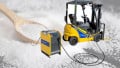
An advanced grid-forming inverter (GFM) system is now operational at Hitachi Industrial Equipment Systems’ Narashino Works plant in Japan. The installation is part of a larger push to enhance grid stability as variable renewable energy sources replace conventional fossil-fuel generation.
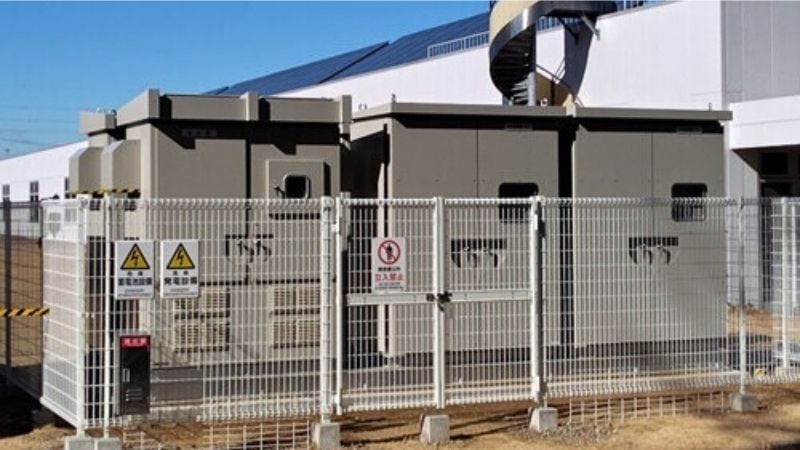
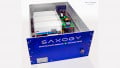
Hitachi’s next-generation inverter technology at Narashino Works in Japan. Image used courtesy of Hitachi Industrial Equipment Systems
How GFMs Work
GFMs deliver key functions traditionally provided by synchronous generators, such as voltage control, frequency regulation, and virtual inertia. Unlike grid-following inverters, which rely on an existing voltage source, GFMs can independently establish and maintain grid conditions. In fully inverter-based networks, GFMs can support black-start capability, fault ride-through, and precise frequency control.
These factors make GFMs useful for stabilizing low-inertia systems with high shares of wind and solar generation, a key reason why the technology is gaining interest from governments and grid operators worldwide.
Hitachi’s Grid-Forming Inverter Solution
Hitachi's GFM technology simulates inertia, helping to maintain frequency stability and balance power flows, even during sudden shifts in demand or renewable generation. Unlike conventional inverters that follow an external grid signal, GFMs can establish and regulate their own voltage and frequency, enabling them to form stable, self-sufficient microgrids that coordinate with other units or operate independently.
At Narashino Works, Hitachi’s GFM system converts DC power from onsite solar arrays and battery storage into AC power for use throughout the plant, where the company manufactures industrial components such as motors, pumps, and inverters. The system integrates 81.9 kW of solar power, including 54 kW newly installed. Battery storage and DC/DC converters tie into a microgrid architecture incorporating both AC and DC systems, designed to maintain critical loads during grid outages.
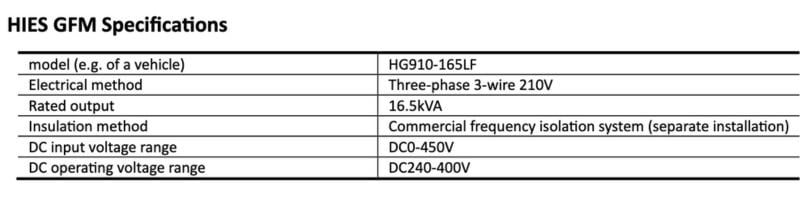
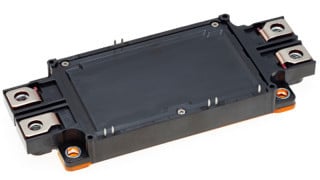
GFM specifications. Image used courtesy of Hitachi Industrial Equipment Systems
The GFM is rated for three-phase, 3-wire operation at 210 volts and delivers a maximum output of 16.5 kVA. It also features a separately installed commercial frequency isolation system for insulation.
On the DC side, it supports a wide input voltage range of 0 to 450 V, operating efficiently between 240 and 400 V. These broad tolerances enable flexible integration with solar panels, storage, and other distributed energy resources.
GFM Results
Hitachi Industrial Equipment Systems states the GFM system ensures uninterrupted service to critical infrastructure, including multiple water pump systems and communications equipment. As detailed in system diagrams, the DC microgrid supports a vortex pump and an industrial water pump room. At the same time, the AC portion feeds an evacuation center and building lighting through a pump system using a motor with integrated control. Onsite broadcasting equipment can also receive power through the AC system.
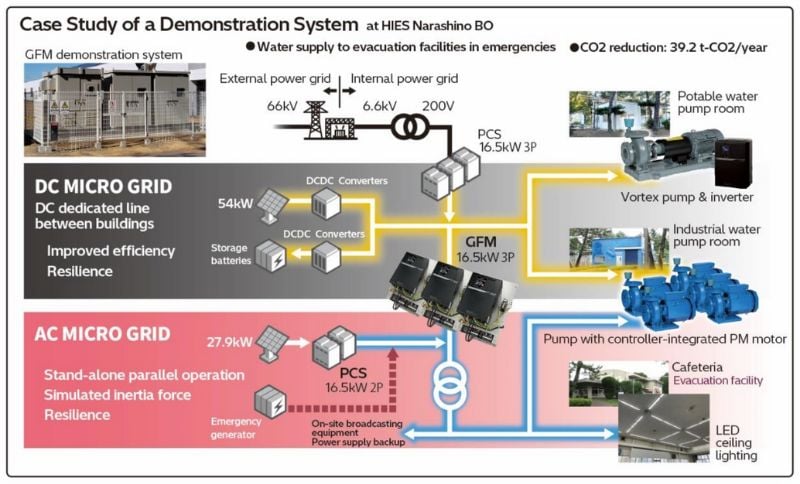
Hitachi’s GFM demonstration system. Image used courtesy of Hitachi Industrial Equipment Systems
The company reports that the Narashino Works plant uses solar energy more efficiently, reduces conversion losses, stores surplus energy, and routes it back into the facility’s operations as needed. The 81.9 kW of solar power is expected to cut carbon dioxide emissions by 39.2 tons annually.
The plant has long served as a testing ground for energy systems, hosting solar and integrated energy monitoring since the early 2000s. More recently, in 2023, engineers demonstrated a vehicle-to-everything (V2X) system using an electric vehicle to supply power for a water unit, extending the plant’s role in exploring energy technologies.