
 Facebook
 Google
 GitHub
 Linkedin
Briefs: Fission and Fusion, Nuclear Projects Abound
Brookfield, The Nuclear Company, Westinghouse Nuclear, Commonwealth Fusion Systems, Blue Energy, GE Vernova, FANCO, and X-energy are among the companies planning new nuclear developments.
Nuclear energy has emerged as a major solution for addressing the world’s energy challenges. Several new deals are underway involving power plants, small modular reactors, and fusion.
Brookfield and The Nuclear Company are teaming up to advance Westinghouse’s nuclear reactor technology, while Commonwealth Fusion Systems has submitted the world’s first fusion plant connection request. Small modular reactors (SMR) are also gaining momentum, as Blue Energy and GE Vernova collaborate on a gas-plus-nuclear design. First American Nuclear is seeking approval for its SMR, and Kentucky utilities are examining the possibilities of using X-energy’s SMRs.
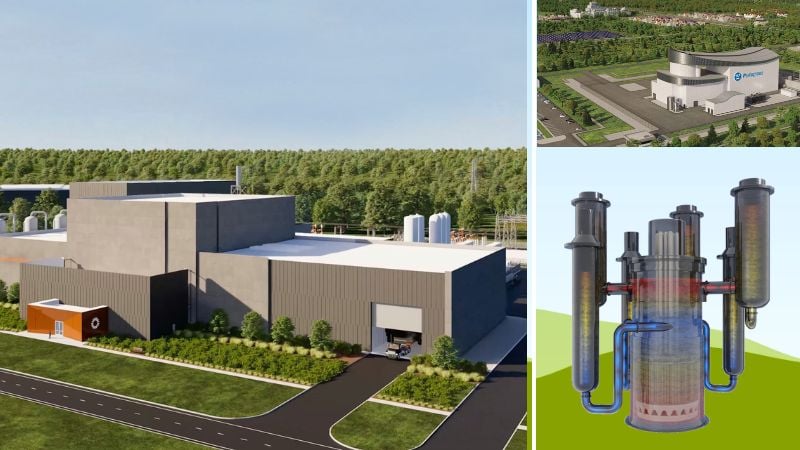
Nuclear reactor technology.
Brookfield and TNC Form Company to Advance Westinghouse Nuclear
Brookfield Asset Management and The Nuclear Company (TNC) will partner to create a company focused on developing Westinghouse nuclear reactor technology.
The company will execute and deploy nuclear projects involving the Westinghouse reactors, including AP1000 and AP300. Services will involve project management, licensing support, engineering oversight, procurement, construction, and commissioning.
The AP1000 is a pressurized water reactor designed for nuclear power plants. The AP300 is a mid-size small modular reactor that is compact and scalable.
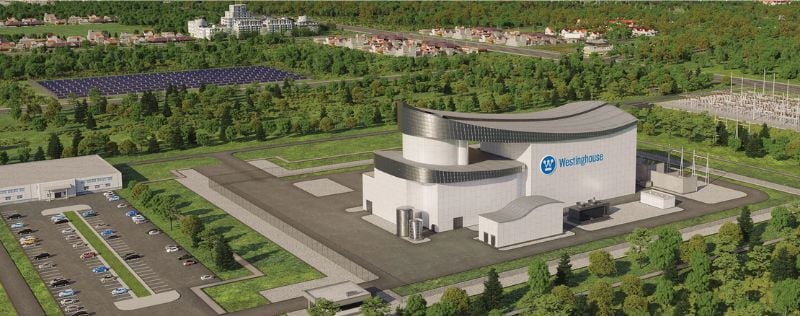
The AP300. Image used courtesy of Westinghouse Nuclear
The new company will serve as the project manager for the V.C. Summer Nuclear Units 2 and 3 in South Carolina, which is already under construction.
Commonwealth Fusion Asks for Grid Connection for Fusion Plant
Nuclear fusion may be a reality sooner than we think. Commonwealth Fusion Systems (CFS) has asked to connect its ARC power plant to PJM Interconnection, the largest Regional Transmission Organization (RTO) in the U.S. The request is a world first.
CFS projects its 400 MW grid-scale fusion plant in central Virginia will be operational in the early 2030s. CFS submitted its request now because the connection process is lengthy. The company must meet PJM’s requirements through stress tests to demonstrate reliable power delivery. These tests include grid simulation models that evaluate the fusion plant’s generation systems.
PJM serves about 65 million customers with 182,000 MW of capacity. The RTO coordinates the networks of energy generators and transmission lines to maintain grid reliability and meet supply and demand.
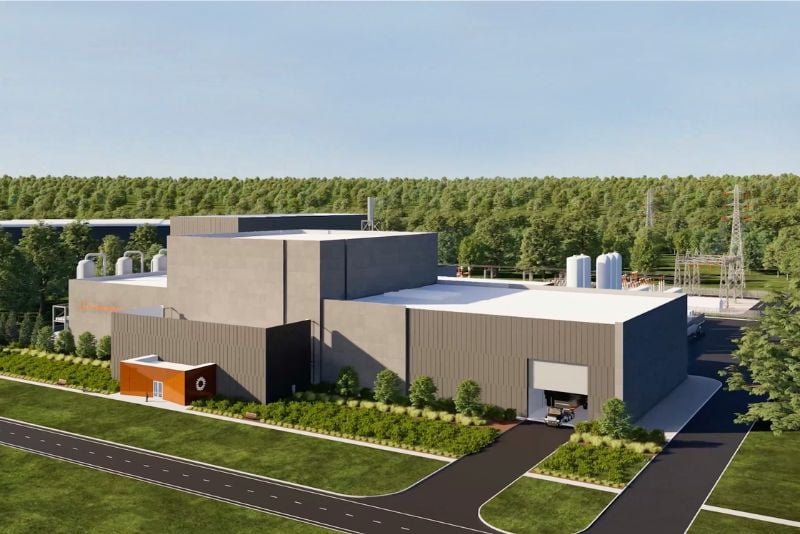
Rendering of the Fall Line Fusion Power Station in Virginia. Image used courtesy of Commonwealth Fusion Systems
Blue Energy and GE Vernova Collaborate on Gas-Plus-Nuclear Tech
Blue Energy and GE Vernova will collaborate to advance the world’s first gas-plus-nuclear power plant, which could deliver up to 2.5 GW of power.
Blue Energy will combine its project financing and nuclear construction expertise with GE Vernova’s reactor technology and turbines to design and develop a nuclear power plant in Texas. The plant will use GE Vernova Hitachi Nuclear Energy’s BWRX-300 small modular reactors.
The final investment decision will be made in 2027, but until then, the companies have reserved delivery of two GE Vernova 7HA.02 gas turbines for the project. The turbines are set for delivery in 2029.
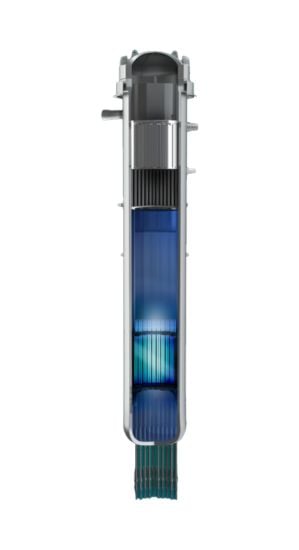
The BMRX-300 SMR. Image used courtesy of GE Vernova
The companies will also seek optimal methods for contracting and off-site construction of power plant modules suitable for the BWFX-300 design, aiming to reduce capital costs and speed up supply chains. Blue Energy plans to build most of its plants off-site and transport them to the location.
First American Nuclear Requests Approval for Fast-Spectrum SMR Plan
First American Nuclear (FANCO) has submitted its regulatory engagement plan for its EAGL-1 small modular reactor to the United States Nuclear Regulatory Commission. The step is the first step toward a construction permit.
The EAGL-1 is a liquid metal fast reactor (LMFR) that produces 240 MWe and 600 MWt per unit. A six-unit cluster can provide power for 1.5 million homes while using 10 times less land than other power plants.
The LMFR uses a non-pressurized, four-loop primary system protected by a guard vessel. All pipe penetrations are above the fuel assemblies, so that a pipe failure cannot affect the reactor core. A fully passive decay heat removal system allows the reactor to stabilize itself without human assistance. The EAGL-1 uses HALEU dioxide fuel, a uranium derivative.
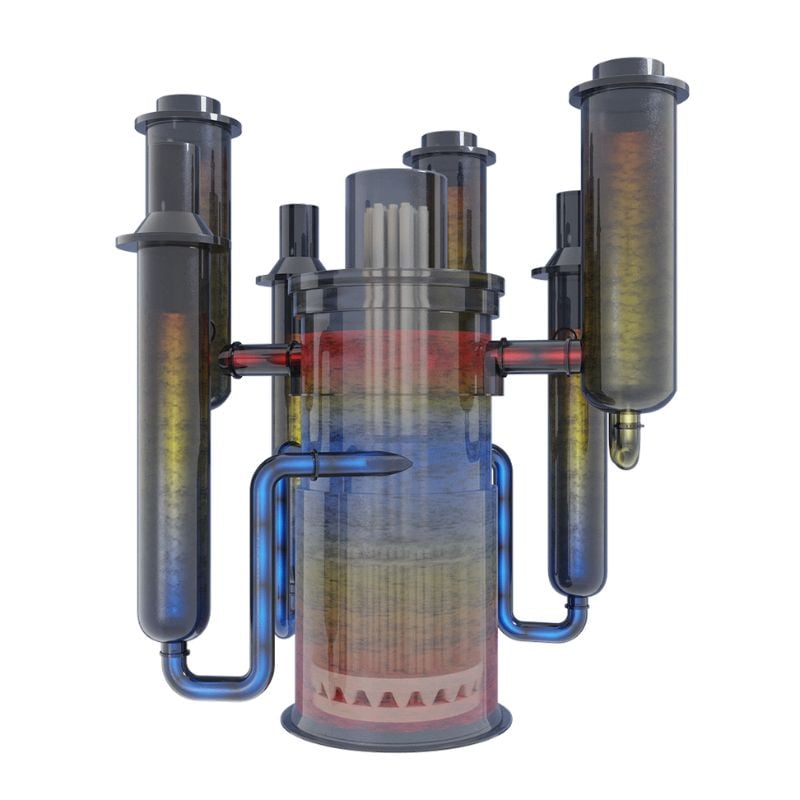
 The EAGl-1 technology. Image used courtesy of FANCO
Lead-bismuth cooling is safer and more stable than liquid sodium. The reactor can operate without an intermediate heat-transformer loop, which lowers construction costs.
After review, the Pacific Northwest National Laboratory determined that the EAGL-1 design would meet NRC licensing criteria.
FANCO is also developing a lead-bismuth test loop to provide the NRC with real-world performance data.
LG&E and Kentucky Utilities To Consider X-energy’s SMR
Louisville Gas and Electric Company (LG&E) and Kentucky Utilities are collaborating with X-energy to conduct feasibility studies for using X-energy’s SMR technology in Kentucky to meet growing energy demand.
X-energy’s Xe-100 SMR is an 80 MW3 high-temperature gas-cooled reactor that can scale up as needed. Each reactor can come online independently, allowing users to expand the system if demand increases. Four units are typically deployed to generate 320 MWe, but it can scale up to 12 units, producing nearly 1 GW, enough to power large urban areas or hyperscale data centers.
The Xe-100 uses helium gas for cooling, enabling it to operate at temperatures over 750°C for higher thermal efficiency. It uses TRISO (TRi-structural ISOtropic) fuel particles, which are uranium pellets encased in ceramic layers. The fuel design allows the reactor to shut down if necessary without human intervention.

TRISO fuel particles. Image used courtesy of Department of Energy
X-energy is developing more than 11 GW of nuclear capacity in projects in the U.S. and the U.K. The company also has partnerships with Dow Chemical, Amazon, and Centrica.
Kentucky will award up to $25 million each to three selected nuclear projects to cover research, permitting, and licensing expenses. The funding is available through the state’s Nuclear Reactor Site Readiness Pilot Program.








Very informative blog about industrial earthing solutions. Proper grounding systems and lightning protection products are essential for telecom towers, solar projects, and commercial buildings.