Facebook
 Google
 GitHub
 Linkedin
Fueling Fusion With Tritium from Nuclear Waste
Los Alamos National Laboratory researchers are modeling a system that converts nuclear waste into tritium, a scarce fuel vital for future fusion energy plants.
Los Alamos National Laboratory researchers are modeling a system that converts nuclear waste into tritium, a scarce fuel vital for future fusion energy plants.
Fusion has long promised a nearly limitless source of clean power, but a single ingredient could block its path: tritium. This isotope of hydrogen is required for deuterium-tritium reactions, the most practical design for near-term fusion plants. The challenge is that the global inventory is tiny, about 25 kg, and continues shrinking. A single two-gigawatt fusion plant could need more than 100 kg per year. Without a new supply chain, large-scale fusion deployment is unlikely.
At the American Chemical Society’s Fall 2025 meeting, Terence Tarnowsky of Los Alamos National Laboratory described a possible solution. His idea is to harvest tritium from nuclear waste using an accelerator-driven system. Instead of leaving thousands of tons of spent uranium and plutonium fuel in storage, Tarnowsky proposes putting that material to work.
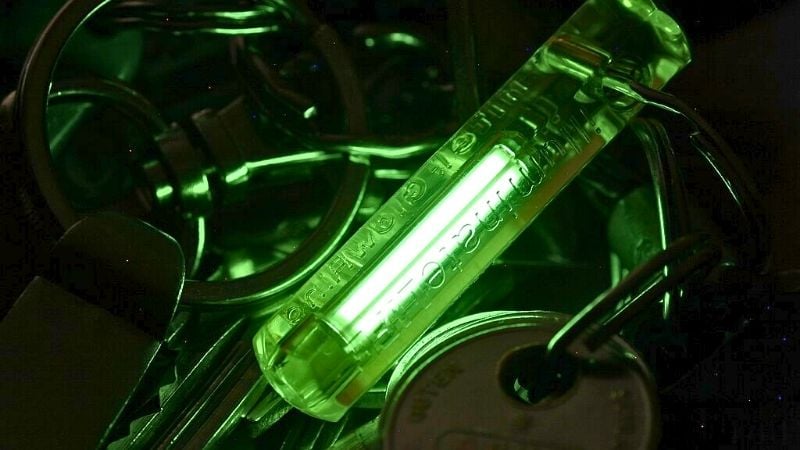
Tritium is a byproduct of nuclear reactors. Image used courtesy of Wikimedia Commons
Los Alamos’ Nuclear Proposal
The concept uses a linear accelerator to fire particles into spent nuclear fuel held in molten lithium salt. That reaction produces neutrons that interact with the lithium to form tritium. Unlike a traditional reactor, the accelerator can simply be switched off, removing the risk of a runaway chain reaction. Early modeling points to meaningful output: a one-gigawatt setup, about the yearly electricity demand of 800,000 U.S. homes, could yield roughly two kg of tritium per year, equal to the entire annual supply now produced in Canada’s fission reactors.
With further optimization, Tarnowsky estimates the technology could generate more than 10 times the tritium per thermal power unit than a fusion reactor. This efficiency would help offset the isotope’s short half-life of 12.3 years, which makes long-term stockpiling impossible. In practice, new production capacity must keep pace with reactor demand.
Nuclear Waste as a Resource
The proposal also recasts the nuclear waste problem. U.S. reactors add about 2,000 metric tons of spent fuel each year, much of which sits in casks or vaults. Managing this material costs hundreds of millions annually and raises long-term safety concerns. Converting it into tritium would reduce liabilities while providing a high-value output.
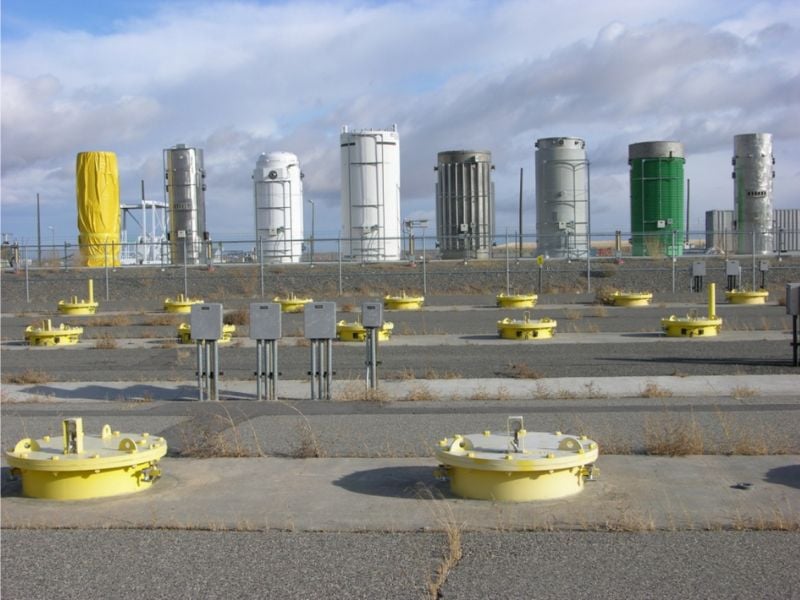
Nuclear fuel is stored at the Idaho National Laboratory. Image used courtesy of Department of Energy
Surrounding the waste with molten lithium salt provides additional safeguards. The salt cools the system, makes it more challenging to extract the radioactive contents, and creates a recordable environment for tracking material. These features align the design with nonproliferation and environmental goals, making it more attractive to regulators and policymakers.
Economic and Strategic Stakes of Tritium
Tritium sells for more than $30 million per kg, a price that highlights just how rare it is. Building a domestic supply would bring costs down and cut reliance on overseas reactors. It would also make tritium more available for uses beyond fusion, from medical imaging to the glow in exit signs, while still meeting the growing demand from energy research.
A reliable supply would help bridge the gap between experimental fusion systems and commercial deployment. It would also give the U.S. a stronger position in the global energy landscape, where tritium access may become as strategically important as oil reserves once were.
What Comes Next for Fusion
The Los Alamos Laboratory’s effort is still at the modeling stage, but new accelerator designs and molten-salt systems make it more realistic than when similar ideas were floated in the 1990s. The team’s next steps are to sharpen efficiency estimates, pin down costs, and weigh different reactor layouts. Tarnowsky’s group is also building fresh simulation codes to test safety limits and long-term reliability.
If the approach proves out, it could tackle two problems at once: the buildup of spent nuclear fuel and the shortage of tritium. Converting waste into a useful fuel would turn a costly burden into an asset, potentially giving fusion the last piece it needs to move from promise to reality.