Facebook
 Google
 GitHub
 Linkedin
Google Gambles on Future Nuclear Fusion Power Plant
Google has signed a deal with Commercial Fusion Systems to purchase fusion energy generated from its future nuclear fusion plant.
In a move Google is calling “a bet” and a “moonshot,” the tech giant has agreed to purchase 200 MW of nuclear fusion energy from Commercial Fusion Systems (CFS) in hopes of accelerating the technology toward commercialization. The technology is still in development.
Google explains its investment in fusion. Video used courtesy of Google
Nuclear fusion, the same technology powering the Sun and stars, has the potential to produce enormous amounts of carbon-free power. However, while many private companies and public laboratories are working on fusion technology, none have succeeded yet in producing sustained energy generation. CFS states its first fusion facility in Chesterfield County, Virginia, will be operational by the early 2030s.
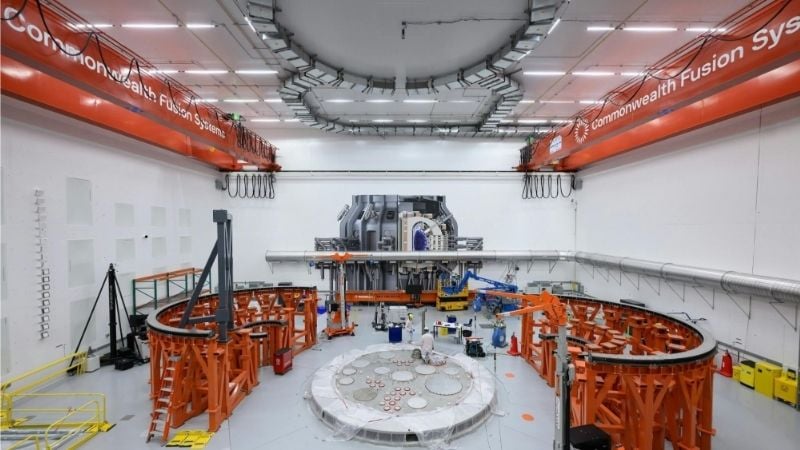
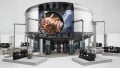
Fusion facility. Image used courtesy of CFS
Big Tech and Nuclear Energy
Google and other tech companies, including Microsoft, Meta, and Amazon, urgently need the energy to power the rapid expansion of their energy-hungry AI data centers, which are straining local grids. These power needs have also derailed their progress toward net-zero emissions.
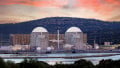
For several years, the tech companies have been developing solar, wind, and geothermal projects, and lately, they’ve turned to nuclear power for clean, consistent energy. For example, Microsoft has recommissioned the former Three Mile Island nuclear facility. Meta has purchased nuclear energy from a struggling plant in Illinois, and Google and Amazon have invested in small modular reactors. All these efforts involve nuclear fission, commonly used in nuclear energy generation since the 1950s.
Google, however, is aiming for future power needs. It has supported CFS’s fusion technology since 2021, when it invested $1.8 billion. The company did not disclose financial details of its latest funding.
CFS and Fusion Technology
Fusion technology has experienced several breakthroughs over the past decade, but commercialization remains elusive. Fusion requires extremely hot temperatures (100 million °C) and powerful magnetic fields to confine and maintain the plasma state that makes fusion possible. So far, the longest fusion sustained was just over 22 minutes by the WEST tokamak in southern France in February. Most laboratories use the tokamak, a toroidal or donut-shaped chamber, for creating fusion, though many are experimenting with other designs and technologies.
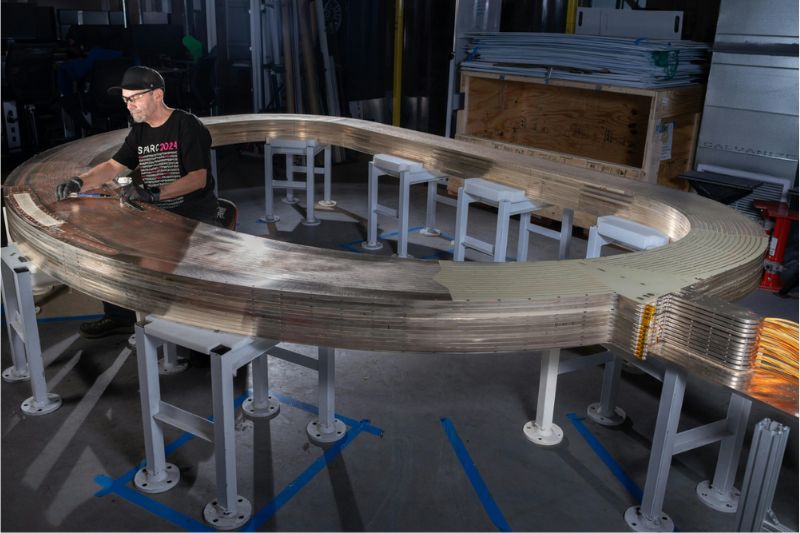
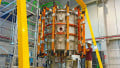
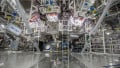
The HTS magnets. Image used courtesy of CFS
CFS, an MIT spin-off, has created high-temperature superconducting (HTS) magnets in a fusion chamber called SPARC, a type of tokamak. The HTS magnets can produce stronger magnetic fields in a more compact area, which can confine the plasma until temperatures reach high enough for fusion.
The technology will eventually be used in the ARC power plant, which CFS claims will be the first grid-scale fusion plant in the world. ARC is expected to be about the size of a big-box store and use less land than solar or wind developments. CFS states that the smaller fusion plant will be more economical than conventional fission plants, allowing placement closer to transmission systems.
ARC uses fuel from the hydrogen forms deuterium and tritium, which is standard for fusion. Both are abundant and inexpensive. During fusion, heating the fuel creates a plasma, which ARC contains as heat with a liquid “blanket.” The heat is transferred to a steam turbine to generate electricity. CFS expects the ARC fusion plant to produce 400 MW of electricity, enough to power about 150,000 homes.
The ARC plant will be located near Richmond, Virginia. Google will have the option of taking energy from future CFS fusion plants.
Big Tech and Fusion’s Future
CFS is not the only fusion company that Google has invested in. In 2015, Google Research collaborated with TAE Technologies to use AI to study plasma behavior. The company contributed to TAE’s $150 million round of funding in June. TAE states it can achieve stable plasma at 70 million °C in a compact, linear fusion device. It employs a technique called “advanced beam-driven Field-Reserve Configuration,” which uses hydrogen-boron as a fuel.
Microsoft is also taking a chance on fusion. It signed a power purchase agreement in 2023 with Helion, owned by OpenAI founder Sam Altman. Helion expects to have a 50 MW facility operating by 2028.