Facebook
 Google
 GitHub
 Linkedin
Ferrari Yacht Sails Smoothly on Renewable Energy and DC Power
ABB and Ferrari are collaborating on an electric sailing yacht with an integrated DC microgrid.
A sleek sailing yacht will use more than the wind to cruise the seas. The Ferrari Hypersail will operate on an electric microgrid.
Ferrari and ABB are teaming up to develop the 100-foot 100-foot oceanic full-foiling monohull yacht. It will rely on a dual 800 VDC and 48 V microgrid architecture to power the vehicle. The ambitious project could influence marine applications and offer insights into how microgrids and smart grids can be better managed on land.
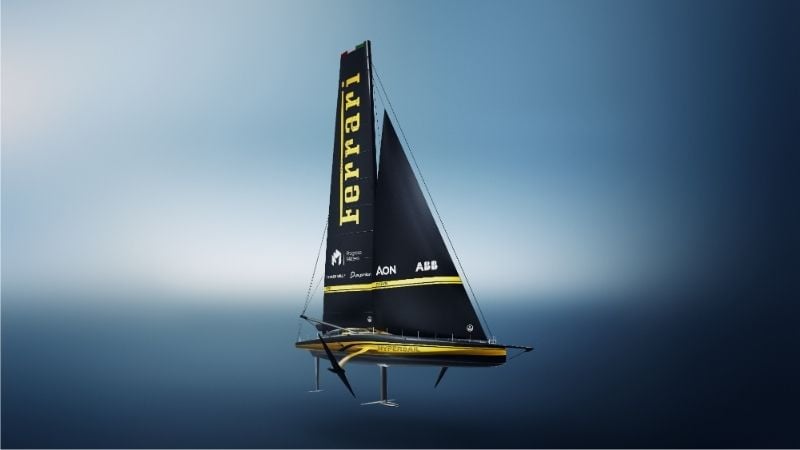
The Ferrari Hypersail. Image used courtesy of ABB
The Ferrari Hypersail
The Hypersail is designed to push the capabilities of sustainable marine performance, bringing together speed, resilience, and safety with onboard renewable energy generation and energy management in demanding marine environments.
The craft is 40 meters high, 30 meters long, and 20 meters wide. It uses a main tilting underwater fin linked to a side wing, while a rear steering blade and two alternating side wings provide stability.
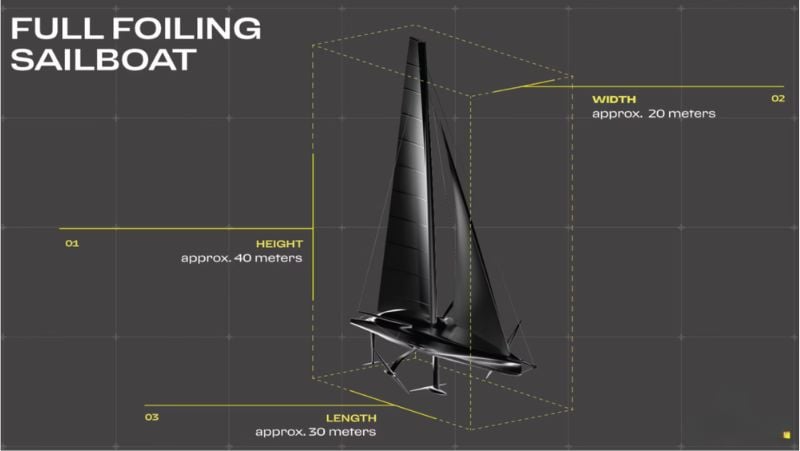
Hypersail dimensions. Image used courtesy of ABB
The Hypersail has integrated wind turbines and solar panels. Running entirely on renewable energy, the Hypersail is designed to be self-sufficient for weeks at a time. The dual-voltage DC architecture acts as a self-sufficient microgrid, enabling the microgrid to generate, store, and manage power for critical navigation, foil controls, and safety systems, even in harsh environments such as extreme cold, salt spray, pressure, and motion.
The Hypersail’s DC Microgrid
Because the microgrid uses a DC architecture, it requires no power conversion (DC to AC and AC to DC), improving the power distribution system's overall energy efficiency. This means captured and stored energy does not need to undergo these conversion stages; the only potential conversion stage is switching from DC to AC to power the Hypersail’s systems and electronic components.
DC microgrids connect renewable energy systems and batteries directly to a DC bus. This allows solar panels to be easily integrated into the microgrid and enables energy to flow directly into the batteries without complex frequency synchronization.
Other distribution systems based on AC architecture undergo multiple conversion stages between generation, storage, distribution, and the final load, which reduces energy efficiency. Each energy conversion stage generates heat and increases electrical losses while also introducing more potential failure points. When out on the water for long periods, the Hypersail will need as high an efficiency as possible to remain self-sufficient.
The 800 VDC batteries allow power distribution at a lower current. Releasing energy at lower current reduces resistive losses, cuts required cabling, and lets the microgrid support higher energy-storage loads.
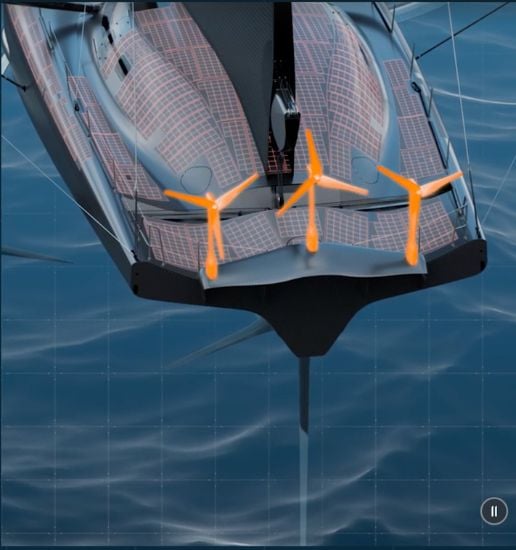
Integrated solar cells and wind turbines. Image used courtesy of Ferrari
One key aspect is the dual-voltage architecture, which uses two voltages rather than a single voltage to operate every device on the Hypersail. The higher 800 V supports the Hypersail's high-power requirements (such as active flight control), while the 48 V architecture supports smaller electronic components that can’t handle such high voltages, such as control electronics, computing systems, and sensors.
DC-DC converters step the voltage up and down between 48 V and 800 V, and because they don’t change the current's phase (unlike AC-DC and DC-AC conversions), the conversion process is much more efficient. The dual-voltage architecture makes the system much more efficient, saving energy and helping the Hypersail remain self-sufficient.
Built to Withstand Harsh Environments
The microgrid architecture and other aspects of the Hypersail are designed to withstand harsh open-water conditions, including corrosion, vibration, moisture, restricted cooling, and mechanical shock. Because maintenance is trickier, these harsh conditions can expose weaknesses that are less obvious in a static installation.
Foiling the vessel also requires active control. This means navigation, foil control, safety functions, and other essential systems all need reliable power within an energy budget, since the power generated and stored for these systems must also be shared with the propulsion system and other electrical loads.
Watch the Hypersail in action. Video used courtesy of Ferrari
This requires an efficient energy management system that can prioritize where energy should be used and when it should be stored, rather than relying on installing enough generating capacity to meet nominal loads.
Because renewable generation output is variable, the smart energy management system plays a key role in ensuring that batteries charge and discharge effectively and that the system meets transient loads regardless of current generation capacity. This approach means the Hypersail will be well equipped to handle changing conditions, and the microgrid architecture will remain robust and reliable during long self-sustaining periods.
Tying the Hypersail to Static Microgrids
The ocean serves as an outdoor laboratory for the Ferrari Hypersail, providing a real-world testbed to advance grid technology. Operating the vessel in harsh offshore conditions helps ABB better understand how electrification, DC architecture, and intelligent energy management improve grid resilience.
Navigating challenges like real-world power distribution, storage, and renewable generation mirrors the demands placed on modern smart grids. Ultimately, these sea trials produce vital data on thermal limits, battery response, transient demand, and control interactions that traditional laboratory testing simply cannot replicate.