Facebook
 Google
 GitHub
 Linkedin
Maximizing Grid Management With Quantum Optimization
Researchers found quantum particle swarm optimization could manage grids with renewable energy, microgrids, and extreme temperatures.
The global shift toward decentralized energy systems contains a wide array of renewable energy resources and other distributed energy resources. These technologies are attached to microgrids before entering the main distribution grid. Microgrids bring more flexibility and resilience to the grid as they can be used to respond to fluctuating demand and reduce greenhouse gas emissions.
However, microgrids use fluctuating power generation capabilities that need to be effectively managed and optimized. Researchers from India and Ukraine have used a quantum particle swarm optimization (QPSO) framework to optimize operational cost and GHG emissions in grid-connected microgrids.

Illustration of a grid-connected microgrid. Image used courtesy of Adobe Stock
Microgrids Provide Support in the Summer Months
In the summer months, when temperatures are higher, electricity demands tend to spike due to increased air conditioning usage. When coupled with losses that can occur around transmission lines in high temperatures, the grid can become vulnerable in summer months, especially in hot climates.
In challenging environments, microgrids support the grid by supplying energy when needed to prevent outages. Microgrids encapsulate the shift in grid infrastructure towards more resilient and robust grids now required in more erratic climate conditions. Microgrids have become particularly useful for increasing grid resilience in increasing natural disasters and cyberattacks, which have the potential to get worse as digitally connected smart grips are widely adopted.
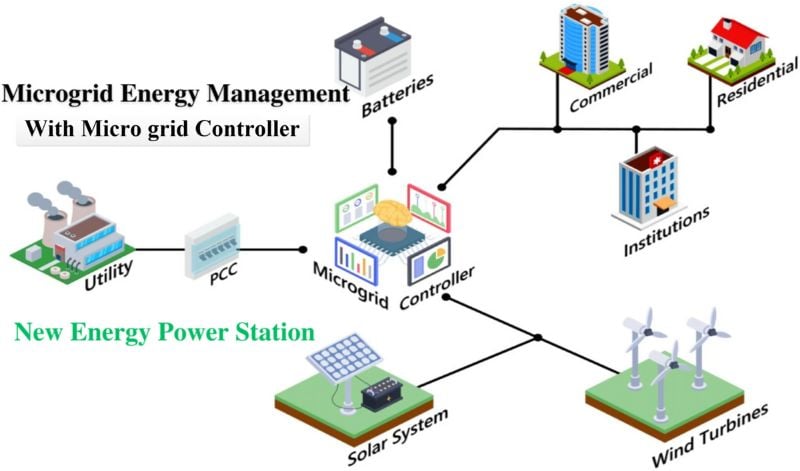
Typical microgrid configuration. Image used courtesy of Paul et al.
Renewables support decarbonization and can be implemented to simultaneously reduce emissions and improve resilience. However, intermittent renewable sources create fluctuating demand patterns that need to be managed. Microgrids are the best way to manage renewable integration to ensure reliability and cost-effectiveness. Since more renewables are to the grid each year, microgrids are essential for their integration and management to better address grid failures and localized downtime.
Analyzing Microgrid Configurations with a QPSO Framework
Operators ensure that microgrids remain dependable for long periods by using energy management systems that cover both supply and demand. These systems help balance and optimize supply with localized demand, provide reactive power support, lower greenhouse gas (GHG) emissions, and improve grid reliability. However, in grid-connected microgrids, balancing GHG emissions with operational costs is often a challenge.
In a study in Scientific Reports, researchers from India and Ukraine used a quantum particle swarm optimization (QPSO) framework. Unlike other optimization frameworks, QPSOs use quantum mechanics principles. This avoids the premature convergence and stagnation seen in more traditional methods by using quantum-inspired operators, such as quantum probability distributions, that can better optimize complex, non-linear, and multimodal problems.
The researchers integrated QPSO into microgrid energy management systems to optimize the microgrid's economic and environmental/emission objectives.
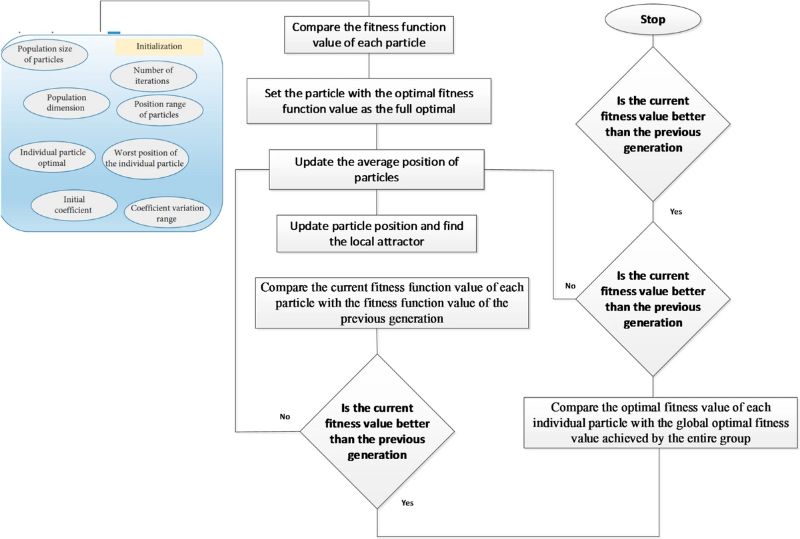
QPSO flowchart. Image used courtesy of Paul et al.
The researchers analyzed multiple microgrid configurations containing varying amounts of photovoltaic panels, wind turbines, and battery storage devices. Integrating QPSO into microgrid energy management systems yielded:
- A 9.67% reduction in operational costs, equal to savings of €158.87
- A 13.23% reduction in carbon emissions in an economic scheduling scenario, equal to lowering the CO2 equivalent to 513.70 kg
- A balanced solution with operational costs of €174.11 and emissions of 401.63 kg of CO2 in a constrained economic scheduling scenario
The researchers validated the algorithm through different configurations, including standard and low-voltage configurations. The research highlighted QPSO’s potential as an effective tool for optimizing microgrid environments. They concluded that QPSO could save computational time over less efficient frameworks while accounting for the economic and environmental sustainability factors.
India’s Extreme Temperatures
The study focused on India because it needs more adaptable energy solutions. The country has a high-temperature climate, especially in the summer, and electricity demand has been surging year after year. During the study, in 2022, the summer months saw record-high temperatures, with a 12% increase in electricity demand between March and July.
The study illustrates the current need to alleviate the pressure on the local power grids in India and other countries with either high temperatures or adverse climate conditions.