Facebook
 Google
 GitHub
 Linkedin
Beyond Solar: The Nuclear Solution for Space Travel
Solar power won’t provide sufficient power for manned missions to Mars. Can nuclear power help?
Manned and unmanned spacecraft in Earth orbit or on the lunar surface can generate most or all of their electrical power needs using photovoltaic solar panels. However, on Mars, to compensate for reduced solar irradiance at greater distances, the solar panels must be larger or more efficient to generate the same amount of power as those that are closer to the Sun.
A NASA engineer explains how the radioisotope thermoelectric generator used in space works. Video used courtesy of NASA
Solar power has been a cornerstone of Mars exploration, helping to power rovers like Curiosity and Perseverance and landers such as InSight. However, so far from home, solar energy isn’t enough. These recent landers and rovers have supplemented solar power with a unique kind of nuclear power device called a radioisotope thermoelectric generator (RTG).
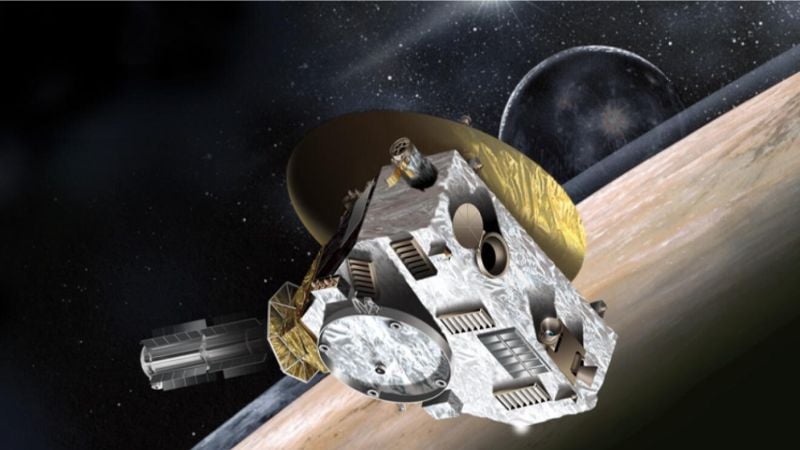
New Horizons, a NASA space probe. Image used courtesy of NASA/Johns Hopkins University Applied Physics Laboratory
Solar Isn’t Enough on Mars
The inverse square law governs the relationship between the distance from the Sun and the energy per unit area a solar panel can obtain. This law states that solar radiation’s intensity decreases with the square of the distance from the Sun.
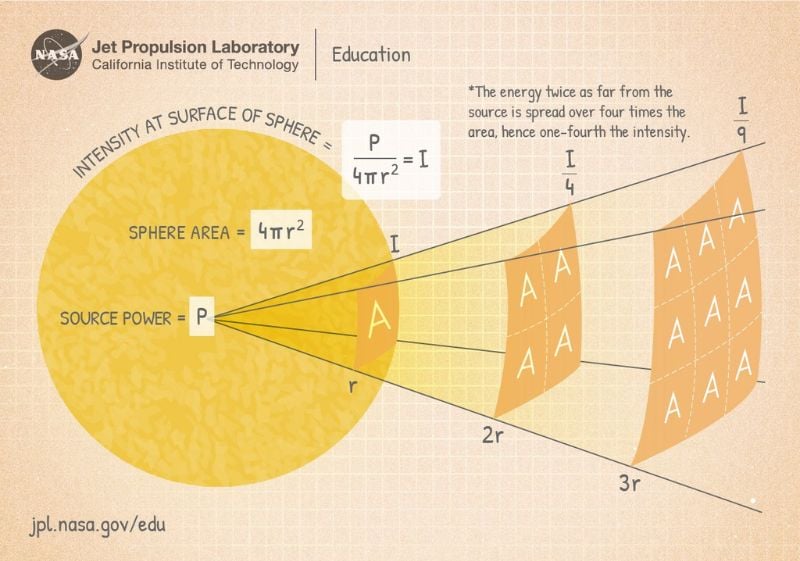
The inverse square law. Image used courtesy of NASA/JPL-CalTech
As the distance from the Sun increases, the solar energy available per unit area decreases significantly. For example, Mars receives about 43 percent of Earth's solar irradiance due to its greater distance.
In space, the radioisotope thermoelectric generator can fill the energy gap.
Radioisotope Thermoelectric Generators
RTGs convert the heat generated by the radioactive decay of isotopes, typically plutonium-238, into electricity, providing a reliable power source for spacecraft.
The first RTG launched in 1961 aboard the Transit 4A spacecraft marked the beginning of nuclear power in space exploration. RTGs were used to power lunar surface experiments during the Apollo missions (1969-1972), ensuring the long-term operation of scientific instruments. RTGs have also enabled missions to the outer Solar System, including Pioneer 10 and 11, Voyager 1 and 2, Ulysses, Galileo, Cassini, and New Horizons spacecraft that visited Pluto in 2015.
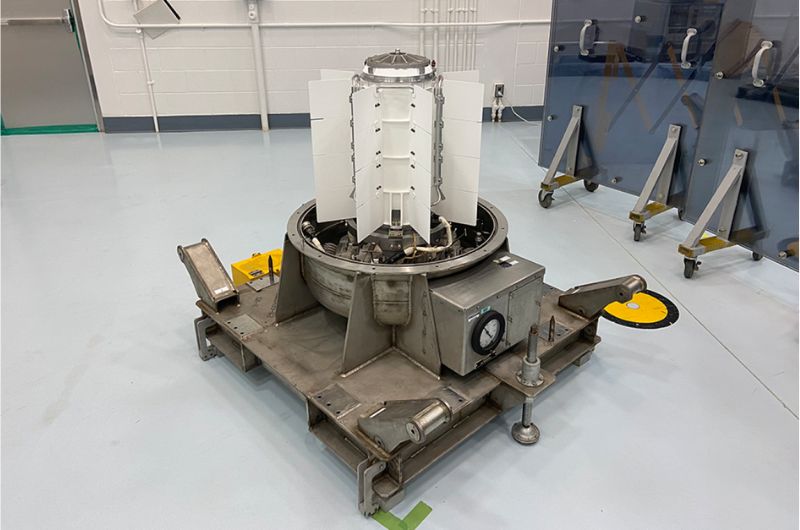
The Multi-Mission Radioisotope Thermoelectric Generator. Image used courtesy of Department of Energy
NASA and the Department of Energy developed the Multi-Mission Radioisotope Thermoelectric Generator (MMRTG) to provide a more flexible and efficient power source for a variety of space missions. It can operate in space and planetary atmospheres using eight general purpose heat source modules containing plutonium dioxide, generating about 125 watts of electricity at the start of a mission. It is designed to operate for at least 14 years. MMRTGs have been used to power NASA's Curiosity and Perseverance rovers on Mars, providing consistent power and heat in the harsh Martian environment.
RTG Advantages and Applications
RTGs offer consistent power without moving parts, making them ideal for long missions in harsh environments. MMRTGs can operate in both space and planetary atmospheres, expanding their application range. They are planned for future missions, such as the Dragonfly mission to Saturn’s moon Titan, highlighting their continued importance in deep space exploration.
The RTG’s size is directly related to its power output. Larger missions requiring more power might necessitate larger RTGs or multiple units. However, increasing size can lead to higher mass and reduced specific power (power per unit mass). To increase power output, multiple RTGs could be used, or new designs with higher efficiency could be developed. For instance, modular designs that scale with the number of general-purpose heat source modules could offer flexibility in power output.
At some point, when humans finally visit Mars, the requirement for reliable and efficient power systems to support life support, scientific operations, and resource utilization will be greater than can be provided by solar and MMRTGs. Recent research and technology developments on miniaturized nuclear fission reactors, such as NASA's Kilopower system, have advanced significantly in recent years and could be a safe, abundant source of energy for future Mars exploration and habitation.