Facebook
 Google
 GitHub
 Linkedin
Plasma Drive May Provide The Thrust For Future Space Travel
RocketStar has developed a fusion-enhanced plasma rocket thruster system that will soon be tested in space.
If you want to get off the planet and into outer space, you need to produce a lot of thrust quickly. Currently, the only way to launch a spacecraft is with chemically fueled rocket motors to overcome the force of gravity and hurl it into orbit. The rocket uses up all of its fuel in the process.
Once you are in outer space, the game changes. Instead of massive thrust over a short period, it’s an advantage for a spacecraft to produce smaller amounts of thrust but maintain the push over hours, days, or even longer. Such small amounts of thrust can be useful to maintain orbit or change a satellite’s attitude. When leaving the planet’s gravitational pull, small amounts of thrust don’t produce very much acceleration. Still, over long periods, the sustained force will result in ever-increasing velocity, and that velocity is the key to traveling between the planets.
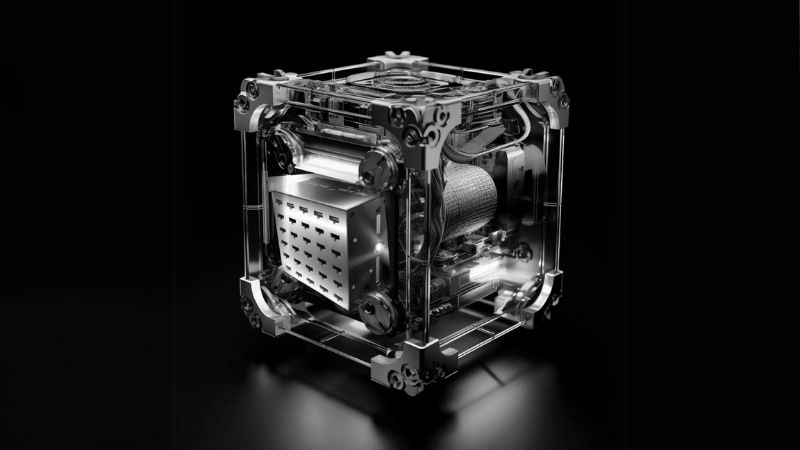
Plasma thruster. Image used courtesy of RocketStar, Inc
Pulsed Plasma
One propulsion system that can power interplanetary spacecraft once they have escaped the Earth’s gravitational pull is the pulsed plasma thruster. A plasma thruster uses electrical energy to produce a plasma made from a variety of materials, including gases like xenon, argon, krypton, and even air, solids like polymer materials or iodine, and liquids like water vapor.
Plasma thrusters work only in a vacuum, which means they can’t be used to leave the planet, but once in space, they can be used for various purposes.
RocketStar has developed such a plasma thrust system. It uses water vapor to produce a usable amount of force from its plasma thruster. This force can be used for primary propulsion, attitude control, and maintaining orbit on tiny cube satellites in Earth orbit.
How Do Plasma Thrusters Work?
The plasma thruster comprises a chamber into which water vapor flows under pressure. As the vapor expands, it encounters an electric spark that creates a plasma separating the water vapor into positive ions and negative electrons. There are two exhaust ports ringed with high-voltage electrodes. One port’s electrodes focus and extract the positive ions while the other affects the electrons.
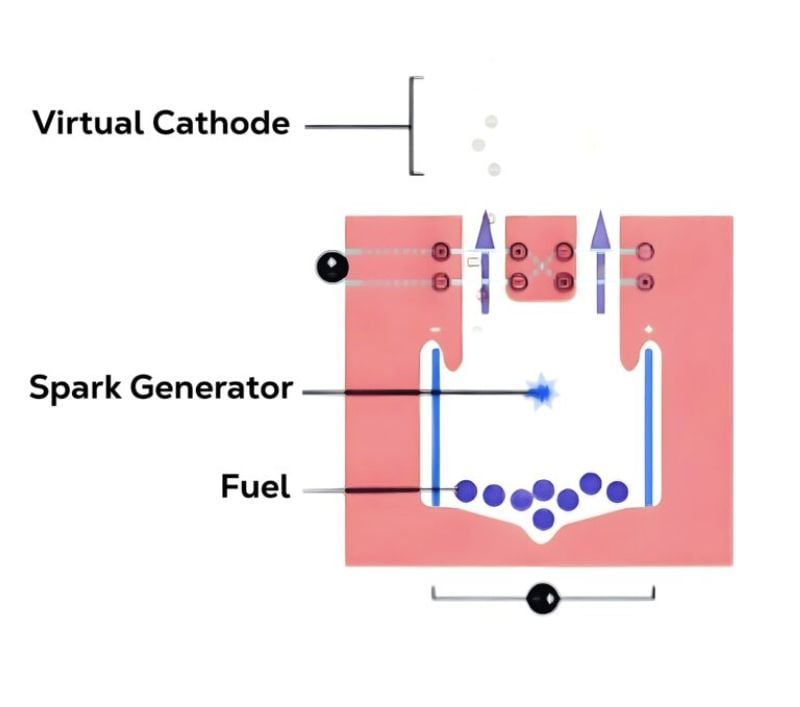
Fusion-enhanced process. Image used courtesy of RocketStar, Inc
Because the electrons are much less massive than positive ions, they leave the chamber first, creating thrust thanks to their interaction with the electrodes surrounding their port. Once outside the chamber, the cloud of negatively charged electrons forms a virtual cathode, attracting the positively charged ions from the chamber and adding to the thrust they receive from the electrode surrounding the positive ion port.
Upon exiting the chamber, the positive ions meet up with the negatively charged electrons, neutralizing the plasma. The resonance between the incoming gas and plasma exit through the two ports can be tuned to optimize the plasma thruster’s performance.
Adding In Fusion
RocketStar recently found a way to dramatically increase the performance of its plasma thruster. When boron is injected into the thruster’s exhaust, the positive ions created by the plasma thruster collide with the boron nuclei, creating a form of aneutronic fusion that converts the boron into a high-energy form of carbon that further decays into three alpha particles along with gamma radiation.
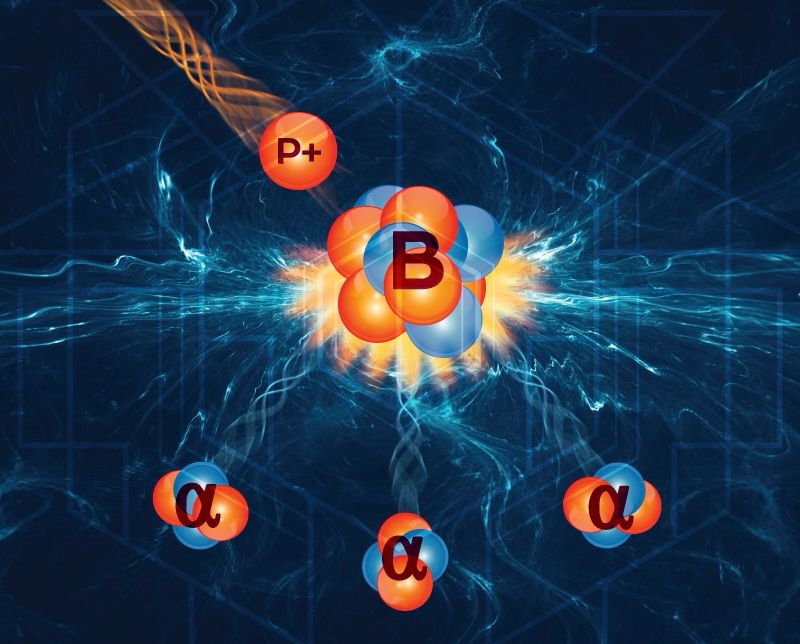
Fusion-enhanced propulsion. Image used courtesy of RocketStar, Inc
The fusion reaction and resulting alpha particles add as much as 50 percent to the based thrust, acting like an afterburner on a jet engine and significantly improving the device's performance. The presence of the created alpha particles and gamma rays confirms that the fusion reaction is occurring within the plasma exhaust stream, independently confirmed by Georgia Tech's High Power Electric Propulsion Laboratory (HPEPL) in Atlanta. RocketStar is calling the thruster FireStar Fusion Drive.
Onward to Outer Space
RocketStar currently offers its plasma thruster for use on cube satellites. The M1.4 thruster is a cube 3.75 inches (95 mm) on a side and weighs slightly over two pounds (980 grams). It draws just 6 watts of power to produce a thrust of 17.2 nM—enough to propel an 8 kg microsatellite with a delta velocity of 2,273 meters per second (m/s).
The M1.4 thruster will be demonstrated as a hosted payload on a proprietary satellite carrier launched by D-Orbit on two Space-X transporter missions scheduled for July and October this year. FireStar Fusion Drive is scheduled for in-space testing as it travels into orbit on Rogue Space System’s Barry-2 spacecraft in February 2025. These small thrusters will prove themselves in Earth orbit, and someday, much larger versions may carry us to the planets and beyond.