Facebook
 Google
 GitHub
 Linkedin
Moon Power: Nuclear Reactors Could Light Up the Lunar Night
Nuclear fission could be the answer to providing energy generation infrastructure on the Moon.
In the 1960s, the U.S. and Soviet Union’s race to the Moon drove technological advancements in electronics, materials, aeronautics, physiology, and communications. Nearly every modern-world device—from cell phones and solar cells to satellites and weather forecasting—owes at least partial success to the 60’s space race.
However, long-term lunar exploration takes electric power, and the Moon lacks energy generation infrastructure. NASA believes nuclear fission may be the solution.
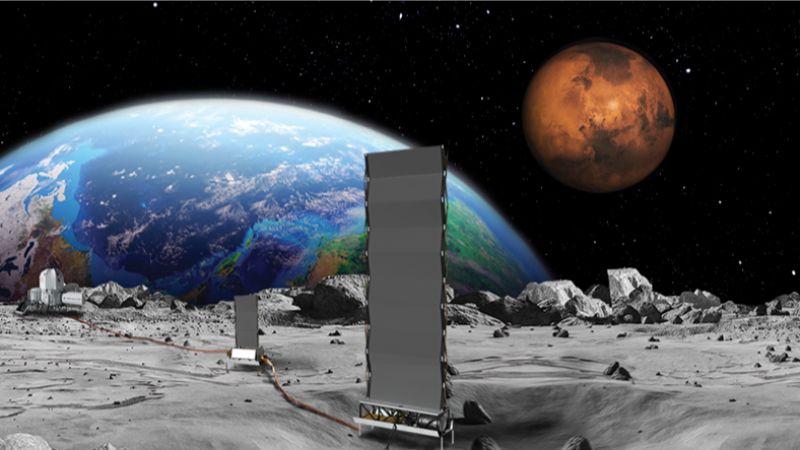
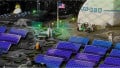
Concept of lunar nuclear power. Image used courtesy of NASA
Lunar Power Options
One problem future lunar missions face is how to generate the electrical power necessary to sustain life in such a hostile place. A lunar day lasts 29.5 Earth days—approximately two daylight weeks followed by two weeks of darkness. During the lunar night, temperatures drop to -130°C (-202°F). This means conventional surface-based solar panels can’t generate power at least half the time, making them less practical as a reliable energy source. One way around this might be to collect solar energy with a lunar orbiting satellite and then beam power to the Moon’s surface via a beam of microwave energy.
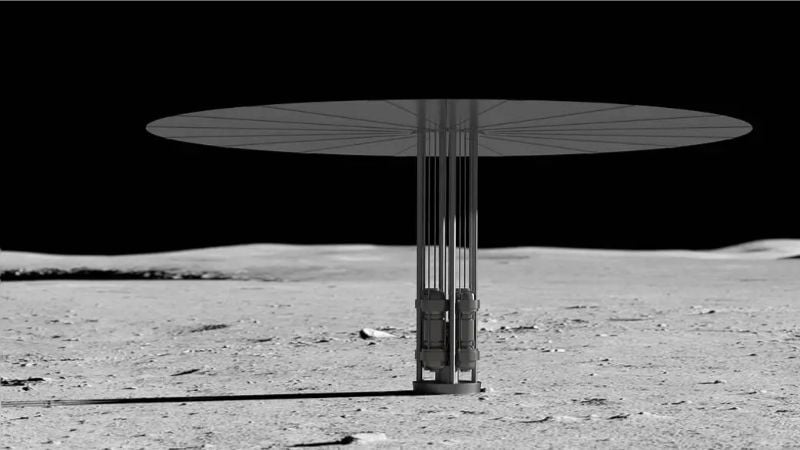
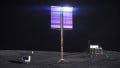
Illustration of nuclear power on the moon. Image used courtesy of NASA
A more likely solution is to build small nuclear reactors to power a Moon base. During the Apollo 11 moon mission in 1969, a small nuclear thermal generator using the heat generated by the radioactive decay of plutonium-238 maintained the mission’s scientific instruments at their working temperatures. On the Apollo 12 mission, the heat from the thermal isotope reactor was converted into electricity to power the lunar instrument package. The power generated by these tiny micro-reactors would be insufficient to provide the energy needed to power a Moon base.
Many Players in Nuclear Efforts
To create a suitable nuclear power source for the Moon, NASA and the U.S. Department of Energy have awarded contracts to fund the development of a 40-kilowatt (kW) fission power system that can last up to 10 years on the lunar surface. The goal is to provide abundant and reliable power, initially on the Moon but eventually on missions to Mars.
Lockheed Martin, Westinghouse, and IX, a company formed as a collaboration between Intuitive Machines and X-Energy, were awarded contracts. In February 2024, Intuitive Machines became the first commercial company to land a spacecraft on the lunar surface.
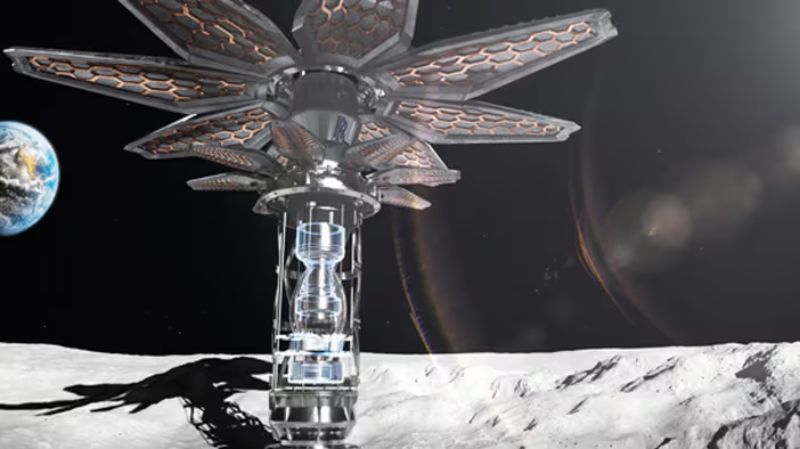
Concept of micro nuclear reactor. Image used courtesy of Rolls Royce
NASA isn’t the only agency considering nuclear power for the Moon. In 2023, the U.K Space Agency signed a £2.9m deal with Rolls Royce to develop concepts for micro-reactors to power future missions to the Moon. For many years, Rolls-Royce has designed nuclear reactors for Britain’s submarines, and it has said it wants to have a micro-reactor ready for lunar missions by 2029.
The Russian space agency Roscosmos and the China National Space Administration plan to build a shared Moon base in the 2033-2035 timeframe. Powering their lunar station will require a nuclear reactor, which Russia states will assemble autonomously on the lunar surface without the presence of humans.
A History of Moon Exploration
Five decades after the last Apollo Moon mission, governments and commercial enterprises are again focused on Earth’s nearest celestial neighbor. NASA’s Artemis program intends to return astronauts to the Moon by mid-2026. China landed its unmanned Chang’e 3 spacecraft on the lunar surface in 2013, returned lunar samples with it Chang’e 5 in 2020, and plans to put a pair of astronauts on the lunar surface by 2030.
Meanwhile, India, Japan, Israel, and South Korea have all put spacecraft into lunar orbit or landers on the Moon’s surface. In addition, dozens of space startups and giant SpaceX have set their sights on lunar landings and exploration.
A Bigger Space Race?
Just as the 60’s space race resulted in the technology and products we take for granted today, the current Moon race might spin off a range of new materials and technologies for use here on Earth. Most experts believe the huge-scale fission reactors making up commercial nuclear power for the past 70 years will eventually be replaced by small, distributed local reactors that can provide carbon-free electricity to more localized power grids. Perhaps the development of reactors to produce electricity on the lunar surface will lead the way to new power systems here on Earth.