Facebook
 Google
 GitHub
 Linkedin
Barge and Charge: Floating Nuclear Reactor Set for Long Beach
Bluecore Energy has installed a prototype water-cooled nuclear reactor on a barge for testing and evaluation, aiming to launch commercialized floating nuclear power.
Startup Bluecore Energy has assembled a non-fueled prototype of a 10 MWe water-cooled nuclear reactor, with the ultimate goal of deploying a power-generating barge in Long Beach Harbor. After testing and approvals, this floating nuclear generator could deliver grid-connected, on-demand electricity to support port activities, coastal AI data centers, and surrounding communities.
Bluecore emerged from stealth in July and has since secured $50 million in Series Seed financing, adding to its $10 million pre-seed funding. In the short term, the company will continue engineering, hardware development, and testing of the non-fueled nuclear systems. At the same time, it will begin seeking licensing and regulatory approval. The long-term goal is to commercialize the floating nuclear plant.
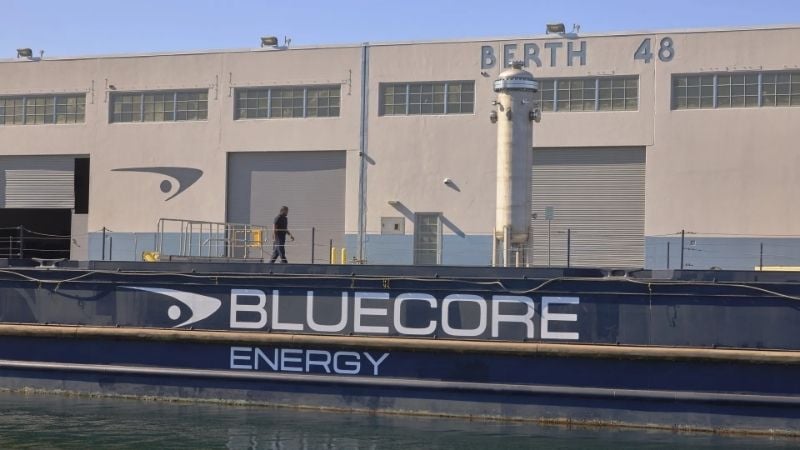
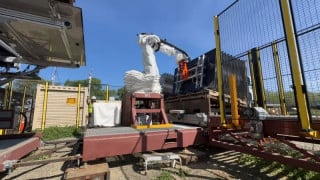
The Bluecore Energy barge. Image used courtesy of Bluecore Energy
Floating Nuclear Technology
A floating nuclear reactor isn’t a new idea, but it’s never been commercialized in the U.S. The U.S. Army Corps of Engineers built the first floating plant in the 1960s on a converted World War II ship. It operated in the Panama Canal area from 1968 to 1975, providing electricity to canal locks and civilian grids. That ship used a 10 MW pressurized water nuclear reactor, similar to what Bluecore Energy plans to use.
In Russia, a floating nuclear barge has been operating since late 2019. Developed by Rosatom, a Moscow-based nuclear firm, the stationary barge in Siberia uses two 35 MW reactors to supply 70 MW of electricity to heat communities and power industrial mining operations.
Bluecore Energy aims to be the first civilian-operated nuclear power plant in the U.S. Founder Kofi Asante said AI data centers have created a need for stable, reliable power that doesn't depend on existing infrastructure. He also noted that billions of people living near coastal areas could benefit from offshore nuclear plants.
The prototype uses proven technology, a scaled-down light-water reactor mounted on a barge. The technology would connect to onshore grids with high-voltage subsea cables. It could produce enough electricity to power about 15,000 homes.
While the barge can be anchored to the ocean floor, it can also be towed to coastal sites to provide power to areas devastated by natural disasters. The ocean cooling system can also produce clean, desalinated water.
The company said it is engineering the reactor with safety principles at the forefront. Several physical barriers will separate the nuclear fuel and the surrounding environment. It will have multiple shutdown systems, passive safety features, and water-based cooling.
Bluecore chose Long Beach as its initial site since it’s one of the busiest container ports in the U.S. Each year, more than 9 million container units and about $300 billion in cargo pass through Long Beach Port.
Testing, Validation, Regulations, and Approvals
Since the prototype does not yet have nuclear fuel, Bluecore is using an electric test reactor to replicate the heat and pressure generated by a live nuclear core. This will allow engineers to stress-test fluid dynamics, heat dissipation, and sensor networks.
They will also refine automated control software. Operations are conducted from a mobile command center inside a converted shipping container. The technicians can simulate real-time power modulations and emergency shutdowns.
_with_guests_inside_a_converted_shipping_container.jpg)
Bluecore founder Kofi Asante (center right) with guests inside a converted shipping container. Image used courtesy of Bluecore Energy
Nuclear licensing for a standardized light-water reactor like Bluecore’s can take from three to seven years.
The company has already begun discussions with the Nuclear Regulatory Commission to evaluate the core design and safety. It is also conferring with the U.S. Coast Guard to certify port safety, maritime issues, and seaworthiness. The U.S. Maritime Administration and port authorities are also involved to establish safety frameworks for integrating floating small modular reactors into commercial harbor areas.
Bluecore Energy has not yet set a firm timeline for fueling the nuclear reactor or bringing it online.
The Future of Floating Nuclear
Interest in floating nuclear technology is growing. In addition to Bluecore Energy, several other companies worldwide are also working on it.
U.K.-based Core Power and Westinghouse are partnering to design floating nuclear plants using Westinghouse’s eVinci microreactor. This reactor uses solid-state heat-pipe technology.
Thorcon is developing a 500 MW floating power plant called the Thorcon Isle, powered by a molten salt reactor. The company is designing the technology for mass production in shipyards, where it can be towed to shallow waters off coastal Indonesia.
Saltfoss Energy (formerly Seaborg Technologies) in Denmark is teaming up with South Korea-based HD Hyundai, the world’s largest shipbuilder, to develop barge-mounted compact molten salt reactors. The barges will range in power from 200 MW to 800 MW and are aimed at supplying power and heat for green hydrogen and ammonia production.
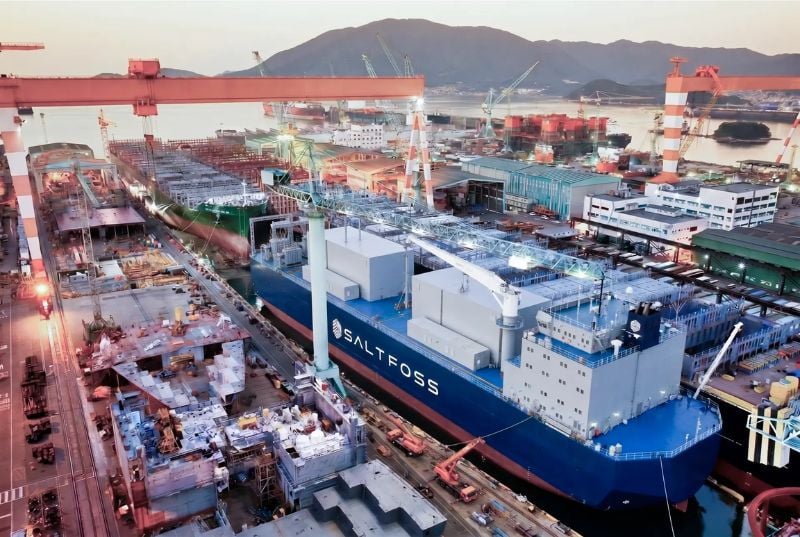
The Saltfoss power platform. Image used courtesy of Saltfoss Energy
In France, Newcleo, Bpifrance Consortium, and others are collaborating on a lead-cooled fast reactor called the “n-Floating” consortium. The non-self-propelled barges will house multiple 200 MWe lead-cooled fast reactors. The project aims to develop zero-emissions power stations that can be deployed to produce electricity, process heat, and produce hydrogen in European coastal areas.
BWX Technologies, a U.S. Defense contractor, is working with shipping and logistics giant Crowley to design microreactor-powered ships and barges to supply emergency power for military bases, islands, and commercial facilities.
Bluecore Energy joins a growing trend to develop flexible, scalable, carbon-free energy that can be quickly deployed where needed. While commercial operations may still be years away, the vision is to modernize nuclear technology to meet the unprecedented energy demand.