Facebook
 Google
 GitHub
 Linkedin
Fertilizer Demand Could Kickstart Green Hydrogen Production
Green fertilizer mandates and supply- and demand-side policies could accelerate the commercialization of carbon-free hydrogen production, according to a U.K. report.
Hydrogen is a highly versatile energy carrier and fuel. It is essential for producing ammonia, which is used as a fertilizer feedstock, and has growing potential to power the transport and energy sectors. As a clean-burning fuel—producing no greenhouse gas emissions at the point of use—it holds significant promise for decarbonizing high-emission industries. However, most hydrogen produced today (gray hydrogen) is generated through fossil fuel-intensive processes, undermining its overall climate benefits.
Although zero-emission hydrogen production exists (green hydrogen) and many countries have expressed interest in scaling it, high production costs and a lack of demand-side policy support remain major barriers.
The Economics of Energy Innovation and System Transition (EEIST), a University of Exeter-led project, used modeling to demonstrate the impact of targeted policies on the supply and the demand sides of green hydrogen. The analysis suggests a path for the commercialization and the large-scale deployment of electrolytic hydrogen.
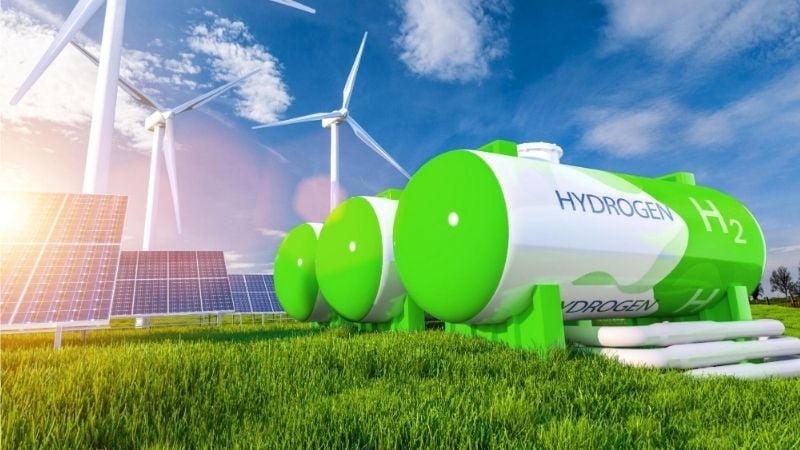
What strategies will accelerate green hydrogen production? Image used courtesy of Adobe Stock
Understanding the Policy Gap
Under a net-zero scenario, the International Energy Agency (IEA) estimates hydrogen could represent 4% of total energy consumption by 2050. Globally, green hydrogen has already been recognized for its potential role in the energy transition, and many countries have set ambitious goals for large-scale deployment. Yet, current policies remain in early stages and largely focus on boosting supply without ensuring demand.
As a result, only 4% of planned electrolytic hydrogen projects for 2030 are under construction or in final investment stages. This imbalance risks creating a chicken or egg dilemma as producers are hesitant to invest without guaranteed demand, while consumers are unlikely to adopt hydrogen without a reliable supply.
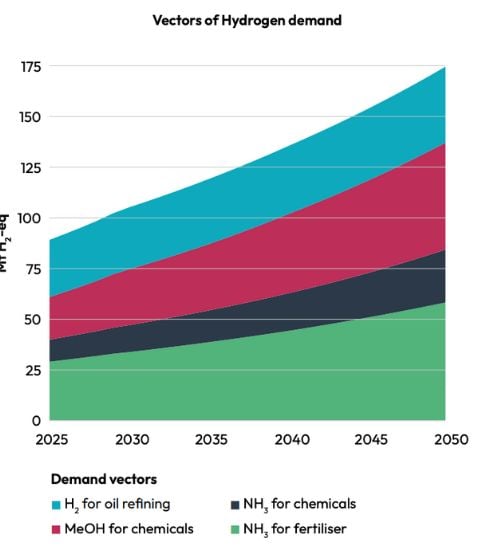
Projected hydrogen demand. Image used courtesy of Vercoulen et al.
Such novel projects require government support that derisks investment and accelerates the commercialization of electrolytic hydrogen technology.
Ammonia as a Pathway to Deployment
The EEIST report identifies green ammonia (ammonia produced using green hydrogen) as a potential catalyst for scaling electrolytic hydrogen production.
Ammonia plays a critical role in global food systems as a core ingredient in fertilizers. It is also widely used in manufacturing, pharmaceuticals, and textiles. Its production accounts for about 2% of global emissions, most of which stem from the gray hydrogen used in producing ammonia. Because ammonia is already a major industrial product and green hydrogen can directly replace gray hydrogen in its production, it presents a strategic and scalable entry point for commercializing green hydrogen at scale.
- Demand and supply grow together. Green ammonia production and electrolytic hydrogen use are closely linked and often occur within the same facility. This integrated structure eliminates the concerns between hydrogen producers and end-users.
- Established industrial integration. Most ammonia producers are also active in fertilizer manufacturing and trade, allowing them to align production and end-use in a single business model, thus accelerating deployment.
- Existing trade infrastructure. Ammonia is already traded internationally at moderate volumes. This infrastructure can be leveraged to facilitate large-scale trade of green ammonia without starting from scratch.
- High technology readiness. Companies are already blending electrolytic hydrogen with gray hydrogen in ammonia production, demonstrating that the technology is mature and scalable.
- Energy and food security benefits. Investing in domestic green ammonia production supports clean energy goals and fertilizer independence, improving resilience in two critical sectors.
- Future versatility across sectors. Beyond fertilizers, green ammonia has long-term potential as a low-carbon fuel for international shipping and a carrier for power generation and long-duration energy storage, broadening the market for green hydrogen.
Policy Can Drive Green Hydrogen Forward
Global green ammonia projects are expected to total 180 million metric tons by 2035, a 73% increase over current production capacity. However, without supportive policies, many of these projects are unlikely to materialize due to significant challenges in securing offtake agreements and financing.
To assess how policy could address these barriers, the research team modeled four policy scenarios focused on hydrogen used specifically as a feedstock:
- Reference (REF): Reflects the current state of hydrogen technology deployment and policy support.
- Carbon Pricing (CP): Adds a gradually increasing global carbon tax to all hydrogen production in the REF scenario, rising to $200/tonne CO₂ by 2050.
- Mandates (MD): Adds a mandate for green ammonia use in fertilizer production to the REF scenario, scaling up to 100% by 2050.
- Combined (CP+MD): Applies both carbon pricing and green ammonia mandates, representing the most ambitious policy pathway.
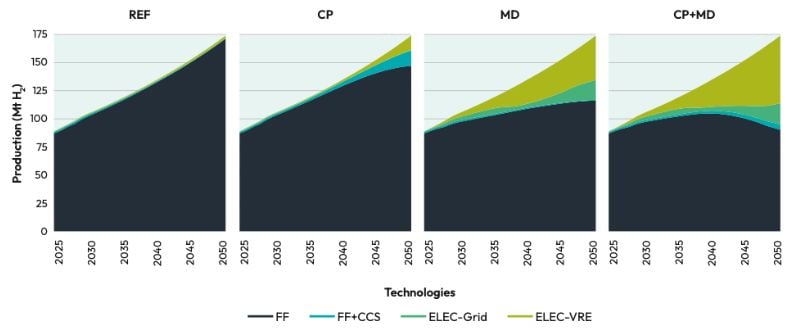
Global production volumes, by each hydrogen technology group in each policy scenario. (FF: fossil-fuelled; FF-CCS: CCS-enabled; ELEC-Grid: Grid-connected; ELEC-VRE: Dedicated renewables). Image used courtesy of Vercoulen et al.
The modeling shows that neither carbon pricing nor mandates alone are sufficient to generate strong demand or achieve large-scale deployment of electrolytic hydrogen. However, the combined CP+MD scenario enables green hydrogen to reach cost parity with fossil-based hydrogen around 2047. Notably, the analysis also finds that electrolytic hydrogen produced using dedicated onsite renewable energy sees greater cost reductions than grid-connected systems.
A Keystone of the Clean Energy Transition
Policymakers have several tools to support the commercialization of electrolytic hydrogen. The EEIST modeling shows that combining carbon pricing and green ammonia mandates can significantly accelerate green hydrogen adoption.
Given hydrogen’s critical role in ammonia production—and ammonia’s importance across agriculture, manufacturing, and other industries—mandating green hydrogen for ammonia offers a practical path to scale production while aligning supply and demand.
Future research could explore alternative policy approaches, such as earlier or higher carbon pricing and various subsidy types, to better understand the strengths of each policy. Modeling insights may also shift depending on broader objectives like energy security or affordability.
Electrolytic hydrogen paired with onsite renewable power is most viable in regions with abundant, low-cost renewables. However, without strong demand, investments risk becoming stranded. Demand-side policies should be emphasized, especially mandates in key end-use sectors.